

IMPORTANT DISCLAIMERS
Medical Disclaimer: The information in this article is provided for educational purposes only and is not intended as medical advice or a substitute for individualized medical care. Every person's health needs are unique. Always consult a qualified healthcare professional before starting, stopping, or changing any medication, supplement, or treatment plan. -------
Article Disclaimer: Articles are reviewed and published by Summit Health to provide evidence-based educational information. While Summit Health strives to provide reliable and current health information, medical knowledge is always evolving over time. Depending on when you are reading this content, it may not reflect the latest research or apply to your individual circumstances.
What if the menopause transition wasn't an indefinite period of uncertainty, but a measurable biological shift you could master? Many women find themselves asking exactly how long does menopause last while struggling with unpredictable flares and a lack of clear answers from their primary care providers. You've likely felt the frustration of being told to simply wait it out while your quality of life feels compromised. It's a common experience, but it shouldn't be your standard.
Precision health. Proven results. Clinical data shows the entire process, including perimenopause, averages seven years; however, your individual experience can be optimized for peak performance rather than just endured. We believe in refinement over mere treatment. This clinical overview breaks down the 2026 timeline for perimenopause and postmenopause with professional clarity. You'll discover the specific stages of the transition and actionable strategies to refine your biological balance. We'll provide the data-driven insights you need to ensure this next chapter is defined by strength, vitality, and a premium quality of life.
Key Takeaways
- Define the biological milestones of each transition stage to accurately determine how long does menopause last for your unique physiological profile.
- Distinguish between early and late perimenopause markers to better anticipate hormonal fluctuations and manage unpredictable symptom flares.
- Analyze how genetic predispositions and lifestyle factors like BMI influence the specific duration and intensity of your menopausal journey.
- Move beyond standard diagnostic testing toward comprehensive labwork that informs a personalized, high-performance health strategy.
- Discover how targeted hormone therapy can resolve persistent symptoms and maintain a premium quality of life well into postmenopause.
Mapping the Menopause Timeline: Stages and Clinical Definitions
Biological precision. Clinical clarity. Understanding the timeline of the female body requires moving beyond vague symptoms to measurable milestones. While many seek a simple answer to the question of how long does menopause last, the reality is a sophisticated, multi-year transition. It's not a singular event but a trajectory of hormonal refinement that begins long before the final period occurs. Recognizing the nuances of this arc allows for a more controlled, optimized experience.
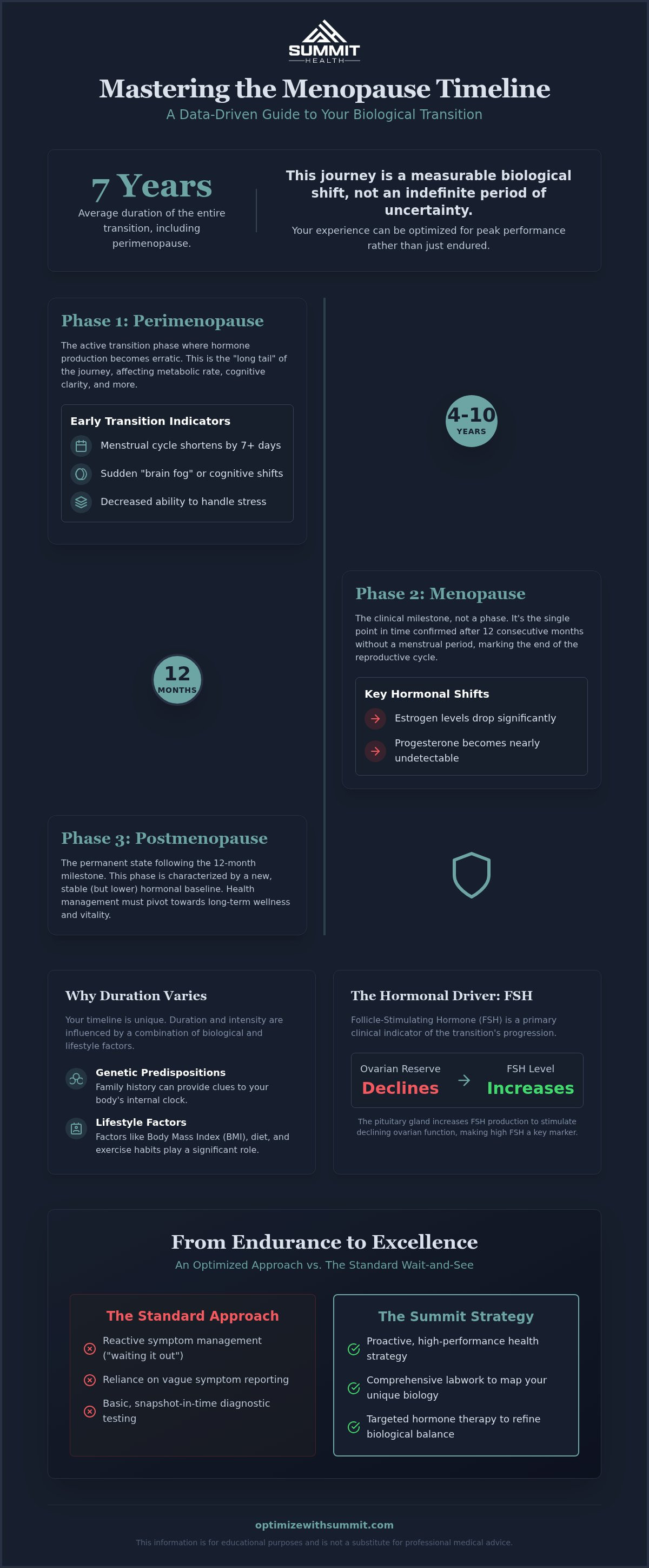
The Menopause journey is structured into three distinct phases: perimenopause, menopause, and postmenopause. Perimenopause represents the active transition where estrogen and progesterone begin their erratic fluctuations. This phase can begin in the mid-40s, often years before the final menstrual cycle. Menopause itself is the chronological midpoint. Postmenopause is the permanent state that follows, characterized by a new hormonal baseline. Mapping these stages is the first step toward reclaiming peak performance.
The 12-Month Milestone
Clinical confirmation. Definitive data. The medical community defines menopause as the point in time exactly 12 consecutive months after the final menstrual period. This one-year mark serves as the diagnostic standard because it indicates the ovaries have ceased the consistent production of eggs and the primary hormones that drive the reproductive cycle. During this juncture, estrogen levels drop significantly while progesterone becomes nearly undetectable. This shift isn't always gradual. For those experiencing 'natural' menopause, the decline follows the body's internal clock. However, 'induced' menopause occurs abruptly through surgical interventions, such as a bilateral oophorectomy. Regardless of the trigger, the 12-month milestone marks the official transition into a post-reproductive state where health management must pivot toward long-term wellness.
Hormonal Architecture of the Transition
Internal signaling. Biological feedback. The transition is governed largely by Follicle-Stimulating Hormone (FSH). As the ovarian reserve declines, the pituitary gland increases FSH production in a strenuous attempt to stimulate the ovaries. High FSH levels are a primary clinical indicator that the body is entering the later stages of the transition. Determining how long does menopause last for your specific biology depends on tracking these hormonal markers with accuracy. This architecture explains why symptoms often precede the final period by several years. The fluctuating levels of estrogen during this time create the "rollercoaster" effect commonly associated with perimenopause. Menopause is a measurable biological transition into a new phase of physiological maturity rather than a chronic illness or a state of deficiency. By viewing the timeline through this lens, you can move from reactive symptom management to proactive hormone therapy.
The Perimenopause Transition: How Long Does the Shift Last?
Active recalibration. Extended transition. While the clinical definition of menopause is a single point in time, the preceding phase known as perimenopause is a marathon. Most women navigate this shift for four to ten years. It is the "long tail" of the menopausal journey. During this decade, your endocrine system undergoes a complex restructuring that affects everything from metabolic rate to cognitive clarity. Understanding how long symptoms of menopause last requires a deep dive into these transitional years.
The duration of this shift is not fixed. It is a highly individualized biological process. Some women move through the transition in a few years, while others experience a slower, more gradual decline in ovarian function. This variability is why a one size fits all approach to health management often fails. Precision is required to maintain your peak state during this decade of change.
Early Transition Indicators
Subtle shifts. Initial warnings. Early perimenopause often begins in the mid-40s and is characterized by slight changes in menstrual cycle length. You might notice your cycle shortening by seven days or more. This is the result of fluctuating estradiol levels. Beyond the cycle, many women experience the sudden emergence of "brain fog" or a decreased ability to handle stress. Standard blood tests often miss these early markers. A single FSH test is merely a snapshot in time; it rarely captures the erratic hormonal waves of the early transition. Comprehensive diagnostics are necessary to identify these patterns before they diminish your quality of life.
The Late Transition Phase
Peak intensity. Hormonal volatility. The late transition phase typically occurs in the final one to three years before the permanent cessation of the menstrual cycle. This is when the "hormonal roller coaster" reaches its zenith. Estrogen levels don't just decline; they spike and crash violently. These fluctuations trigger an increase in vasomotor symptoms, specifically hot flashes and night sweats. Sleep architecture often breaks down during this phase, leading to chronic fatigue that affects professional performance and personal well-being.
Body composition also shifts during these final years. Declining estrogen levels often lead to an increase in visceral fat and a loss of lean muscle mass. This is not an inevitable decline. It is a biological signal that your system requires support. By identifying where you are on the timeline, you can implement targeted hormone therapy to stabilize these fluctuations. Proactive management ensures that the late transition is a period of refinement rather than a struggle for balance.
Why Duration Varies: Biological and Lifestyle Factors
Clinical variance. Individualized data. While averages provide a useful baseline, the specific answer to how long does menopause last depends entirely on your unique biological profile. No two transitions are identical. Your endocrine system responds to a combination of genetic scripts, environmental modifiers, and medical history. Mapping these variables is the only way to move from general estimates to a precision health strategy.
Biological baseline. Hormonal reserves. Women who enter their 40s with a higher initial ovarian reserve may experience a later transition. Conversely, medical interventions can disrupt this natural timeline. Chemotherapy and radiation frequently accelerate the depletion of follicles, leading to an earlier onset of symptoms. Even a hysterectomy that spares the ovaries can sometimes impair localized blood flow, potentially shortening the path to menopause. Recognizing these triggers allows for proactive management rather than reactive treatment.
The Genetic Blueprint
Genetic legacy. Ovarian aging. Your mother's age at menopause remains the single most reliable indicator for your own trajectory. Hereditary markers govern the rate of oocyte depletion and the sensitivity of your hormonal receptors. Ethnicity also influences the experience; data suggests that Black and Hispanic women may enter perimenopause earlier and navigate a longer duration of vasomotor symptoms than their peers. Utilizing early diagnostic labwork to identify these hereditary patterns is essential for maintaining peak performance during midlife. It transforms an unpredictable shift into a manageable process.
Environmental and Health Triggers
Lifestyle modifiers. Environmental impact. Your daily choices act as powerful levers that can either stabilize or disrupt your endocrine health. Smoking is a primary disruptor, as it introduces toxins that are directly toxic to the ovaries and can cause menopause to occur significantly earlier. Metabolic health and Body Mass Index (BMI) also play critical roles. Adipose tissue produces small amounts of estrogen, which can influence how your body perceives the decline in ovarian production. This interaction often dictates the intensity of the "hormonal roller coaster" you experience during the late transition.
Endocrine resilience. Stress management. Chronic stress elevates cortisol, which competes with progesterone and can exacerbate the physiological strain of the transition. Understanding the intersection of these factors is essential for determining how long does menopause last for your specific physiology. Consulting a Trusted Guide to Menopause and Perimenopause provides the context needed to navigate these complex variables. Strategic lifestyle optimization can mitigate symptom intensity and improve resilience even if it doesn't fundamentally alter the biological duration of the transition.
Postmenopause: Life After the Transition
Permanent state. Definitive shift. Postmenopause is the biological reality for the remainder of your life once you've reached the 12-month milestone. While the fluctuating "roller coaster" of perimenopause eventually concludes, the low-estrogen environment becomes your permanent baseline. Understanding how long does menopause last involves recognizing that while the transition has a finish line, the physiological effects of estrogen depletion do not. It's a shift from active change to long-term maintenance.
Clinical data suggests that the "end" of menopause doesn't always mean the end of symptoms. Approximately 10% to 15% of postmenopausal women continue to experience hot flashes for up to 15 years. Knowing how long does menopause last allows you to pivot from temporary coping mechanisms to a sustainable health strategy. True health optimization requires managing this new hormonal landscape with precision to prevent age-related decline and maintain a premium quality of life.
The 'New Normal' of Hormonal Balance
Stable levels. Ongoing care. In postmenopause, your body no longer produces significant amounts of estradiol or progesterone. This permanent decline can lead to urogenital changes that don't resolve on their own. Vaginal dryness and tissue thinning are common, affecting comfort and intimacy long after other symptoms fade. The clinical application of estradiol vaginal cream is a standard for restorative wellness, providing localized support where it's needed most. Monitoring biomarkers through comprehensive labwork ensures your "new normal" remains a state of high performance rather than a gradual loss of vitality.
Managing Long-Term Health Risks
Protective loss. Strategic defense. Estrogen plays a vital role in protecting the cardiovascular system and maintaining cognitive function. When these levels drop, risks for heart disease and bone density loss increase. Bone resorption accelerates significantly during the first five years of postmenopause, making this a critical window for clinical intervention. A long-term strategy for longevity must include weight-bearing exercise, nutritional support, and bioidentical hormone replacement. We help you navigate this phase with data-driven insights to ensure your skeletal and cardiac health remain robust. To begin your personalized maintenance plan, schedule a consultation with our clinical team.
Optimizing the Journey: Beyond Just 'Waiting it Out'
Passive observation. Clinical stagnation. For too long, the medical establishment has treated the question of how long does menopause last as a prompt for patience rather than action. Waiting for symptoms to resolve on their own is a strategy that compromises years of your prime. Optimization is the alternative. By leveraging modern diagnostics and targeted hormone therapy, you can effectively shorten the 'struggle' phase of the transition and maintain your peak state. You don't have to accept a diminished quality of life as a biological necessity.
Precision diagnostics. Targeted results. Moving beyond the traditional model requires a shift from basic screening to a comprehensive analysis of your endocrine system. Standard primary care often relies on singular tests that fail to capture the nuances of your hormonal shifts. A sophisticated approach integrates health coaching for sleep, weight, and recovery to ensure your biology supports your lifestyle goals. This synergy allows you to navigate the transition with calm confidence and measurable progress.
Data-Driven Hormone Optimization
Clinical excellence. Personalized precision. The distinction between 'normal' and 'optimal' is where peak performance is found. Lab ranges provided by standard providers are often broad averages of the general population; they don't reflect the levels required for a high-functioning, modern life. Our hormone blood work protocol identifies your specific biomarker deficiencies with exacting detail. By customizing your treatment to your unique profile, we move past guesswork. We refine your hormonal balance to eliminate brain fog, restore energy, and protect your long-term health. Data is the foundation of every successful intervention.
The Summit Health Approach
Virtual convenience. Expert care. We designed our telehealth model for the modern woman who values efficiency and clinical authority. Traditional medical friction, such as long wait times and sterile offices, is replaced with seamless virtual consultations and continuous monitoring. This ensures your treatment remains safe and effective as your body evolves. Understanding how long does menopause last for your specific physiology starts with a clear baseline. Taking the hormone quiz is the first step toward mapping your trajectory. From there, we provide the tools, the data, and the professional guidance necessary to turn a period of transition into a season of advancement. Your biological peak is within reach.
Mastering Your Biological Future
Clinical precision. Lasting vitality. You've moved beyond the ambiguity of general timelines to understand that menopause is a structured, manageable transition. Identifying your specific stage allows you to replace uncertainty with a data-driven strategy. Whether you're navigating the erratic waves of perimenopause or establishing a new baseline in postmenopause, your focus should remain on peak performance. While the question of how long does menopause last is rooted in biology, the quality of your experience is defined by your proactive choices.
Summit Health offers a path to refinement. Through telehealth-led precision medicine and customized HRT based on clinical labwork, we ensure your transition is optimized for your unique profile. Our expert health coaching provides the support needed for long-term vitality and recovery. You don't have to wait for the transition to end to start feeling like yourself again. Take the first step toward a premium life experience today.
Take the Hormone Quiz to see if optimization is right for you.
Your best years aren't behind you; they're currently being refined. We're here to guide you toward your peak state.
Frequently Asked Questions
What is the average age for menopause to start in 2026?
Clinical data indicates the average age for menopause in the United States remains 51 or 52. Most women enter the preceding perimenopause stage in their mid-to-late 40s, typically around age 47. While these are statistical averages, your personal timeline is influenced by genetics and lifestyle. Early diagnostic testing helps you move beyond generalities to understand your unique biological trajectory and maintain peak performance.
Can perimenopause last for 10 years or more?
Yes, the perimenopause transition can extend for a decade. While the average duration is approximately four years, the range spans from a few months to ten years. This long tail of hormonal fluctuation is why many women seek clarity on how long does menopause last. Identifying where you are in this decade-long shift is essential for maintaining cognitive clarity and physical resilience during your prime years.
How do I know if my symptoms are perimenopause or something else?
Definitive confirmation requires comprehensive labwork rather than symptom tracking alone. Perimenopause symptoms often overlap with thyroid dysfunction or nutritional deficiencies. High-performance diagnostics measure Follicle-Stimulating Hormone and estradiol levels to identify the specific hormonal shifts indicative of the transition. This data-driven approach removes the guesswork and ensures you're treating the actual biological cause of your symptoms with clinical precision.
Do hot flashes ever truly go away after menopause?
Most vasomotor symptoms eventually subside, but they can persist significantly longer than many expect. Approximately 10% to 15% of women continue to experience hot flashes for up to 15 years after their final period. Postmenopause is a permanent state of low estrogen. Without clinical intervention, some symptoms may remain for over a decade. Targeted hormone therapy provides a solution to resolve these lingering issues and restore systemic balance.
Does hormone replacement therapy (HRT) make menopause last longer?
No, hormone replacement therapy does not extend the biological duration of the menopause transition. HRT is a tool for optimization. It manages the physiological impact of declining hormones rather than pausing the body's internal clock. It effectively shortens the struggle phase by stabilizing erratic fluctuations. You're simply replacing what your body no longer produces to maintain your quality of life during and after the shift.
What is the difference between perimenopause and menopause symptoms?
Perimenopause symptoms are driven by erratic hormonal spikes and crashes, leading to irregular cycles and mood volatility. In contrast, menopause symptoms result from a permanent, low-estrogen baseline. While hot flashes can occur in both stages, menopause often brings more consistent urogenital changes and bone density concerns. Recognizing this distinction helps you determine how long does menopause last for your specific needs and choose the correct restorative protocol.
Is it possible to skip perimenopause and go straight to menopause?
Natural menopause always involves a perimenopausal transition, but surgical or medical interventions can cause an immediate shift. The removal of both ovaries, known as a bilateral oophorectomy, triggers induced menopause instantly. Similarly, certain chemotherapy treatments may deplete ovarian follicles abruptly. In these cases, the body enters postmenopause without the multi-year transition. This requires immediate and precise hormonal support to manage the sudden physiological decline.
How can I track where I am in the menopause transition?
Effective tracking combines menstrual cycle monitoring with serial diagnostic testing. Changes in cycle length are the primary early indicator of the shift. However, comprehensive lab panels that measure FSH, progesterone, and estradiol provide the most accurate map of your trajectory. We utilize virtual monitoring and precision diagnostics to help you visualize your progress. This data allows you to anticipate shifts and refine your treatment plan with authority.

Article by
Dr. David Richardson
David Richardson, is the founder and CEO of Summit Health and the author of "Insights from the Summit", where he writes about hormone optimization, metabolic health, thyroid function, longevity, and preventive medicine.
After entering healthcare in 2009, David became increasingly interested in a question that traditional medicine often struggles to answer:
Why do so many people continue to feel terrible despite being told their labs are "normal"?
That question eventually led him into the field of health optimization in 2020, where he became passionate about understanding physiology at a deeper level and helping patients uncover the root causes of their symptoms rather than simply managing them.
Today, David's philosophy is simple: normal and optimal are not the same thing. Every patient is physiologically unique, and meaningful healthcare begins by listening to symptoms, understanding the science, and recognizing that laboratory values are only one piece of a much larger picture.
Through Summit Health and Insights from the Summit, David's mission is to help people better understand their bodies, ask better questions, and make informed decisions that improve both their health span and quality of life.


