

IMPORTANT DISCLAIMERS
Medical Disclaimer: The information in this article is provided for educational purposes only and is not intended as medical advice or a substitute for individualized medical care. Every person's health needs are unique. Always consult a qualified healthcare professional before starting, stopping, or changing any medication, supplement, or treatment plan. -------
Article Disclaimer: Articles are reviewed and published by Summit Health to provide evidence-based educational information. While Summit Health strives to provide reliable and current health information, medical knowledge is always evolving over time. Depending on when you are reading this content, it may not reflect the latest research or apply to your individual circumstances.
What if the most meaningful way to support your wife through menopause isn’t finding the right fix, but helping her feel heard without having to explain herself twice? If you’re asking yourself, “how to support my wife through menopause,” it’s understandable to feel unsure. Symptoms vary, and changes in sleep, mood, or energy may be difficult to connect to menopause. Perimenopause can also last four to eight years before the final menstrual period.
You don’t need to identify every symptom or have an answer ready. Start by listening, asking what would help, and respecting her choices. Practical support is most useful when it’s offered rather than assumed. Care is a personal decision, not a requirement.
This guide covers ways to communicate with empathy, share day-to-day responsibilities in ways she welcomes, and support her if she wants to explore qualified care. You’ll find simple ways to check in, respond without dismissing her experience, and make space for her preferences, so you can approach this transition as a team.
Key Takeaways
- Understand the difference between the menopausal transition and menopause, without assuming any symptom has a particular cause.
- Use simple, open questions to learn whether your wife wants listening, reassurance, or practical help in the moment.
- Match support at home to what she says would help, from adjusting routines to sharing household tasks.
- Ask permission before helping with care conversations, notes, or appointment preparation.
- Keep check-ins brief and flexible, and let her preferences guide what support looks like over time.
How to Support Your Wife Through Menopause Starts With Understanding
Understanding the terms is a useful first step. Menopause is the point reached after 12 consecutive months without a menstrual period, when there isn’t another medical explanation. The years of change leading up to that point are called perimenopause, or the menopausal transition. Menopause is a milestone; the transition is the broader period of change around it. For an overview of the stages and possible effects, see this guide to understanding menopause.
This context can help you recognize that changes may unfold over time, but it can’t tell you exactly what your wife is experiencing or why. Her account matters more than a checklist.
What menopause can change, and what it cannot tell you
During the transition, some women experience hot flashes or night sweats, disrupted sleep, mood changes, difficulty concentrating, or changes in comfort and routines. Others experience different symptoms, fewer changes, or none that they identify as disruptive. The pattern and impact vary from person to person.
These possibilities may help explain what she describes, but they aren’t a diagnosis. A tired day, low mood, or trouble concentrating can have more than one cause. If a symptom is new, severe, persistent, or concerning to her, encourage a conversation with a qualified clinician rather than deciding for her what’s behind it.
Why assumptions can undermine support
Menopause may be relevant, but it doesn’t explain every disagreement or emotion. Saying “You’re just hormonal” can dismiss what she’s telling you and reduce her to a symptom. Comparisons can land badly, too: another person’s menopause story doesn’t set the standard for hers.
Curiosity works better than certainty. Instead of interpreting a change for her, ask what she’s noticed and what kind of support she wants. Try, “Has anything felt different lately?” or “Would you like to talk about it, or would something practical help?” Then give her room to answer without correcting, diagnosing, or rushing to fix the situation.
This is the foundation of how to support my wife through menopause: learn enough to approach the subject with care, while letting her define her own experience. Understanding doesn’t mean becoming the expert on her behalf. It means taking her seriously, staying open to what you don’t know, and responding to the person in front of you.
Listen First: What to Say When Your Wife Is Having a Hard Day
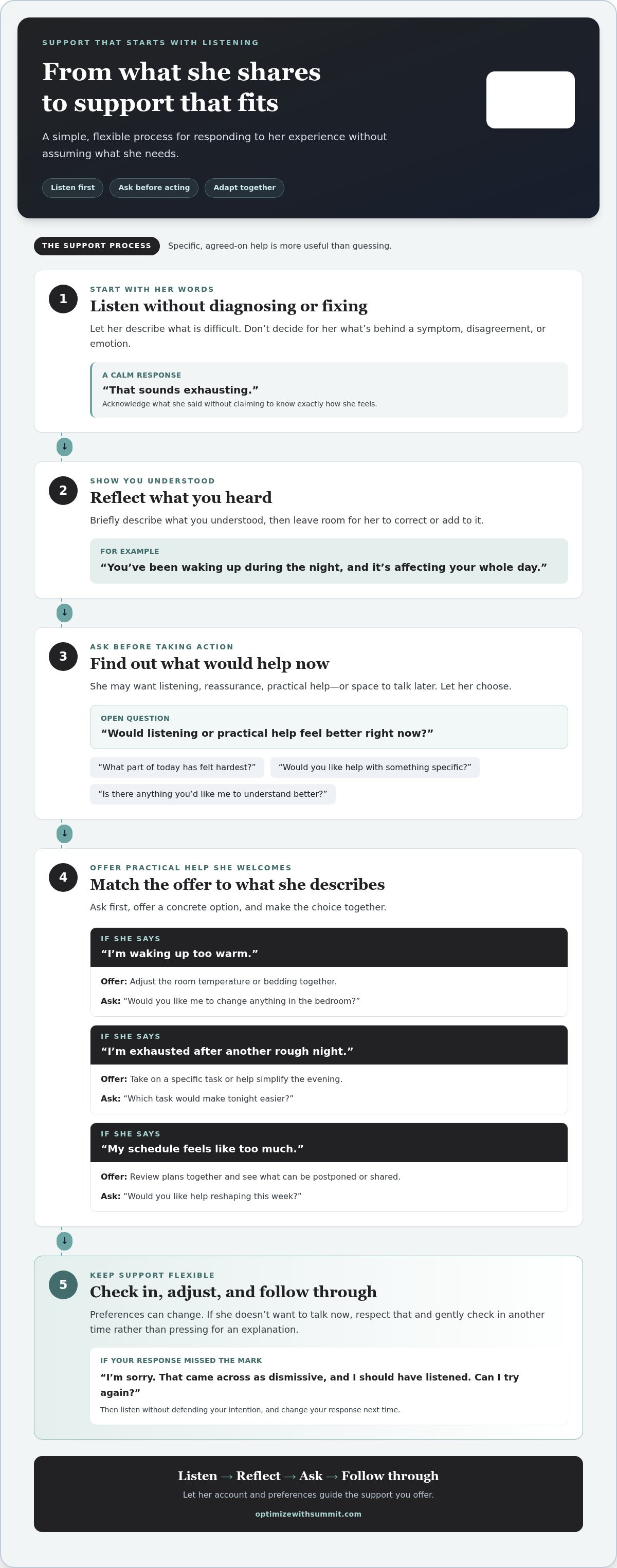
When your wife describes a difficult day, resist the urge to explain it, solve it, or make it feel smaller. Begin by listening. A calm response such as “That sounds exhausting” shows you’ve heard her without claiming to know exactly how she feels.
Then reflect what you understood: “You’ve been waking up during the night, and it’s affecting your whole day.” Before taking action, ask what would help: “Would listening or practical help feel better right now?” This pause keeps your support aligned with what she actually wants. The Office on Women’s Health offers information about managing menopause symptoms, which may also help you understand the concerns she chooses to share.
Helpful words that leave room for her experience
Keep your words simple and sincere. Try “I believe you,” “I’m here,” or “I want to understand what this is like for you.” Open questions can invite conversation without turning it into an interview:
- “What part of today has felt hardest?”
- “Would you like me to listen, or help with something specific?”
- “Is there anything you’d like me to understand better?”
She may not want to talk immediately. Respect that. You might say, “That’s okay. I’m here if you want to talk later,” then check in gently another time rather than pressing for an explanation.
Responses to avoid when emotions or symptoms feel unfamiliar
“It’s just hormones,” “You’re overreacting,” or a joke at her expense can make her feel dismissed, even if you mean to lighten the mood. Comparing her with another woman can have the same effect. Her experience doesn’t need to match anyone else’s to deserve your attention.
If you get it wrong, repair the moment directly. Say, “I’m sorry. That came across as dismissive, and I should have listened. Can I try again?” Then let her speak without defending your intention. Follow through by changing your response next time.
A useful sequence to remember is listen, reflect, ask, follow through. It offers a practical starting point for how to support my wife through menopause, especially when you aren’t sure what to say. If she chooses to explore clinical support, Summit Health’s telehealth-led consultations provide space for an individualized discussion of her concerns and possible next steps.
Practical Menopause Support at Home Should Match What She Wants
Useful help is specific, agreed on, and flexible. A cooler bedroom may matter if she’s waking hot; a lighter schedule may help if poor sleep is affecting her energy. Don’t assume a change is needed just because you’ve read about a symptom. Ask first, offer a practical option, and adjust based on her response.
| What she describes | What you could offer | What to ask first |
|---|---|---|
| “I’m waking up too warm.” | Adjust the room temperature or bedding together. | “Would you like me to change anything in the bedroom?” |
| “I’m exhausted after another rough night.” | Take on a specific task or help simplify the evening. | “Which task would make tonight easier?” |
| “My schedule feels like too much.” | Review plans together and see what can be postponed or shared. | “Would you like help reshaping this week?” |
Small changes that respect her preferences
Agree on a change rather than making it a surprise. If you offer to handle dinner or another household task, treat it as a shared responsibility, not a favor she has to earn. Check whether the arrangement is still useful, since needs and preferences can shift. Respect her privacy, too. Let her decide what to wear, whether to discuss symptoms with others, and what she wants to share about intimacy.
Stay connected through changes in intimacy and mood
Changes in mood, desire, or physical comfort can affect closeness, but they don’t determine what either of you should want. Talk at a calm moment and make room for an honest answer: “What kind of closeness feels right for you lately?” Mutual consent matters each time. Affection, conversation, or other forms of intimacy may feel welcome, but let her help define what works for both of you.
If persistent changes are distressing and she wants support, offer to help her explore a conversation with a qualified clinician. The National Institute on Aging provides information about exploring menopause care options, including discussing symptoms and possible approaches with a doctor. Clinical guidance can be one option, not an expectation.
There’s no fixed script for how to support my wife through menopause. Ask, offer help without pressure, and check whether it’s working. That keeps day-to-day support responsive to her rather than organized around a symptom checklist.
How to Support Your Wife in Exploring Menopause Care
Clinical support is one option she may choose, not a required step or a decision you should make for her. If she wants help, ask permission, listen to what she wants to address, and respect her choices. For background on how the transition can vary over time, see this menopause transition timeline guide.
Prepare for a menopause appointment together
Start with a simple offer: “Would it help if I took notes with you before your appointment?” If she agrees, help her record what she has noticed, when it tends to happen, how it affects daily life, and what she wants to ask. Keep the notes factual and in her words. She should lead the conversation, and she gets to decide whether you attend or wait nearby.
Questions can help her understand proposed care without steering her toward a particular choice. She might ask:
- “What could be contributing to these symptoms?”
- “What are the potential benefits, risks, and alternatives to this option?”
- “What follow-up would help us assess whether this approach suits me?”
Encourage her to raise any concerns directly with the clinician. Don’t recommend a specific hormone, supplement, test, or treatment change yourself. A clinician can assess her symptoms and discuss options in light of her health history and circumstances.
Understand personalized care without pressure
There isn’t one plan that fits every woman. Decisions may depend on symptoms, medical history, preferences, and clinical assessment. If she wants to learn about hormone therapy, Summit Health’s personalized hormone therapy information is an optional resource. General context on testing is available in the hormone blood work guide. Neither resource replaces an individualized clinical discussion or means she needs treatment.
For some women, Summit Health’s telehealth-led consultations, comprehensive labwork, and personalized treatment plans support a discussion of individual needs. The choice to explore care, what to discuss, and whether to pursue any option remains hers. Support her in getting informed without turning your concern into pressure.
If she wants to explore a personalized clinical discussion, she can schedule an appointment with Summit Health.
Build Ongoing Support Around Her, Not Around a Menopause Checklist
Support that works today may need to change next week. Rather than tracking symptoms for her or following a fixed routine, agree on a simple way to check in. Ask whether she’d prefer a brief conversation at a convenient time, occasional check-ins, or no set schedule. The goal is to understand what feels useful, not to supervise her experience.
Create a check-in that feels supportive, not supervisory
Keep the conversation low-pressure and focused on her preferences. Try, “Is anything I’ve been doing especially helpful?” or “Would you like something to change?” Listen without turning it into a scorecard or expecting her to report symptoms. If she doesn’t want to talk, respect that and leave the door open. Revisit the arrangement together if her needs or circumstances shift.
Small follow-through builds trust. If she says a quieter evening or more help with a particular responsibility would make a difference, agree on what that looks like and do it consistently. Don’t assume the same adjustment will always be right. Check in again and let her guide what happens next.
When additional support may be welcome
If symptoms are persistent, disrupt daily life, or concern her, she may want to discuss them with a qualified clinician. Offer practical help, such as making time for an appointment or organizing questions, while leaving the decision and conversation in her hands. Clinical input can help assess her situation and discuss options suited to her needs; it doesn’t mean she must choose a particular treatment.
Summit Health offers telehealth consultations and individualized care informed by comprehensive labwork. If she wants to explore clinical support, she can learn more about a virtual appointment.
At its core, how to support my wife through menopause is a question answered through everyday respect: believe what she shares, ask before acting, share responsibilities by agreement, and honor her choices. Stay attentive without making menopause the center of every conversation. Consistent care isn’t a checklist to complete. It’s a willingness to adapt, keep communicating, and support her on her terms.
Make Support a Steady Practice
There’s no single script for how to support my wife through menopause. The strongest approach is to believe what she shares, listen before offering solutions, and ask what would make daily life easier. Share responsibilities by agreement, and keep checking whether your support still fits what she wants.
Her experience is personal, and so are any decisions about care. If symptoms are persistent, disruptive, or concerning to her, a qualified clinician can help assess them and discuss options. Summit Health offers telehealth-led consultations, comprehensive diagnostic labwork, personalized treatment plans, ongoing virtual monitoring, and health coaching for those who choose clinical support.
If she’d like to explore that option, explore a virtual appointment. Your role isn’t to direct her choices. It’s to stay attentive, respect her agency, and keep showing up as a thoughtful partner.
Frequently Asked Questions
What is the best way to support my wife through menopause?
Start by listening and asking what kind of support she wants. Menopause affects people differently, so don’t assume you know what she’s experiencing or what will help. Offer specific assistance, such as taking on a household task, and follow through. Check in later to see if the support still works. If she wants clinical guidance, encourage her to discuss her concerns with a qualified clinician and leave care decisions in her hands.
What should I say to my wife when she is having menopause symptoms?
Use calm, validating words, such as, “I hear that this is affecting you. Would you like me to listen, help with something practical, or give you space?” Avoid calling her symptoms moodiness or saying they’re simply hormones. You don’t need a perfect response or an instant solution. Listen carefully, ask what she needs, and follow through on what you agree to do.
Can menopause affect a relationship?
Menopause-related changes may affect comfort, sleep, mood, energy, or intimacy, which can shape how you feel together day to day. The experience varies, and menopause doesn’t explain every relationship difficulty. Talk about what each of you is noticing without assigning blame or assuming symptoms are the cause. If a change is distressing, you can discuss professional support together if your wife wants to explore it.
How can I help my wife sleep better during menopause?
Ask what’s disrupting her sleep and whether she wants help adjusting routines, schedules, or the bedroom environment. Don’t assume one change or supplement will solve the problem. After a difficult night, offer to take on a specific morning or household task if that would help. If sleep problems persist or affect her daily life, support her in raising them with a qualified clinician.
Should I encourage my wife to take hormones for menopause?
Don’t steer her toward or away from a specific treatment. Hormone therapy is a personal medical decision based on her symptoms, health history, preferences, and a clinician’s assessment of potential benefits and risks. You can offer to help her prepare questions or attend an appointment if she invites you. The decision belongs to her and her healthcare professional, not to you as her partner.
What should I do if my wife does not want to talk about menopause?
Respect her choice and don’t press for details. Let her know you’re available to listen or help with practical tasks if she wants, then show care through everyday actions. You can check in later by asking whether she’d prefer a conversation, more privacy, or a change in household support. If she shares a concern, follow her lead rather than taking over or demanding an explanation.
When should my wife talk with a doctor about menopause symptoms?
She can seek clinical guidance whenever symptoms concern her, disrupt daily life, or raise questions about her health. New or severe symptoms shouldn’t automatically be attributed to menopause; a clinician can assess them in context. If she wants help, offer to write down her concerns with her or support her in arranging an appointment. Let her decide what to discuss and what care to pursue.

Article by
Dr. David Richardson
David Richardson, is the founder and CEO of Summit Health and the author of "Insights from the Summit", where he writes about hormone optimization, metabolic health, thyroid function, longevity, and preventive medicine.
After entering healthcare in 2009, David became increasingly interested in a question that traditional medicine often struggles to answer:
Why do so many people continue to feel terrible despite being told their labs are "normal"?
That question eventually led him into the field of health optimization in 2020, where he became passionate about understanding physiology at a deeper level and helping patients uncover the root causes of their symptoms rather than simply managing them.
Today, David's philosophy is simple: normal and optimal are not the same thing. Every patient is physiologically unique, and meaningful healthcare begins by listening to symptoms, understanding the science, and recognizing that laboratory values are only one piece of a much larger picture.
Through Summit Health and Insights from the Summit, David's mission is to help people better understand their bodies, ask better questions, and make informed decisions that improve both their health span and quality of life.


