

IMPORTANT DISCLAIMERS
Medical Disclaimer: The information in this article is provided for educational purposes only and is not intended as medical advice or a substitute for individualized medical care. Every person's health needs are unique. Always consult a qualified healthcare professional before starting, stopping, or changing any medication, supplement, or treatment plan. -------
Article Disclaimer: Articles are reviewed and published by Summit Health to provide evidence-based educational information. While Summit Health strives to provide reliable and current health information, medical knowledge is always evolving over time. Depending on when you are reading this content, it may not reflect the latest research or apply to your individual circumstances.
Anxiety can feel psychological, physical, or both. So, can low testosterone cause anxiety? It may contribute to anxiety symptoms for some people, but a possible association doesn’t prove that low testosterone is the cause. Fatigue, irritability, trouble concentrating, and disrupted sleep can occur with several health conditions, making the source difficult to identify from symptoms alone.
If you’re looking for a clear answer, it makes sense to want more than conflicting claims online. This article explains what the evidence suggests about testosterone and anxiety, what other factors may play a role, and how a clinician can assess the full picture. You’ll also learn why lab results need to be interpreted alongside symptoms and health context, rather than treated as a diagnosis on their own.
A careful evaluation can help distinguish a hormone concern from other contributors, or identify when more than one factor may be involved. The goal is an informed next step, not a rush toward hormone treatment.
Key Takeaways
- Can low testosterone cause anxiety? It may be one factor, but the connection alone doesn’t establish the cause of your symptoms.
- Notice patterns in sleep, stress, mood, and energy, and share them with a clinician as part of the broader health picture.
- Similar symptoms can have different contributors, including medication effects, other health conditions, and life stressors.
- Test results are most useful when interpreted alongside symptoms and clinical context, rather than in isolation.
- Explore hormone therapy as an individualized option only when clinically appropriate, not as a guaranteed treatment for anxiety.
Can low testosterone cause anxiety? What the relationship may mean
Low testosterone may be associated with anxiety symptoms, but that doesn’t prove it causes anxiety. Anxiety can have psychological, medical, medication-related, and situational contributors, and more than one may be present at a time. A hormone level is one piece of context, not an explanation on its own.
Testosterone concerns may coexist with changes in mood or well-being, but anxiety isn’t a defining symptom of testosterone deficiency. The distinction matters: feeling anxious alongside low testosterone doesn’t establish that one caused the other, or that hormone treatment would resolve the anxiety.
What research can, and cannot, say
Human studies may find an association between testosterone levels and mental or emotional symptoms. But study design and the outcomes measured matter. An observational link can’t show whether testosterone contributes to anxiety, whether another factor affects both, or whether anxiety-related stress and disrupted sleep influence hormone levels.
It’s also important to separate anxiety from depression, irritability, fatigue, and general well-being. These can overlap, but they aren’t interchangeable outcomes. Evidence about one doesn’t automatically establish an effect on another, and group-level findings can’t determine the cause of an individual’s symptoms.
Correlation describes a pattern; a possible contribution is a hypothesis; only a careful individual assessment can judge whether low testosterone is relevant to one person’s anxiety.
When symptoms overlap
Low energy, changes in sleep, reduced libido, and shifts in mood may prompt someone to consider testosterone. Anxiety can also affect sleep, concentration, and energy, while life stress or a health condition may influence several of these at once. These symptoms are nonspecific, so they can’t confirm testosterone deficiency by themselves.
For context, the overview of late-onset hypogonadism describes symptoms such as irritability and poor concentration. Those concerns can overlap with anxiety, but overlap is not proof of a shared cause. The pattern, timing, severity, and broader health context all matter.
If anxiety is affecting daily life, it deserves attention whether or not a hormone issue is also present. A useful starting point is to note when symptoms began, what changes alongside them, and any medications or major stressors. That information can help guide a more complete clinical assessment rather than relying on symptoms or a single lab result alone.
How testosterone, stress, sleep, and mood can interact
Hormones don’t operate in isolation. The hypothalamic-pituitary-gonadal (HPG) axis is the communication system linking the brain and reproductive glands: signals from the brain prompt the testes to produce testosterone, while feedback helps regulate that process. Sleep, overall health, and other influences can affect how this system functions, so a testosterone result needs to be understood within a broader picture.
Why sleep, stress, and health context matter
A run of poor sleep can leave someone feeling depleted, less focused, and more emotionally reactive. Ongoing stress can also affect sleep and daily functioning. These effects may resemble concerns associated with low testosterone, and disrupted sleep or illness may also influence hormone measurements. Anxiety can feed into this cycle: worry may make it harder to sleep or concentrate, which can then intensify distress.
Health conditions and medications may also be relevant. For example, a clinician might consider sleep apnea, thyroid problems, a recent illness, or medication effects based on a person’s history. These are possibilities to review, not conclusions to draw from symptoms alone. No single hormone, including cortisol, offers a simple explanation for anxiety.
One symptom or one lab result can’t establish the cause; the pattern over time and the full clinical context matter.
Why one testosterone test may not tell the whole story
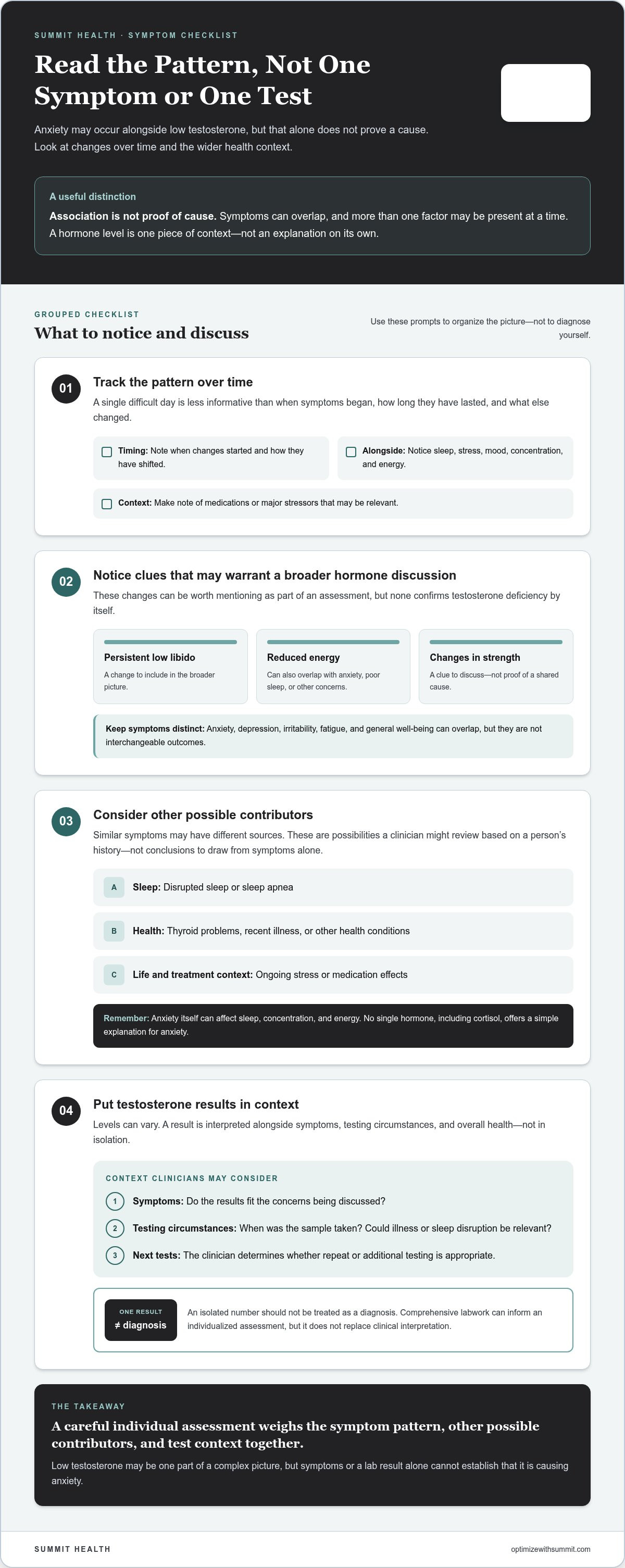
Testosterone levels can vary, and results are interpreted in light of symptoms and the circumstances of testing. A clinician may consider when the sample was taken, whether illness or sleep disruption could be relevant, and whether the result fits the person’s overall health picture. They determine whether repeat or additional testing is appropriate; an isolated number shouldn’t be treated as a diagnosis.
For a closer look at how test results fit into a broader hormone assessment, read this guide to hormone blood work. Comprehensive labwork can inform an individualized assessment, but it doesn’t replace clinical interpretation.
So, can low testosterone cause anxiety? It may be one part of a complex interaction, but stress, sleep, health conditions, and anxiety itself can shape the same symptoms and affect how results are understood. If evaluation points to a hormone concern, individualized hormone therapy planning can be considered in clinical context, rather than assumed to be an anxiety treatment.
Low testosterone or another cause? How to interpret anxiety symptoms
Anxiety can occur alongside concerns about testosterone, but the same symptoms can arise from very different causes. Persistent low libido, reduced energy, or changes in strength may be worth discussing as part of a broader hormone assessment. They’re clues, not proof. Age, health conditions, medications, sleep, and individual circumstances all shape what a symptom may mean.
Symptoms that may prompt a broader hormone discussion
Look at the pattern, not a single rough day. Note when changes began, how long they’ve lasted, whether they’re getting better or worse, and what else changed around the same time. Tracking sleep, stress, libido, energy, and strength can make a clinical conversation more specific. Anxiety alone isn’t proof of low testosterone, and it isn’t by itself an indication for hormone therapy.
Other contributors a clinician may consider
Possible contributors include anxiety disorders, disrupted sleep, medication effects, other medical factors, and stressful life events. More than one may be relevant at once. A clinician considers the history and overall presentation rather than ranking causes from a symptom list. The comparison below can help organize what to discuss, but none of these clues confirms a diagnosis.
| Possible contributor | Clues to discuss | Why clues aren’t a diagnosis |
|---|---|---|
| Hormone-related concern | Persistent changes in libido, energy, or strength alongside other symptoms | These concerns are nonspecific and need to be interpreted with clinical findings and appropriate testing. |
| Sleep disruption | Difficulty falling or staying asleep, an irregular schedule, or feeling unrefreshed | Poor sleep can affect mood and daytime energy, but doesn’t identify the underlying cause. |
| Medication effects | Symptoms that began or shifted after starting, stopping, or changing a medication | Timing can be useful context, but medication effects require a clinician’s review. |
| Other health factors | New or changing symptoms alongside a health condition or illness | Several conditions can affect mood and energy; symptoms alone can’t distinguish them. |
| Anxiety or life stress | Worry, tension, or distress linked with daily demands or affecting routines | Anxiety can coexist with other concerns, so it doesn’t rule them in or out. |
If you’re wondering, “Can low testosterone cause anxiety?”, the useful next step is to explore the whole picture rather than assume a single cause. A hormone therapy overview can provide broader treatment context, but therapy is an individualized consideration, not a default response to anxiety.
How clinicians evaluate anxiety when low testosterone is a concern
A sound evaluation moves in sequence: clarify the symptoms, understand the health context, assess concerns clinically, then interpret any appropriate tests. This helps distinguish a possible hormone issue from anxiety that needs its own attention. The two can coexist, and evaluating one doesn’t replace considering the other.
What to prepare before a medical consultation
A brief symptom record can make the conversation more precise. Note when anxiety or other changes began, how often they occur, how intense they feel, and whether they affect work, relationships, or daily routines. Include sleep patterns, relevant health changes, and any medication starts or changes. Bring existing test results and a short list of questions, such as what the results can and can’t explain. Don’t start, stop, or change medication without guidance from a clinician.
What labwork can contribute to the assessment
A clinician may order or review labwork based on symptoms, medical history, and the circumstances of testing. Testosterone results aren’t self-interpreting: timing, possible influences on the measurement, and how the result fits the overall clinical picture all matter. The clinician determines whether repeat testing or additional markers are appropriate for the individual. A single result should not be treated as a stand-alone explanation for anxiety.
This guide to hormone blood work offers more context on how testing can inform an individualized assessment.
Evaluation also needs to address anxiety directly. A clinician can discuss its pattern, effects on daily life, and potential psychological, situational, medication-related, or medical contributors. If anxiety is persistent or disruptive, it deserves care in its own right, whether or not testosterone is part of the picture. Mentioning hormone concerns should broaden the assessment, not narrow it prematurely.
Treatment decisions should reflect symptoms, validated findings, and clinical judgment, not a lab value or symptom in isolation. If you’re considering whether hormone factors warrant a closer look, Summit Health’s hormone quiz can be a starting point for organizing your questions and exploring individualized evaluation.
What to do next: personalized evaluation, not assumptions
Anxiety deserves attention whether or not testosterone is involved. If you’re asking, “Can low testosterone cause anxiety?”, use that question to open a broader health conversation, not to settle on a diagnosis. Anxiety can have several contributors, and hormone therapy isn’t a guaranteed anxiety treatment. It should be considered only when an individualized clinical assessment supports it.
How individualized hormone care can fit into the picture
At Summit Health, telehealth consultations, comprehensive diagnostic labwork, and health context can inform an individualized hormone assessment and treatment plan. Symptoms and test results are considered together, rather than treating a lab value as a complete answer. If hormone therapy is clinically appropriate, ongoing virtual monitoring and health coaching support follow-up and adjustments to the plan. The aim is to address the person’s assessment and health goals, not promise a specific mental-health outcome.
For more background on online care and hormone replacement, explore this online hormone replacement therapy guide. It can help frame questions about personalized care, while a clinician’s evaluation remains central to decisions about your own health.
Choose a clear next step
If you’re unsure where to begin, the personalized hormone assessment can be an educational starting point for organizing your concerns. You can note what has changed, when it began, and what you’d like to understand. It doesn’t replace clinical evaluation, and it shouldn’t be used to diagnose yourself.
For an individualized discussion, schedule an appointment to review symptoms, health context, and whether labwork may help clarify the picture. If mental health symptoms are urgent or severe, seek timely support from qualified local services. You don’t need to determine the cause on your own before asking for help.
Move forward with a clearer picture
So, can low testosterone cause anxiety? It may be part of the picture for some people, but a possible connection doesn’t establish the cause. Anxiety has multiple potential contributors, and overlapping symptoms call for a broader assessment rather than a diagnosis based on one symptom or lab result.
Sleep, stress, medications, and other health factors can all provide useful context. A clinician can review how symptoms developed, assess anxiety and overall health, and interpret appropriate testing in combination. Hormone therapy isn’t a guaranteed anxiety treatment; it’s an individualized option only when the clinical findings support it.
Summit Health’s telehealth consultations and comprehensive diagnostic labwork support individualized assessment and planning. Ongoing monitoring helps guide follow-up as care progresses. If you’re ready to discuss your symptoms and explore whether hormone evaluation may be relevant, schedule a personalized consultation.
A thoughtful next step can replace uncertainty with a more informed plan, one shaped around your health and needs.
Frequently Asked Questions
Can low testosterone cause anxiety in men?
Low testosterone may contribute to anxiety symptoms for some men, but an association doesn’t prove it’s the cause. Anxiety can also relate to sleep disruption, stress, medications, medical conditions, or mental health concerns. Low testosterone and anxiety may occur together, so a clinician considers symptoms, health history, and appropriate test results before determining whether hormone levels are relevant to an individual’s experience.
Is anxiety a symptom of low testosterone?
Anxiety can occur alongside low testosterone, but it isn’t a defining symptom on its own. Possible testosterone-related concerns such as reduced libido, low energy, or mood changes are also nonspecific and can have many explanations. A symptom list can help guide a conversation, but it can’t diagnose testosterone deficiency. Clinicians interpret the overall pattern and relevant testing in the context of a person’s health.
Can testosterone therapy help with anxiety?
Testosterone therapy isn’t a guaranteed anxiety treatment or a first-line treatment for anxiety disorders. It may be considered when an evaluation supports testosterone deficiency, but that doesn’t ensure anxiety will improve. Anxiety may need its own assessment and care, which can include approaches tailored to its cause and impact. Treatment decisions should reflect symptoms, test findings, health context, and clinical judgment.
How do doctors test for low testosterone?
Doctors consider symptoms and health history alongside blood tests. For men, American Urological Association guidance uses total testosterone below 300 ng/dL as a reasonable cutoff supporting diagnosis; diagnosis typically also requires symptoms and low results on two separate early-morning tests. A clinician interprets results in context and determines whether repeat or additional testing is appropriate. A single result or symptom alone doesn’t establish deficiency.
Can anxiety affect testosterone levels?
Anxiety may affect sleep and daily functioning, and chronic stress or poor sleep can influence hormone production and test results. That doesn’t mean anxiety always lowers testosterone or that a particular level explains anxiety. The relationship can be complex, with overlapping influences in either direction. Share changes in stress, sleep, and symptoms with a clinician so results can be considered alongside the circumstances in which they were measured.
What else can cause anxiety and low energy?
Anxiety and low energy can be associated with disrupted sleep, life stress, medication effects, anxiety disorders, or other health conditions. For example, a clinician may consider thyroid concerns or sleep apnea depending on symptoms and history. These are possibilities, not diagnoses, and more than one factor may be involved. Note when symptoms began, how they affect daily life, and any related health or medication changes.
Should I get my testosterone checked if I feel anxious?
Anxiety alone doesn’t mean testosterone testing is needed, but discussing testing may make sense if you also have persistent concerns such as reduced libido or unexplained changes in energy. A clinician can review your symptoms, health history, medications, and sleep, then decide whether testing is appropriate. Anxiety deserves attention in its own right, too. Don’t start hormone therapy based on symptoms or an isolated result.

Article by
Dr. David Richardson
David Richardson, is the founder and CEO of Summit Health and the author of "Insights from the Summit", where he writes about hormone optimization, metabolic health, thyroid function, longevity, and preventive medicine.
After entering healthcare in 2009, David became increasingly interested in a question that traditional medicine often struggles to answer:
Why do so many people continue to feel terrible despite being told their labs are "normal"?
That question eventually led him into the field of health optimization in 2020, where he became passionate about understanding physiology at a deeper level and helping patients uncover the root causes of their symptoms rather than simply managing them.
Today, David's philosophy is simple: normal and optimal are not the same thing. Every patient is physiologically unique, and meaningful healthcare begins by listening to symptoms, understanding the science, and recognizing that laboratory values are only one piece of a much larger picture.
Through Summit Health and Insights from the Summit, David's mission is to help people better understand their bodies, ask better questions, and make informed decisions that improve both their health span and quality of life.


