

IMPORTANT DISCLAIMERS
Medical Disclaimer: The information in this article is provided for educational purposes only and is not intended as medical advice or a substitute for individualized medical care. Every person's health needs are unique. Always consult a qualified healthcare professional before starting, stopping, or changing any medication, supplement, or treatment plan. -------
Article Disclaimer: Articles are reviewed and published by Summit Health to provide evidence-based educational information. While Summit Health strives to provide reliable and current health information, medical knowledge is always evolving over time. Depending on when you are reading this content, it may not reflect the latest research or apply to your individual circumstances.
Could changing hormones be affecting your focus, or is another factor behind the mental slowdown? The connection between brain fog and hormone imbalance is possible, but symptoms alone can’t identify the cause. Difficulty concentrating, forgetfulness, or slower thinking can feel unsettling, especially when they begin to disrupt work and daily routines.
These changes deserve thoughtful attention. Hormone shifts during life stages such as perimenopause may play a role in cognitive symptoms, yet sleep disruption, stress, thyroid concerns, nutritional deficiencies, and other health factors can also contribute. Looking at when symptoms occur and what else is changing can help frame a more useful evaluation than settling on a single explanation.
This article explores how hormones may influence brain function, what other causes to consider, and how to prepare for an individualized clinical evaluation. You’ll learn what details to track, why a broader review of symptoms and health history can be useful, and how comprehensive labwork may inform next steps. A measured, data-informed approach can help bring greater clarity without assuming that brain fog proves a hormone imbalance or that hormone therapy will resolve it.
Key Takeaways
- “Brain fog” describes cognitive symptoms, not a diagnosis, so it’s useful to describe the specific changes you’re noticing.
- The connection between brain fog and hormone imbalance is possible, but symptom timing offers context rather than proof of a hormonal cause.
- Track patterns in focus, memory, energy, sleep, and daily functioning to help identify factors worth discussing in an evaluation.
- Prepare a symptom timeline, relevant health context, medication list, and questions to make your clinical discussion more focused.
- Virtual consultations, comprehensive labwork, and ongoing monitoring can support a personalized assessment without assuming hormone therapy is the right next step.
Brain Fog and Hormone Imbalance: What the Terms Mean
“Brain fog” is a descriptive phrase, not a standalone medical diagnosis. People use it to describe changes in concentration, memory retrieval, or mental clarity that make thinking feel less efficient than usual. The experience can fluctuate, vary from person to person, and range from occasional difficulty following a conversation to a more persistent sense of mental sluggishness.
The phrase brain fog and hormone imbalance points to a possible connection worth assessing, not a cause that can be established from symptoms alone. Hormones affect multiple body systems, and their levels can vary with life stage and other individual factors. A careful evaluation considers the full picture before drawing conclusions.
What does brain fog feel like in daily life?
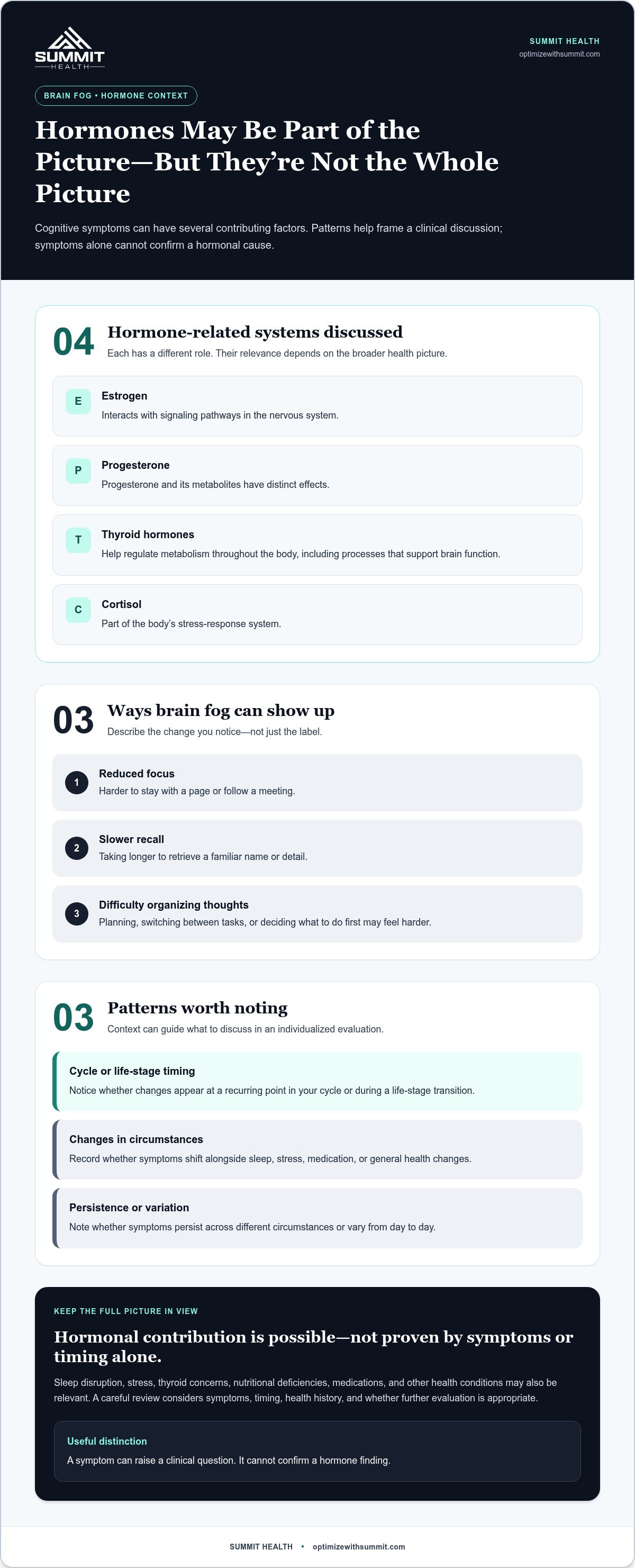
Different cognitive experiences can overlap, but they aren’t interchangeable. Reduced focus may make it harder to stay with a page or follow a meeting. Slower recall can mean taking longer to retrieve a familiar name or detail. Difficulty organizing thoughts may disrupt planning, switching between tasks, or deciding what to do first.
Notice the practical effect, not just the label. You might reread a paragraph several times, lose your place while speaking, or need more effort to complete a routine task. These examples describe an experience; on their own, they don’t identify a specific condition.
For a clearer account, note when the changes began and whether they’re steady or come and go. Record what seems to make them better or worse, and how they affect work, home responsibilities, or other parts of your routine. For example, note whether you lose focus during particular tasks, whether the change lasts for a short period or most of the day, and whether it affects more than one part of your routine.
What does “hormone imbalance” mean in this context?
Hormones are chemical messengers involved in processes throughout the body. Their activity is shaped by context, including life stage, health, and the interaction of different body systems. “Hormone imbalance” is a broad phrase, not a precise explanation of a particular cognitive symptom. Determining whether a hormone-related issue is relevant takes more than noticing a change in concentration or memory.
A symptom can raise a clinical question, but it can’t confirm a hormone finding. That distinction helps keep the next step measured: describe what has changed, consider when it happens, and discuss whether further evaluation is appropriate. Timing around a life stage or recurring pattern may provide useful context, but it isn’t diagnostic proof.
Clear descriptions give an individualized assessment a stronger starting point. Rather than assuming one cause, track the changes you notice and the circumstances around them. The next section looks at how hormones may relate to cognitive symptoms while keeping other possible explanations in view.
How Hormone Changes May Relate to Brain Fog
Hormones can influence systems involved in brain function, but they don’t act as a single switch for concentration. Estrogen interacts with signaling pathways in the nervous system, while progesterone and its metabolites have distinct effects. Thyroid hormones help regulate metabolism throughout the body, including processes that support brain function. Cortisol is part of the body’s stress-response system. These roles make a hormonal contribution biologically plausible, but they don’t establish an individual diagnosis or explain every experience of mental fogginess.
Patterns can offer useful context. A change that repeatedly appears at a certain point in the menstrual cycle, or alongside a broader life-stage transition, is worth describing in a clinical discussion. Timing is a clue to explore, not proof that hormones are responsible. Hormone levels and their effects vary, and a single result may not tell the full story without symptoms and health history.
Which hormone-related patterns may be worth discussing?
Note whether cognitive changes coincide with cycle changes or a life-stage transition, and whether the pattern repeats. Include any other symptoms you’ve noticed rather than trying to match them to a particular hormone. Thyroid-related changes may also be relevant context, but no symptom checklist can confirm a thyroid condition. A clinician can consider the overall pattern and whether evaluation is appropriate.
Why timing and the wider picture matter
Concentration can be shaped by overlapping biological, behavioral, and medical factors. Poor-quality sleep may affect attention and recall, while ongoing stress can make it harder to sustain focus. Medications and health conditions may also be relevant, so a timeline that includes changes in treatment or health can add perspective. For more context, consider how restorative sleep and recovery fit into your overall pattern.
As you track changes, look for connections without treating them as conclusions. For example, record whether the symptoms:
- Appear at a recurring point in your cycle or during a life-stage change.
- Shift after changes in sleep, stress, medication, or general health.
- Persist across different circumstances or vary from day to day.
This context can help guide a more individualized evaluation. A measured review may consider symptoms alongside comprehensive labwork and other relevant health information, rather than assuming a particular hormone is the cause. Summit Health provides virtual consultations and comprehensive diagnostic labwork to support personalized health planning. To discuss an individualized assessment, schedule a virtual appointment.
Hormonal or Something Else? How to Think About Brain Fog
Brain fog alone cannot confirm hormone imbalance. The same difficulty concentrating can occur in different circumstances, and more than one factor may be involved. A recurring pattern can help shape a clinical discussion, but it can’t reliably identify a cause or replace an individualized assessment.
Compare what you notice over time rather than trying to diagnose yourself. Symptoms that persist across different situations may call for a broad review. Changes that seem to follow a cycle, life-stage transition, disrupted sleep, medication change, or period of stress offer useful context, but none proves a specific explanation. The aim is to gather observations, not rank possible causes before the full picture is considered.
What patterns can help frame the possibilities?
Use a simple record to capture what was happening around the time your focus or memory changed. The discussion points below are prompts for a clinician, not a self-diagnosis checklist. Several contexts can overlap, and the pattern may not point to one clear factor.
| Possible context | Clues to record | Discussion points |
|---|---|---|
| Cycle or life-stage changes | When symptoms occur and whether the timing repeats | Whether the pattern and other changes merit hormone-related evaluation |
| Sleep disruption or stress | Sleep quality, schedule changes, and periods of increased stress | How these factors may overlap with daytime concentration |
| Medication changes | Medication or supplement start dates and changes in symptoms | Whether the timing is relevant to a medication review |
| Other health concerns | New or ongoing symptoms and changes in general health | What broader assessment may be appropriate |
Thyroid concerns and other health conditions may also be part of a clinician’s review. This table doesn’t rank causes or suggest that any one is more likely. It helps organize observations that can guide a more complete conversation.
When should brain fog receive prompt attention?
Gradual or fluctuating cognitive concerns can be discussed in a planned clinical evaluation, particularly if they persist or interfere with daily life. Sudden confusion, abrupt difficulty speaking or seeing, new weakness or numbness, or another severe, rapid change is different. These symptoms may signal an acute medical problem and need emergency care. Don’t wait for a routine appointment or try to determine the cause remotely.
For ongoing concerns, bring the timeline and relevant context to a clinician. The relationship between brain fog and hormone imbalance is one possibility to assess alongside sleep, stress, medications, and other health factors. A thoughtful review can help determine appropriate next steps without assuming a diagnosis from symptoms alone.
How to Prepare for an Evaluation of Brain Fog and Hormones
A clear record can make a clinical conversation more productive. You don’t need to arrive with a theory about the cause. Instead, bring a practical account of what’s changed, when it happens, and how it affects your day. This can help a clinician consider the relationship between brain fog and hormone imbalance alongside other relevant factors.
What information should you bring to a consultation?
Use this sequence to organize the details. Brief notes are enough; consistency matters more than precision.
- Build a symptom timeline. Note when changes in focus or memory began, how often they occur, how long they last, and whether they’re improving, worsening, or fluctuating.
- Record daily effects and context. Track changes in focus, memory, energy, sleep, and daily functioning. Include relevant cycle or life-stage timing, recent health changes, and periods of unusual stress, without assuming any one pattern identifies the cause.
- List medications and health history. Bring current medications and supplements, relevant diagnoses, and any recent changes in treatment or health. These details can help place symptoms and any test results in context.
- Prepare questions. Ask what possible explanations may be considered, whether testing could help, and how results would inform next steps. You can also ask what to monitor and when to review the plan.
These notes provide a useful starting point, not a self-diagnosis. If you’re preparing to discuss hormone blood work and diagnostic context, remember that testing decisions are guided by your symptoms, health history, and the questions being evaluated.
How are testing decisions interpreted?
Testing is selected in context, rather than from one symptom alone. A clinician considers the history and overall presentation when deciding whether labwork is appropriate and which results may be relevant. A number outside or inside a reference range doesn’t independently explain brain fog; results require qualified clinical interpretation alongside individual circumstances.
This is why it helps to share timing and changes in daily functioning, not just a list of symptoms. Comprehensive labwork may inform an individualized plan, but it doesn’t guarantee that a particular result will explain cognitive concerns. Ask how findings relate to your symptoms, what uncertainty remains, and whether follow-up is recommended.
If evaluation identifies a hormone-related concern and treatment is appropriate, personalized hormone therapy information can help you understand that possible care pathway. Hormone therapy isn’t the automatic next step for everyone experiencing brain fog. For a virtual conversation about your symptoms and potential evaluation, schedule an appointment.
A Personalized Path Forward with Summit Health
Understanding possible causes is a useful first step. The next is an evaluation that considers your symptoms in context rather than treating brain fog as proof of a hormone issue. Summit Health provides virtual consultations and comprehensive diagnostic labwork to support personalized health planning and a focused discussion about next steps.
What a data-informed, individualized approach can involve
A consultation can begin with your symptom history, relevant health context, and the changes you’ve been tracking. Summit Health’s comprehensive labwork can add information to that discussion. Results are considered alongside your reported symptoms and clinical context, not used in isolation to promise a particular explanation or outcome.
From there, a plan is tailored to the individual. Hormone therapy may be considered when clinically appropriate, but it isn’t the assumed response to concentration or memory concerns. Other findings may point toward different areas to discuss. The goal is clarity about what the information suggests, what remains uncertain, and which next steps fit your situation.
Care can continue through virtual follow-up and ongoing monitoring. Reviewing symptoms and results over time helps keep the plan connected to how you’re doing. Health coaching can also support a personalized wellness approach, with attention to relevant habits and goals alongside clinical care. This process doesn’t guarantee that a specific cause will be identified or that cognitive symptoms will resolve.
Choosing a measured next step
Bring your symptom timeline, relevant health details, and questions to a consultation. You might ask what the evaluation can help clarify, whether labwork is appropriate, how findings will inform a plan, and what follow-up could involve. Clear questions make it easier to understand both the options and the limits of what can be concluded.
Brain fog can have more than one possible contributor, so an individualized review matters. Summit Health’s virtual consultations, diagnostic labwork, and ongoing health coaching can support a thoughtful assessment; any treatment decision depends on the evaluation and clinician guidance. You don’t need to decide in advance that hormones are the cause or that hormone therapy is right for you.
If you’re ready to discuss your symptoms and possible next steps, connect with Summit Health for an individualized conversation.
Move Forward with Greater Clarity
You don’t need to know the cause of your symptoms before seeking guidance. A useful next step is to bring your questions and observations into a conversation where they can be considered in context. The connection between brain fog and hormone imbalance is one possibility to explore, not a conclusion to reach from symptoms alone.
At Summit Health, comprehensive diagnostic labwork can inform individualized health planning, while virtual monitoring and health coaching support care over time. The aim is a measured discussion of what may be relevant for you and which next steps make sense, without assuming a particular diagnosis or treatment outcome. Progress can begin with a clearer understanding of your own health picture.
If you’re ready to discuss your symptoms and possible next steps, schedule a personalized consultation. Bring your questions as they are. A thoughtful, individualized conversation can help you move forward with greater confidence.
Frequently Asked Questions
Can hormone imbalance cause brain fog?
Hormone changes may contribute to brain fog for some people, but the relationship isn’t the same for everyone. Estrogen fluctuations, thyroid concerns, and other biological changes may be relevant, while sleep disruption, stress, medication effects, or other health conditions can also affect thinking. The phrase “brain fog and hormone imbalance” describes a possible connection to assess, not a diagnosis. A clinician considers symptoms and health context together.
Which hormones are associated with brain fog?
Estrogen, progesterone, thyroid hormones, and cortisol may be relevant to cognitive symptoms, though they have different roles in the body. Their levels and effects depend on individual context, and no single hormone explains every person’s experience. Testosterone may also be considered in some clinical evaluations, depending on symptoms and history. A clinician determines which hormone questions are relevant rather than relying on a symptom-to-hormone checklist.
Can perimenopause cause brain fog?
Perimenopause may coincide with subjective changes in concentration or memory for some people. Hormonal fluctuations during this transition can be part of the picture, while changes in sleep, mood, or daily demands may also affect mental clarity. If symptoms seem to vary alongside cycle changes or other transition-related experiences, record that timing. The pattern can inform a clinical discussion, but it doesn’t confirm that perimenopause is the sole cause.
How do you know if brain fog is caused by a hormone imbalance?
You can’t determine the cause from brain fog alone. A repeating pattern, such as symptoms that align with a cycle or a broader life-stage change, may offer useful context but isn’t proof. Keep notes on when symptoms occur, how long they last, and any changes in health, medication, or sleep. A clinician can use that history to decide whether hormone evaluation or another line of investigation is appropriate.
Can low thyroid levels cause brain fog?
Low thyroid hormone levels can be associated with changes in concentration or thinking, but those symptoms don’t establish a thyroid condition. A clinician may consider thyroid testing when your history and overall symptoms suggest it could be relevant. Results need to be interpreted alongside your health context and, when appropriate, other findings. Don’t start, stop, or adjust thyroid medication based on brain fog or a lab result without clinical guidance.
What tests are used to investigate brain fog and hormone imbalance?
There isn’t one test panel that identifies the cause of brain fog for everyone. Depending on your history, a clinician may consider thyroid function, selected hormone levels, or tests for other potential contributors, such as vitamin levels. The evaluation may also include a review of medications and health history. Testing should address specific clinical questions, and results are interpreted with symptoms rather than in isolation.
When should I seek medical care for brain fog?
Arrange a clinical evaluation if cognitive changes persist, worsen, or interfere with work, relationships, or everyday responsibilities. Seek emergency care for sudden severe confusion or abrupt neurological changes, such as new weakness, numbness, trouble speaking, or sudden vision problems. These symptoms need prompt assessment, not a routine hormone workup. If you’re unsure how urgent a change is, seek individualized medical guidance rather than trying to diagnose it yourself.

Article by
Dr. David Richardson
David Richardson, is the founder and CEO of Summit Health and the author of "Insights from the Summit", where he writes about hormone optimization, metabolic health, thyroid function, longevity, and preventive medicine.
After entering healthcare in 2009, David became increasingly interested in a question that traditional medicine often struggles to answer:
Why do so many people continue to feel terrible despite being told their labs are "normal"?
That question eventually led him into the field of health optimization in 2020, where he became passionate about understanding physiology at a deeper level and helping patients uncover the root causes of their symptoms rather than simply managing them.
Today, David's philosophy is simple: normal and optimal are not the same thing. Every patient is physiologically unique, and meaningful healthcare begins by listening to symptoms, understanding the science, and recognizing that laboratory values are only one piece of a much larger picture.
Through Summit Health and Insights from the Summit, David's mission is to help people better understand their bodies, ask better questions, and make informed decisions that improve both their health span and quality of life.


