

IMPORTANT DISCLAIMERS
Medical Disclaimer: The information in this article is provided for educational purposes only and is not intended as medical advice or a substitute for individualized medical care. Every person's health needs are unique. Always consult a qualified healthcare professional before starting, stopping, or changing any medication, supplement, or treatment plan. -------
Article Disclaimer: Articles are reviewed and published by Summit Health to provide evidence-based educational information. While Summit Health strives to provide reliable and current health information, medical knowledge is always evolving over time. Depending on when you are reading this content, it may not reflect the latest research or apply to your individual circumstances.
Normal is a trap. For many, a standard hormone level test serves as a binary check for disease rather than a roadmap for excellence. You likely know the frustration. You struggle with brain fog, persistent fatigue, or weight gain that won't budge, yet your results are dismissed because they fall within a broad clinical range. This "normal" is simply a statistical average of a declining population. It's not a benchmark for your peak potential.
We recognize that feeling fine isn't the same as performing at your best. You are seeking a premium, optimized version of your life. This 2026 reference guide empowers you to master your biology by moving beyond basic diagnostics. It's time to bridge the gap between baseline health and true diagnostic optimization through the lens of biomarker synergy and precision data.
We'll provide a clear map of essential biomarkers and explain the vital difference between clinical ranges and peak performance targets. You'll discover a sophisticated path to expert interpretation that turns raw data into a bespoke strategy for your long term wellness and advancement.
Key Takeaways
- Precision diagnostics. Shift your perspective from avoiding disease to achieving peak performance by understanding the critical gap between "normal" and "optimal" ranges.
- The data roadmap. Learn to navigate "The Big Five" biomarker categories and why measuring free hormone levels is essential for an accurate biological snapshot.
- Protocol for accuracy. Discover why a hormone level test requires strict fasting and specific morning timing to ensure your metabolic data is precise and actionable.
- Data-driven action. Explore how comprehensive labwork integrates into a telehealth-led strategy for customized hormone therapy and long-term health coaching.
Beyond the Reference Range: Why a Hormone Level Test is Your Baseline for Peak Performance
Data is power. A hormone level test provides more than just numbers on a page; it offers a high-resolution snapshot of your endocrine health and metabolic efficiency. Within the field of Endocrinology, these diagnostics are the primary tools used to understand how your body regulates everything from energy production to tissue repair. While traditional medicine often uses these tests to identify pathology, we use them to identify potential.
Optimization requires a baseline. You cannot refine your body composition or cognitive drive without first understanding your current biological state. This "Baseline Concept" is the foundation of any high-performance strategy. It moves you away from the reactive model of healthcare and into a proactive model of self-mastery. Most standard physicals are designed to detect disease, not to facilitate refinement. If your results aren't "broken," a typical provider might send you home. We believe there is a significant difference between not being sick and being truly optimized.
This data also reveals your biological age. Chronological age is a fixed number, but your hormonal markers tell a different story. By measuring specific biomarkers, you can see how well your internal systems are actually functioning relative to your years. A man in his 40s can possess the testosterone profile of a 25-year-old through intentional optimization. This shift in perspective allows you to manage your health based on performance metrics rather than birth dates.
The Problem with "Feeling Fine"
Adaptation is silent. Your body is remarkably efficient at compensating for internal imbalances, often masking the gradual decline of your vitality. Many people mistake chronic fatigue or a loss of drive for "just getting older." This slow fade is often the result of shifting chemistry that hasn't yet reached a crisis point. Understanding the Signs of Hormonal Imbalance in Men is the first step toward reclaiming your edge. Don't wait for a total system failure to address your health.
Data Over Guesswork
Precision beats intuition. Subjective symptoms like brain fog or stubborn weight gain need objective confirmation through comprehensive blood work. Without a hormone level test, you're likely trapped in a cycle of "supplement fatigue," trying various vitamins and minerals without knowing what your body actually requires. Diagnostic precision eliminates the guesswork. It allows for a bespoke approach to supplementation and therapy that respects your unique chemistry. Before you schedule your labs, taking the Summit Health Hormone Quiz can help identify which areas of your biology require the most immediate attention. This preliminary step ensures that your diagnostic journey is both efficient and targeted.
Decoding the Panel: Essential Biomarkers for Men’s and Women’s Health
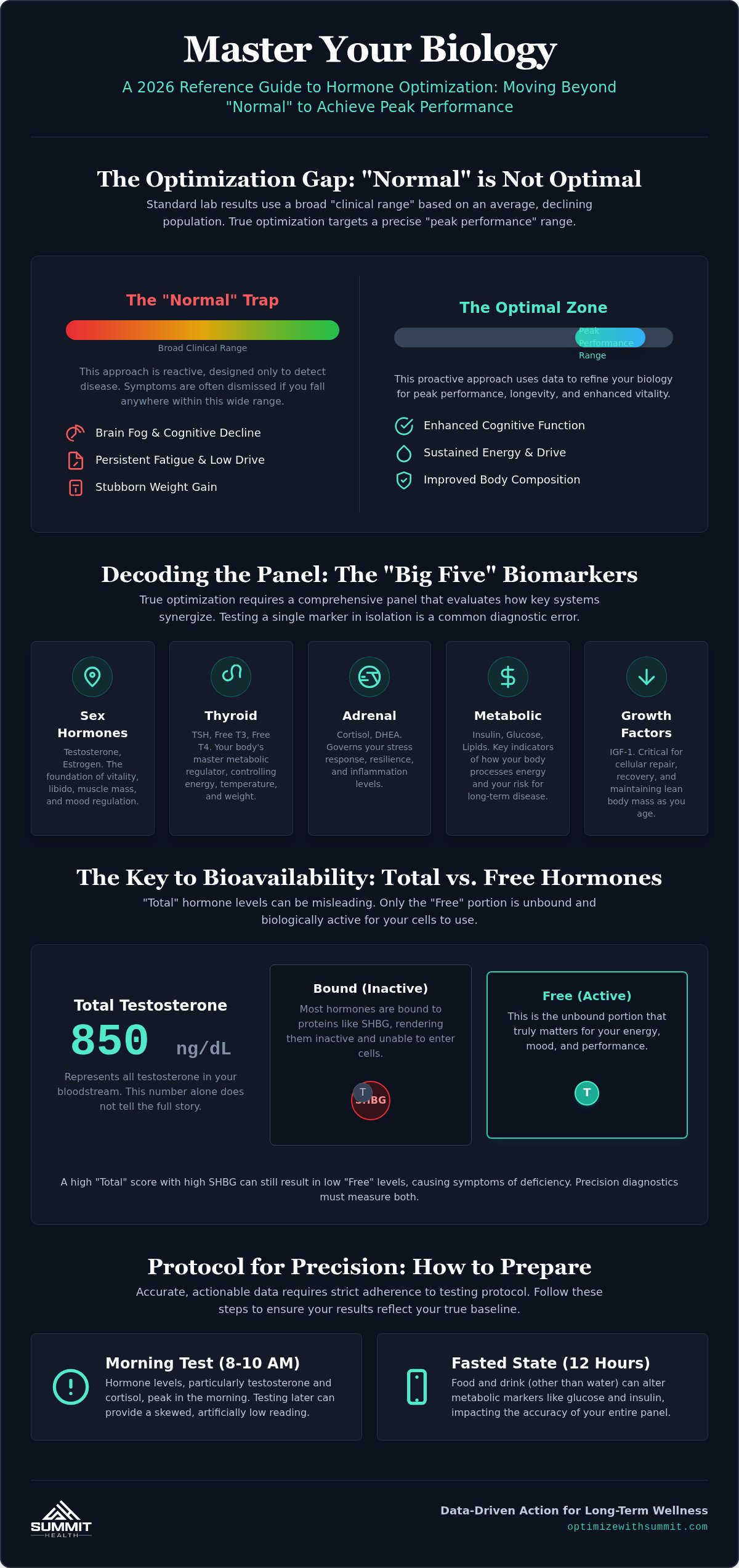
Endocrine health is a complex symphony. A single marker provides a glimpse; a comprehensive panel provides the full story. Hormone levels fluctuate in response to one another, making it essential to evaluate "The Big Five" categories: Sex Hormones, Thyroid, Adrenal, Metabolic, and Growth Factors. Testing these in isolation is a common diagnostic error. True optimization requires a hormone level test that evaluates how these systems synergize to drive your performance.
Bioavailability is the key. When you receive your hormone level test results, you'll often see "Total" and "Free" values. Total levels represent the entire amount in your system, while Free levels represent what is actually available for your cells to use. Sex Hormone Binding Globulin (SHBG) acts as a transport protein that binds to hormones, rendering them inactive. If your SHBG is too high, even a high "Total" score can leave you feeling the symptoms of a deficiency. Precision diagnostics must account for this binding to determine your true metabolic capacity.
The Male Optimization Panel
Focus on the foundation. For men, this panel includes Total and Free Testosterone, Estradiol (Sensitive), PSA, and LH/FSH. Estrogen management is often overlooked in men, yet it's critical for bone health, cognitive function, and libido. High testosterone is useless if it's being excessively converted to estrogen or suppressed by poor signaling. For a deeper dive into these metrics, consult our Hormone Blood Work Guide.
The Female Vitality Panel
Complexity requires precision. A female panel evaluates Estradiol, Progesterone, Testosterone, DHEA-S, and AMH. These markers must be interpreted through the lens of the menstrual cycle or menopause status to be meaningful. Testing at the wrong time can yield misleading data that fails to capture your true hormonal rhythm. You can explore the nuances of this process in our guide to Hormone Testing for Women. Understanding these cycles is the first step toward reclaiming your energy and biological balance. If you're ready to move beyond generic lab results, you can review our diagnostic options to see which panel fits your goals.
The Optimization Gap: Normal vs. Optimal Hormone Levels
The statistical "normal" is a moving target. Most laboratories derive their reference ranges from a broad cross-section of the population. This includes individuals with varying degrees of metabolic dysfunction, sedentary lifestyles, and chronic stress. When you receive a hormone level test, your results are compared against this average. In 2026, being "average" is rarely the goal for someone pursuing a high-performance lifestyle. It is a benchmark for the status quo, not a blueprint for advancement.
Clinical ranges are designed to identify pathology. They mark the point where a physician must intervene to prevent acute illness. However, falling within the bottom 10% of a reference range can still leave you with debilitating symptoms. You may lack the "disease" required for a traditional diagnosis, yet you remain far from your potential. True Hormone Optimization requires looking beyond these wide margins to find your individualized peak. The shift in 2026 is toward personalized medicine, where your own historical data serves as the most important reference point for refinement.
Why Your Doctor Might Say You are "Normal"
Standard medicine focuses on the absence of disease. If your biomarkers don't trigger a red flag on a standard lab report, you are often dismissed as healthy. This approach ignores sub-clinical imbalances that erode your quality of life over time. You aren't seeking to just get by; you're seeking to thrive. Excellence requires a different metric. The Optimal Range is the specific hormonal window where biological systems function at their peak capacity rather than their minimum requirement.
Case Study: Testosterone and Cortisol
Hormones don't exist in a vacuum. A hormone level test might show a testosterone level that appears adequate, yet you still feel sluggish. High levels of cortisol, the body's primary stress hormone, can effectively negate the benefits of your sex hormones. This adrenal-gonadal axis synergy is why we look at the whole picture. Chronic stress drives cortisol up, which often leads to a rise in SHBG, locking away your available testosterone. Managing this balance often starts with recovery. Implementing a protocol for Magnesium Glycinate Sleep can help lower nocturnal cortisol, creating the biological environment necessary for your sex hormones to thrive. Precision health means understanding these overlaps and adjusting your lifestyle to support total systemic balance.
Protocol and Precision: How to Prepare for Your Hormone Blood Work
Precision requires protocol. A hormone level test is only as accurate as the environment in which it's conducted. To capture a true reflection of your biological state, you must eliminate external variables that skew data. This isn't just about following rules. It's about ensuring your optimization strategy is built on a foundation of integrity. When your data is clean, your path to peak performance becomes clear.
Timing is the first pillar of accuracy. Most key markers, including testosterone and cortisol, follow a strict circadian rhythm. They peak in the early morning hours and decline as the day progresses. Scheduling your draw between 7 AM and 9 AM is non-negotiable for an accurate baseline. If you test in the afternoon, your results may reflect a false deficiency that leads to unnecessary intervention. You can learn more about these biological windows in our guide on The Best Time to Test for Hormone Imbalance.
Fasting is the second pillar. Metabolic state directly influences endocrine readings. Consuming food before your hormone level test triggers an insulin response that can acutely suppress growth hormone and alter lipid and glucose markers. A 10 to 12-hour fast ensures that your metabolic baseline is stable. Additionally, certain supplements can interfere with laboratory assays. Biotin, or Vitamin B7, is known to cause false highs or lows in various hormone tests. We recommend pausing non-essential supplements for at least 48 to 72 hours prior to your appointment.
The Importance of Diurnal Rhythms
Your body operates on a clock. Cortisol levels should be highest shortly after waking to provide energy and focus. Testing later in the day misses this peak, making it impossible to evaluate adrenal efficiency. Use this checklist for a clean lab draw:
- Fast for a minimum of 10 hours; water only.
- Avoid caffeine and nicotine on the morning of the test.
- Ensure 7 to 8 hours of restorative sleep the night before.
- Refrain from intense physical activity for 48 hours to avoid acute inflammatory spikes.
What to Expect During the Draw
Quality matters. While finger-prick kits offer convenience, a venous blood draw remains the gold standard for diagnostic optimization. It provides the volume and stability required for the complex, multi-marker panels used in high-performance medicine. In 2026, lab processing for telehealth-led providers has become highly efficient, with most comprehensive results delivered within 3 to 5 business days. This speed allows for a rapid transition from data collection to clinical action. For more information on lab logistics and what's included in our panels, view our Pricing and FAQs. If you're ready to establish your baseline today, you can schedule your diagnostic consultation here.
Data to Action: Summit Health Hormone Optimization
A lab report is raw data. Without expert interpretation, those numbers remain static. Summit Health bridges this gap by transforming your hormone level test into a telehealth-led clinical strategy designed for peak performance. We don't just hand you a PDF; we provide a comprehensive roadmap for advancement. Our focus remains on the constant refinement of your biological state rather than just the management of ailments.
Success requires continuity and synergy. Our diagnostic protocols integrate seamlessly with our Hormone Therapy and Weight Loss programs to ensure every biological adjustment is supported by hard data. This isn't a one-time fix. It's a structured process where clinical data meets behavioral change. Ongoing health coaching plays a vital role here, as it helps you implement the sleep, recovery, and nutritional shifts necessary to maintain your new hormonal balance. Your biology is an interconnected system. Your treatment strategy should be as well.
Telehealth-Led Interpretation
Specialization is essential for optimization. A generalist looks for the presence of illness, but a high-performance specialist looks for the optimization gap. Summit Health provides direct access to experts who understand the intricacies of high-end diagnostics and endocrine synergy. Our virtual model respects your time and your need for privacy. You receive elite, specialist-led care through virtual consultations that fit into a demanding professional schedule. You can learn more about our team’s clinical background and our commitment to excellence on the About Summit Health page.
Personalized Treatment Plans
Precision is personal. Your plan might include bioidentical hormone replacement, peptide therapy, or targeted lifestyle shifts based on your unique biomarkers. We prioritize long-term wellness management over temporary fixes. Progress is tracked through consistent, data-driven monitoring. We recommend re-testing every 3 to 6 months to ensure your levels remain in the optimal zone as your body adapts to therapy. This iterative process allows for the fine-tuning of your protocol, ensuring you never plateau. If you're ready to stop guessing and start mastering your biology, Contact Us to begin your diagnostic journey.
Your hormone level test is not a destination. It's the first step in a lifelong journey of refinement. Master the science of your biology and reclaim the premium version of your life.
Secure Your Biological Edge
Precision is non-negotiable. You now understand that a standard hormone level test is more than a diagnostic check; it's the essential baseline for your biological evolution. By moving beyond generic reference ranges and embracing a protocol rooted in diurnal accuracy, you've transitioned from subjective guesswork to objective mastery. You're no longer settling for the status quo. You're pursuing the peak.
Summit Health provides the clinical authority and national coverage necessary to turn these insights into a personalized reality. Our telehealth-led model ensures that expert interpretation is accessible wherever you are in the United States. With personalized health coaching included, your data transforms into a sustainable lifestyle strategy. This is the definitive shift from baseline health to true diagnostic optimization. We provide the map; you provide the drive.
Begin Your Optimization Journey: Schedule Your Comprehensive Labwork
Your potential is measurable. Take the first step toward the optimized version of your life today.
Hormone Optimization: Frequently Asked Questions
How often should I get a hormone level test for optimization?
You should typically schedule a diagnostic assessment every three to six months during the initial phase of your optimization journey. This frequency allows your clinical team to track metabolic responses and adjust protocols with precision. Once you reach your target optimal range, transitioning to an annual or bi-annual monitoring schedule is usually sufficient to maintain long-term biological balance and peak performance.
Can I get a hormone level test while on birth control?
You can undergo testing while using hormonal contraceptives, but the results will reflect the influence of synthetic hormones rather than your natural production. Oral contraceptives often suppress endogenous estradiol and progesterone while significantly increasing Sex Hormone Binding Globulin (SHBG). This data remains valuable for understanding your current metabolic state, although it requires specialized interpretation to account for these external variables and their impact on bioavailability.
What is the difference between a saliva test and a blood test for hormones?
Venous blood testing remains the gold standard for clinical precision and strategy development. While saliva tests offer a non-invasive alternative, they often lack the analytical stability and depth required to accurately dose hormone replacement or peptide therapies. Blood work provides a comprehensive view of both total and free hormone levels, which is essential for identifying the specific gaps in your endocrine health.
How much does a comprehensive hormone level test cost in 2026?
Diagnostic costs in 2026 fluctuate based on the depth of the biomarkers requested and the laboratory's processing requirements. Entry-level tests for single markers are available through various direct-to-consumer models, while comprehensive optimization panels involve a more significant investment in data and interpretation. We recommend reviewing our current service details to understand the specific requirements for a full biological assessment tailored to your goals.
Will my insurance cover hormone optimization blood work?
Coverage for a hormone level test depends on your specific policy and the presence of documented clinical symptoms. As of late 2026, many major carriers have implemented stricter requirements for coverage, often limiting reimbursement to patients with specific endocrine disorders rather than those seeking proactive health refinement. You should verify your benefits, as many high-performance diagnostics are considered elective by traditional insurance providers.
What are the most important markers for a male hormone level test?
The most critical markers for men include Free and Total Testosterone, Estradiol (Sensitive), and SHBG. Evaluating Prostate-Specific Antigen (PSA) and Luteinizing Hormone (LH) is also essential for a complete safety and signaling profile. These biomarkers must be viewed collectively to understand how your body is actually utilizing its available hormones for muscle retention, metabolic efficiency, and cognitive drive.
How long does it take to see changes in my lab results after starting therapy?
You can expect to see measurable shifts in your blood chemistry within four to eight weeks of starting a new clinical protocol. While laboratory values adjust relatively quickly, the physical resolution of symptoms like brain fog or fatigue may take longer as your tissues adapt to the new hormonal environment. Consistent re-testing ensures that your strategy remains aligned with your body’s evolving needs and progress.
Do I need to stop taking my supplements before a hormone blood test?
You should pause most non-essential supplements for 48 to 72 hours before your scheduled blood draw. Biotin is particularly problematic as it can skew the assays used in a hormone level test, leading to inaccurate readings for thyroid and sex hormones. Maintaining a clean window ensures that your data reflects your true biological baseline rather than the temporary influence of high-dose vitamins or minerals.

Article by
Dr. David Richardson
David Richardson, is the founder and CEO of Summit Health and the author of "Insights from the Summit", where he writes about hormone optimization, metabolic health, thyroid function, longevity, and preventive medicine.
After entering healthcare in 2009, David became increasingly interested in a question that traditional medicine often struggles to answer:
Why do so many people continue to feel terrible despite being told their labs are "normal"?
That question eventually led him into the field of health optimization in 2020, where he became passionate about understanding physiology at a deeper level and helping patients uncover the root causes of their symptoms rather than simply managing them.
Today, David's philosophy is simple: normal and optimal are not the same thing. Every patient is physiologically unique, and meaningful healthcare begins by listening to symptoms, understanding the science, and recognizing that laboratory values are only one piece of a much larger picture.
Through Summit Health and Insights from the Summit, David's mission is to help people better understand their bodies, ask better questions, and make informed decisions that improve both their health span and quality of life.


