

IMPORTANT DISCLAIMERS
Medical Disclaimer: The information in this article is provided for educational purposes only and is not intended as medical advice or a substitute for individualized medical care. Every person's health needs are unique. Always consult a qualified healthcare professional before starting, stopping, or changing any medication, supplement, or treatment plan. -------
Article Disclaimer: Articles are reviewed and published by Summit Health to provide evidence-based educational information. While Summit Health strives to provide reliable and current health information, medical knowledge is always evolving over time. Depending on when you are reading this content, it may not reflect the latest research or apply to your individual circumstances.
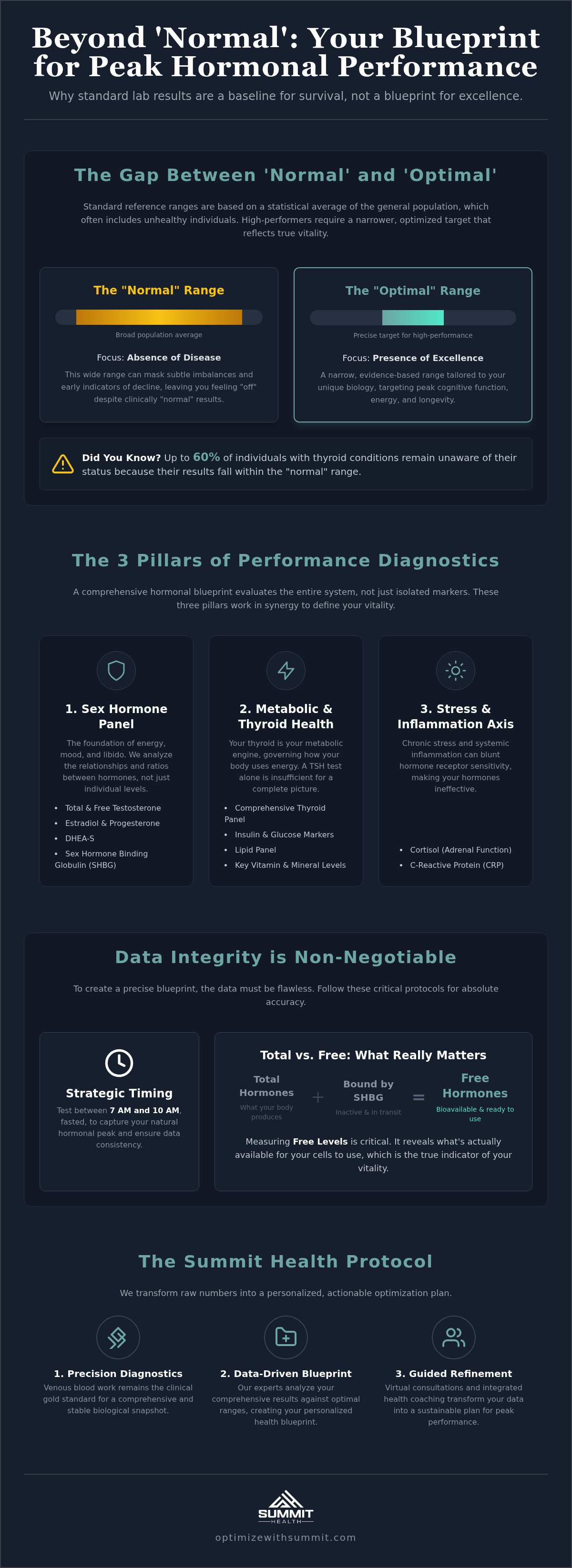
Your "normal" lab results are a baseline for survival, not a blueprint for peak performance. It's a common frustration. You feel a distinct loss of vitality, yet your clinical report says you're within the standard range. This gap exists because traditional medicine focuses on the absence of disease rather than the presence of excellence. To bridge it, you need specific lab tests for hormone imbalance that prioritize biological optimization over mere maintenance.
Data is the map. Optimization is the destination. With research showing that up to 60% of individuals with thyroid conditions remain unaware of their status, the standard medical approach is clearly insufficient. You deserve a sophisticated diagnostic blueprint. This guide identifies the specific biomarkers required to move beyond "normal" ranges and achieve peak hormonal performance in 2026. We'll outline the essential panels, explain the critical difference between clinical and optimal levels, and provide a streamlined path to reclaiming your edge.
Key Takeaways
- Biological snapshots. Understand why standard clinical reports often overlook subtle shifts and why your diagnostics should serve as a blueprint for your future self.
- Pillar diagnostics. Discover why specific lab tests for hormone imbalance must measure free levels to accurately reflect your current vitality.
- Optimal performance. Learn to distinguish between the "clinical normal" and the precise ranges required for high-performance living.
- Strategic timing. Master the strict 7 AM to 10 AM window and fasting protocols necessary for absolute data integrity.
- Data-driven refinement. See how virtual consultations and integrated health coaching transform raw numbers into a personalized optimization plan.
Decoding Lab Tests for Hormone Imbalance: The Diagnostic Blueprint
Precision diagnostics. Your endocrine system is a dynamic, high-speed communication network. In this context, hormone lab tests serve as biological snapshots, capturing a specific moment in your metabolic and reproductive timeline. While many providers offer basic screenings, these often fail to detect the nuances of high-performance health. In 2026, venous blood work remains the clinical gold standard for precision. It provides the most stable and comprehensive data for creating a bespoke Optimization Blueprint. This approach moves beyond identifying disease. It focuses on refining your current state. A standard screening might tell you that you aren't sick, but it won't tell you how to feel your best. By utilizing sophisticated lab tests for hormone imbalance, we can identify the subtle deviations that stand between you and peak performance.
Why Symptoms Outpace Standard Lab Results
Feeling "off" while being told your labs are "normal" is a common paradox. Standard reference ranges are based on a statistical bell curve of the general population, where up to 60% of individuals with thyroid disease are actually unaware of their condition. If you're seeking excellence, "normal" is a low bar. High-performers require a more narrow, optimized target that reflects vitality rather than just the absence of illness. Bio-individuality is the unique biological signature where your endocrine receptors and signaling pathways function at their specific peak efficiency regardless of broad population averages.
When you rely on generic lab tests for hormone imbalance, you risk missing the subtle shifts that precede clinical symptoms. Your body may be struggling to maintain balance long before a standard test flags a problem. We look for these early indicators to intervene before your quality of life declines. This forward-thinking methodology ensures that your health strategy is proactive rather than reactive.
The Systemic Nature of Hormonal Synergy
Hormones don't function in isolation. They operate as a synchronized network where the thyroid, adrenal glands, and sex organs constantly communicate. An imbalance in one area often triggers a compensatory response in another. For example, Thyroid function tests are vital for assessing metabolic speed, but their results must be interpreted alongside cortisol and sex hormone levels to be truly meaningful.
Evaluating the whole system is essential for sustainable health. Testing isolated markers provides a fragmented view that leads to incomplete solutions. This integrated perspective is the foundation of effective Hormone Therapy, ensuring every biomarker is balanced in relation to the others. We treat the system, not just the symptom, to ensure long-term stability and peak performance.
Essential Biomarkers for Performance and Longevity
Precision requires depth. We categorize optimization into three distinct pillars: Sex Hormones, Metabolic Markers, and the Stress Axis. To achieve a high-resolution view of your biology, you must look beyond basic numbers. Measuring both Total and Free hormone levels is non-negotiable. Total levels show what your body produces, but Free levels reveal what is actually bioavailable for your cells to use. Additionally, C-Reactive Protein (CRP) serves as a critical marker for systemic inflammation. High inflammation can blunt hormone receptor sensitivity, rendering even "optimal" levels ineffective. Sex Hormone Binding Globulin (SHBG) acts as the primary transport vehicle; if SHBG is too high, it traps your active hormones, hindering the delivery of these vital biological signals to your tissues. Integrating these specific lab tests for hormone imbalance provides the clarity needed for long-term vitality.
The Sex Hormone Panel: Beyond Testosterone
A comprehensive evaluation includes Total and Free Testosterone, Estradiol, Progesterone, and DHEA-S. Numbers alone are secondary to the relationship between them. For instance, the aromatization process converts testosterone into estrogen. If this ratio is skewed, you may experience symptoms of imbalance despite having high total testosterone. For those navigating specific life stages, such as the transition into midlife, reviewing a female hormone test list provides the necessary granularity for gender-specific optimization. Balance is the ultimate goal.
Metabolic and Thyroid Health Markers
The thyroid is your metabolic engine. Relying solely on a TSH test is a common clinical oversight that misses peripheral conversion issues. A truly precise assessment requires Free T3, Free T4, and Reverse T3 to identify where the metabolic signal is failing. Metabolic health and hormonal output are inextricably linked. Fasting Insulin and HbA1c identify early insulin resistance, which silently sabotages your endocrine output. High circulating insulin levels directly inhibit the production of testosterone in the Leydig cells while simultaneously increasing the conversion of testosterone to estrogen in fat tissue. Utilizing comprehensive lab tests for hormone imbalance allows you to see these hidden drivers before they manifest as chronic fatigue or weight gain. If you are ready to move from guesswork to data-driven health, you can schedule a consultation to review your biomarkers.
The Gap Between 'Normal' and 'Optimal' Lab Results
The reference range is a statistical trap. Most standard laboratory reports utilize a broad bell curve based on the general population. Because the general population is increasingly sedentary and metabolically compromised, being "normal" simply means you're as healthy as the average person. This is a low bar for anyone seeking a premium version of their life. When you receive lab tests for hormone imbalance, the results are compared against 95% of the people who walked into that lab before you. If the majority of those people are unwell, the range itself becomes a reflection of collective decline rather than individual excellence.
We define "Optimal" as the specific biological window where symptoms resolve and performance peaks. There's a profound psychological weight to being told your results are fine when you feel depleted. It creates a sense of frustration and stalls your progress. At Summit Health, we utilize "Precision Ranges" to move beyond basic screening. We focus on the refinement of your current state, identifying the exact biomarkers required to move you from baseline to peak performance. Data is the foundation, but your subjective experience is the guide.
Normal vs. Optimal: A Clinical Comparison
Context matters. A total testosterone level of 300 ng/dL is frequently flagged as "normal" by standard labs, yet it's clinically low for many high-performing adults. Living in the bottom 10% of a reference range is not a strategy for longevity. Similarly, Estrogen levels testing might place a patient within a broad clinical range that fails to account for her specific cycle-based optimization needs. We prioritize the upper quartiles of these ranges to ensure your hormones are working for you, not against you. You can learn more about how these precision targets influence our customized treatment plans by visiting our Pricing and FAQs.
The Role of Clinical Interpretation
A lab report is raw data. A consultation is the strategy. Numbers on a page cannot capture the nuance of your daily energy levels, sleep quality, or cognitive clarity. Effective optimization requires matching objective lab tests for hormone imbalance with your specific, patient-reported symptoms. We don't treat the paper; we treat the person. If you're unsure where your symptoms fall on the spectrum of imbalance, we recommend taking our Hormone Quiz to see if your biological data aligns with your current reality. This is the first step toward a data-driven refinement of your health.
Strategic Testing: Timing, Preparation, and Frequency
Data integrity is the foundation of any optimization strategy. To ensure your lab tests for hormone imbalance yield actionable insights, you must adhere to strict clinical protocols. Hormones are not static. They are pulsatile and follow a strict circadian rhythm. This means the time of day you step into the lab is just as important as the biomarkers being measured. Precision requires consistency. By standardizing the environment of your blood draw, we eliminate variables that could lead to a misinterpretation of your biological state.
Preparation begins 48 to 72 hours before the collection. Specific supplements, particularly Biotin (Vitamin B7), can significantly interfere with the immunoassay technology used in modern laboratories. Biotin can cause falsely high or low results in thyroid and sex hormone panels, potentially leading to an incorrect diagnosis. We recommend pausing high-dose B-complex vitamins for three days prior to testing. Additionally, a 10 to 12-hour fast is required to ensure metabolic markers, such as fasting insulin and lipids, are not skewed by recent caloric intake. Water is encouraged, but caffeine and nicotine should be avoided until after the draw to prevent transient spikes in cortisol levels.
Circadian Rhythms and Diagnostic Accuracy
The "Morning Draw" rule is non-negotiable for precision diagnostics. Testosterone and Cortisol peak between 7 AM and 10 AM. Testing later in the day often results in a false "low" reading that doesn't reflect your true physiological capacity. To prepare, maintain a consistent sleep schedule the night before and avoid high-intensity exercise, which can temporarily alter inflammatory markers. For a comprehensive breakdown of the ideal testing window, refer to The Best Time to Test for Hormone Imbalance. This ensures your baseline is a true reflection of your peak state.
Tracking Progress Over Time
A single blood draw is a snapshot; serial testing is a movie. One set of data tells us where you are, but subsequent tests tell us where you are going. Our protocol establishes a clear frequency for long-term health refinement. We begin with a comprehensive baseline, followed by a 90-day refinement draw to assess your response to Hormone Therapy or Peptide therapy. Once we achieve your optimal range, annual maintenance labs ensure you remain in that peak window. This iterative process allows us to fine-tune dosages with surgical precision. If you're ready to establish your baseline, schedule your diagnostic labs today.
The Summit Health Protocol: Data-Driven Refinement
Data meets strategy. The completion of your lab tests for hormone imbalance marks the beginning of a sophisticated refinement process. Our protocol bridges the gap between raw biological data and high-performance living. This transition is seamless. Once your results are processed, you move directly into a virtual medical consultation where your diagnostic blueprint is translated into a personalized action plan. This national telehealth model eliminates the friction of traditional healthcare, providing elite medical oversight regardless of your location. No waiting rooms. No sterile environments. Just clinical expertise delivered with the sleekness of modern technology.
Integrated health coaching. Optimization isn't a single event. It's a continuous upward movement. While medical interventions like Hormone Therapy or peptide protocols provide the biological foundation, our health coaching ensures your daily habits align with your new physiological capacity. We address the synergy between your biomarkers and your performance, focusing on sleep, recovery, and metabolic efficiency. This dual approach ensures that your progress is both rapid and sustainable. We don't just fix what's broken; we refine what's already working to reach its absolute peak.
Personalized Treatment Architecture
Your biological data dictates the strategy. There are no generic protocols here. Based on your specific lab results, we architect a plan that may include Bioidentical Hormone Replacement, targeted peptide therapy, or precise lifestyle refinements. This isn't about reaching a baseline. It's about maintaining a peak state through continuous virtual monitoring and data-driven adjustments. To learn more about our commitment to clinical excellence, you can explore the details About Summit Health and our specialized team of experts.
Your Path to Peak Performance
The journey is methodical. Test. Consult. Optimize. Refine. This iterative loop ensures you never settle for a "normal" that feels like decline. By utilizing advanced lab tests for hormone imbalance, you gain the clarity needed to move beyond the frustration of standard care. You aren't just treating a condition; you're investing in a premium version of your life. It's time to stop surviving and start thriving. The path to your future self is paved with precision data and expert guidance. Optimize your biology with Summit Health and take the first step toward your peak performance.
Your Blueprint for Peak Performance
Data-driven clarity. You've discovered that standard reference ranges are often a reflection of a compromised population rather than a standard for excellence. By prioritizing sophisticated lab tests for hormone imbalance, you move beyond the limitations of "normal" and into the realm of elite biological function. Precision is the non-negotiable key to longevity. Your diagnostic blueprint serves as the foundation for a tailored optimization plan, architected specifically for your unique physiology and performance goals.
Summit Health provides telehealth-led precision diagnostics combined with expert clinical monitoring to ensure your progress remains steady and measurable. We transform raw biological markers into a strategic roadmap for your future self. This is the shift from reactive medicine to proactive refinement. You deserve a health strategy that matches your ambition and respects your time. The path to a refined, high-performance life begins with the right data and a guide who understands the pursuit of the peak experience.
Book Your Comprehensive Diagnostic Consultation
Reclaim your edge. Your journey toward a more vital, optimized version of yourself starts today.
Frequently Asked Questions
What are the most important lab tests for hormone imbalance in men and women?
The core diagnostic panel must evaluate sex hormones, metabolic markers, and the stress axis. For men, this includes Total and Free Testosterone, PSA, and SHBG. Women require Estradiol, Progesterone, FSH, and LH. Both genders benefit from a full thyroid panel and fasting insulin to identify underlying metabolic resistance. These markers provide the high-resolution data needed to move beyond basic screening and into true biological refinement.
Can I get hormone blood work done without a doctor's referral?
You can access high-level diagnostics directly through specialized optimization platforms. Traditional healthcare often requires a symptomatic diagnosis before ordering comprehensive panels. We streamline this by providing the necessary medical orders as part of our health optimization protocol. This ensures you get the data you need without the delays of a traditional primary care system. It's a modern, efficient approach to proactive health management.
How long does it take to get results back from a hormone panel test?
Most comprehensive results are available within three to five business days following your blood draw. Some advanced biomarkers or specialized assays may require additional processing time for accuracy. Once the data is finalized, it is immediately integrated into your digital profile for clinical review. This rapid turnaround allows for a swift transition from diagnostic data to your personalized optimization strategy. Efficiency is a priority in our protocol.
Is fasting required for all hormone lab tests?
Fasting is essential for absolute diagnostic precision. While some sex hormones don't fluctuate with food intake, metabolic markers like fasting insulin and your lipid profile are highly sensitive to recent meals. We require a 10 to 12 hour fast to ensure your lab tests for hormone imbalance provide a clean, unskewed baseline for your treatment architecture. This protocol ensures your data is actionable and accurate for long-term monitoring.
Why are my hormone levels 'normal' if I still feel tired and have low libido?
Standard reference ranges are based on broad population averages that include individuals with sub-optimal health. Your "normal" result might fall in the bottom 10% of the range, which is often insufficient for peak performance. We focus on optimal ranges where symptoms resolve and vitality returns. Clinical interpretation must prioritize your subjective experience over generic statistical bell curves to ensure you feel like yourself again. Performance is the ultimate goal.
How much do comprehensive hormone lab tests typically cost in 2026?
Market rates for advanced endocrine panels vary based on the depth of the biomarkers measured. Basic panels from national laboratories provide an entry-level view of primary hormones. Comprehensive diagnostic snapshots covering sex hormones, thyroid, and metabolic health require more sophisticated assays and detailed processing. These costs reflect the precision technology and standardized testing protocols necessary for high-sensitivity results that drive an effective, data-driven health strategy.
What happens if my lab tests show a hormone imbalance?
Identification of an imbalance triggers a shift from diagnostics to optimization. Your clinical team will architect a personalized treatment plan that may include Bioidentical Hormone Replacement, peptide therapy, or targeted lifestyle refinements. We monitor your progress through follow-up lab tests for hormone imbalance to ensure your biomarkers reach and maintain their peak states safely and effectively. This iterative process ensures your health journey is always moving upward.
Can hormone testing help with weight loss resistance?
Hormonal data is critical for overcoming weight loss plateaus. Resistance often stems from underlying issues like insulin insensitivity, thyroid dysfunction, or elevated cortisol levels that signal the body to store fat. By identifying these biological roadblocks, we can implement evidence-based solutions that restore metabolic flexibility. Optimization makes your body a more efficient machine for fat oxidation and energy production. It's about working with your biology to achieve measurable results.

Article by
Dr. David Richardson
David Richardson, is the founder and CEO of Summit Health and the author of "Insights from the Summit", where he writes about hormone optimization, metabolic health, thyroid function, longevity, and preventive medicine.
After entering healthcare in 2009, David became increasingly interested in a question that traditional medicine often struggles to answer:
Why do so many people continue to feel terrible despite being told their labs are "normal"?
That question eventually led him into the field of health optimization in 2020, where he became passionate about understanding physiology at a deeper level and helping patients uncover the root causes of their symptoms rather than simply managing them.
Today, David's philosophy is simple: normal and optimal are not the same thing. Every patient is physiologically unique, and meaningful healthcare begins by listening to symptoms, understanding the science, and recognizing that laboratory values are only one piece of a much larger picture.
Through Summit Health and Insights from the Summit, David's mission is to help people better understand their bodies, ask better questions, and make informed decisions that improve both their health span and quality of life.


