
IMPORTANT DISCLAIMERS
Medical Disclaimer: The information in this article is provided for educational purposes only and is not intended as medical advice or a substitute for individualized medical care. Every person's health needs are unique. Always consult a qualified healthcare professional before starting, stopping, or changing any medication, supplement, or treatment plan. -------
Article Disclaimer: Articles are reviewed and published by Summit Health to provide evidence-based educational information. While Summit Health strives to provide reliable and current health information, medical knowledge is always evolving over time. Depending on when you are reading this content, it may not reflect the latest research or apply to your individual circumstances.
Nearly 45 percent of adults over age 60 now face the clinical reality of sarcopenia. For many, this begins as an unexplained loss of muscle tone or a frustratingly slow recovery after a simple workout. You might feel like you're fighting a losing battle against your own biology. It's a common experience, but it's not an inevitable one. Learning how to reverse muscle loss with age requires moving beyond basic fitness advice into the realm of precision medicine.
Peak performance. Lasting independence. Biological resilience. You deserve a body that supports your ambitions rather than limiting them. This 2026 guide delivers a science-backed protocol designed to recalibrate your internal environment. We'll bridge the gap between clinical data and daily action to help you restore physical strength and metabolic health. By the end of this article, you'll understand the essential pillars of hormonal optimization, targeted protein synthesis, and the updated 2026 resistance training standards. Your path to reclaiming vitality starts with a commitment to data-driven optimization.
Key Takeaways
- Identify the biological tipping point of sarcopenia and understand why muscle breakdown begins to outpace repair as early as your late 30s.
- Discover the role of testosterone, DHEA, and growth hormone as the primary architects of muscle protein synthesis and long-term skeletal density.
- Establish your specific protein threshold and leverage leucine as a chemical trigger to effectively overcome age-related anabolic resistance.
- Apply the principles of progressive overload and strategic resistance training to learn exactly how to reverse muscle loss with age.
- Utilize comprehensive diagnostic lab work to move beyond generic fitness advice and build a medical-grade protocol tailored to your unique physiology.
What is Sarcopenia? Understanding Age-Related Muscle Loss
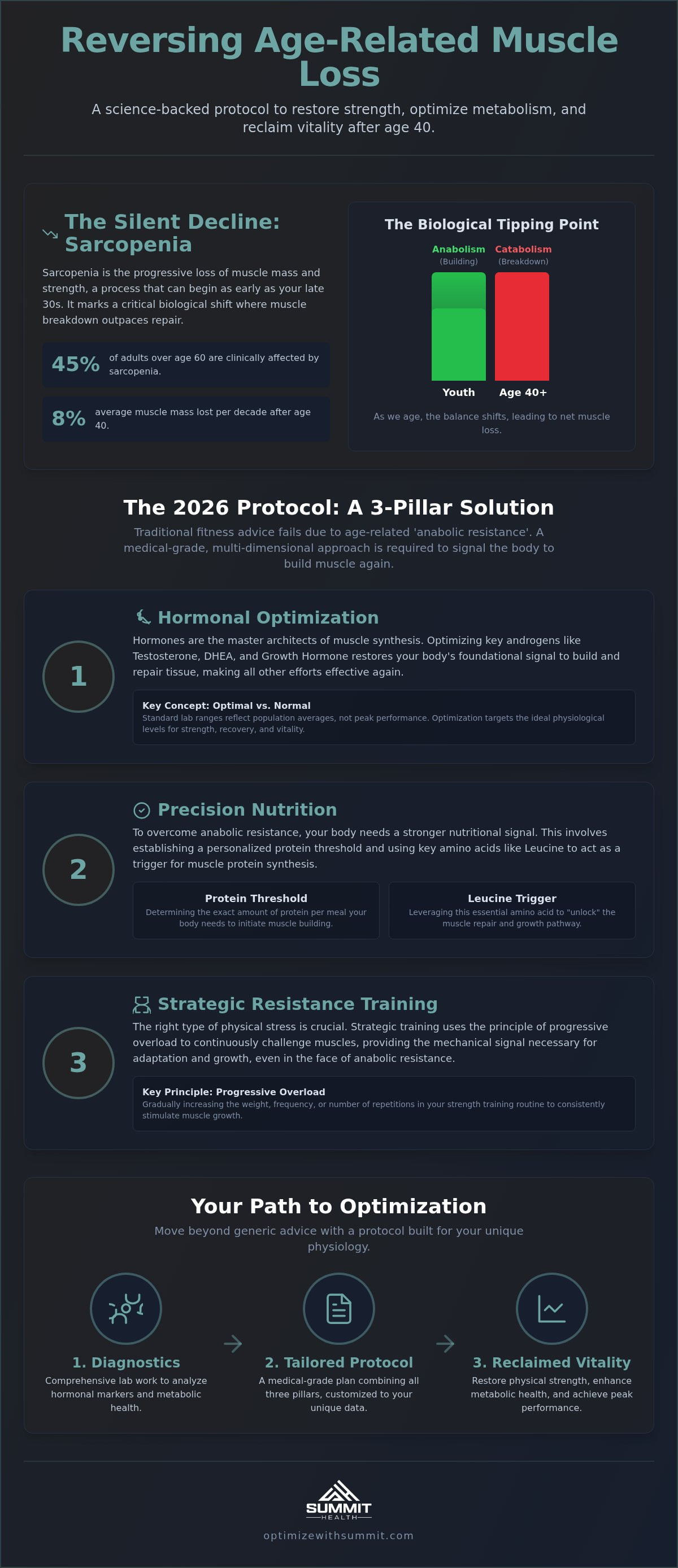
Biological decline isn't a choice. It's a process. Sarcopenia represents the progressive loss of skeletal muscle mass and functional strength. While many believe this is a concern reserved for the elderly, the decline often begins in your late 30s. It marks a fundamental shift in your internal economy. When you're young, your body exists in a state of anabolic dominance. It builds more than it breaks down. As you age, this balance shifts. You reach a biological tipping point where catabolism, or muscle breakdown, begins to outpace muscle building.
The data is clear. After age 40, most adults lose approximately 8% of their muscle mass every decade. This isn't just about aesthetics; it's about the erosion of your metabolic engine. Understanding What is Sarcopenia? is the first step in reclaiming your physical baseline. While some loss is part of chronological aging, accelerated atrophy is often driven by specific hormonal imbalances and lifestyle factors. If you want to learn how to reverse muscle loss with age, you must first recognize that your body's "maintenance mode" has changed.
The Early Warning Signs of Muscle Decline
Muscle loss doesn't happen overnight. It's a quiet erosion. You might notice a slight reduction in your walking speed or a subtle struggle with balance. Fatigue becomes more persistent. Many high performers experience the "softening" effect, known clinically as sarcopenic obesity. Your weight stays the same, but your body composition shifts. Muscle is replaced by fat. This transition triggers a significant metabolic slowdown in your 40s and 50s, making weight management increasingly difficult despite no changes in your diet.
Why Traditional Advice Often Fails After 50
The rules have changed. In your 20s, a 30-minute walk or a casual jog was enough to maintain tone. After 50, your body develops anabolic resistance. This is a decreased sensitivity to protein intake and mechanical stress. Your muscles simply stop responding to low-intensity signals. A multi-dimensional approach is required. You cannot rely on movement alone. To truly understand how to reverse muscle loss with age, you must address the triad of hormones, precision nutrition, and strategic resistance. This is where hormone therapy and medical-grade protocols become essential for those seeking a premium, optimized life.
The Hormonal Catalyst: Reversing the Anabolic Decline
Hormones are the master architects of your physique. They govern the blueprint of your biological economy. While nutrition provides the raw materials, hormones like testosterone, growth hormone (GH), and DHEA dictate where those materials are allocated. In a youthful state, these androgens are abundant. They signal the body to prioritize muscle protein synthesis over fat storage. As these levels decline in both men and women, that signal weakens. Muscle density begins to fade. Understanding Resistance Training for Reversing Muscle Loss is vital, but even the most disciplined workout cannot overcome a broken hormonal environment.
Hormone optimization serves as the foundation for your progress. It makes your effort count again. Beyond muscle building, hormones regulate insulin sensitivity, which is the key to effective nutrient partitioning. When your body is sensitive to insulin, it shuttles calories into muscle cells for repair rather than storing them in adipose tissue. Without this balance, your diet feels like a constant uphill battle. Reclaiming your hormonal baseline is the first step in learning how to reverse muscle loss with age effectively.
Testosterone and the Muscle Synthesis Signal
Testosterone is the primary driver of repair. It stimulates satellite cells, the specialized stem cells responsible for repairing damaged muscle fibers after a workout. When levels are low, this repair process stalls. Many high performers find that testosterone replacement therapy provides the necessary signal to preserve lean mass and maintain strength. It's not just about being in the "normal" range. Clinical ranges are often based on broad population averages, not on the peak performance required for longevity. For those seeking to master how to reverse muscle loss with age, "optimal" is the only standard that matters.
Growth Hormone and Peptide Therapy for Recovery
Recovery is the bottleneck of physical progress. Growth hormone plays a critical role here, specifically in collagen synthesis and the health of your connective tissues. As production slows, joints become stiffer and recovery times lengthen. Peptide therapy offers a sophisticated way to support your natural production levels. By enhancing recovery speed, you can maintain a consistent, high-intensity training schedule. Consistency is the only way to signal the body to grow. If you're ready to see where your levels stand, you can take our hormone quiz to begin your optimization journey.
Precision Nutrition: Overcoming Anabolic Resistance
Nutrition is the raw material for cellular architecture. For the aging high-performer, standard dietary advice is often inadequate. This is due to a phenomenon called anabolic resistance. Your muscles become less sensitive to the signals that trigger growth. To learn Overcoming Anabolic Resistance, you must shift from general healthy eating to precision nutrition. This is a critical component of how to reverse muscle loss with age. It requires reaching a specific 'Protein Threshold' in every meal to initiate muscle protein synthesis.
Leucine is the essential amino acid that acts as a chemical master switch. Younger bodies can trigger growth with minimal amounts. Older adults, however, require approximately 2.5 to 3 grams of leucine per sitting to activate the mTOR pathway. Without hitting this threshold, the protein you consume is often oxidized for energy rather than used for structural repair. Precision is the difference between maintenance and growth.
The High-Protein Protocol for Longevity
Precision matters. Target 1.2 to 1.6 grams of protein per kilogram of body weight daily. This is significantly higher than the standard RDA. Distribution is equally vital. Use protein pacing to spread your intake across 3-4 high-quality meals. This ensures a steady supply of amino acids throughout the day. High-quality whey isolate or essential amino acids (EAAs) can bridge the gap when whole foods aren't sufficient. This consistent signaling is a fundamental pillar of how to reverse muscle loss with age.
Micronutrients that Support Muscle Function
Muscle function relies on more than just macronutrients. Magnesium glycinate sleep support is a cornerstone of this protocol. It facilitates the nocturnal repair of muscle tissue by regulating muscle contraction and relaxation. Vitamin D is another non-negotiable. It maintains fast-twitch muscle fibers, which are the first to atrophy as we age. Finally, omega-3 fatty acids reduce 'smoldering' inflammation. This systemic inflammation can otherwise degrade muscle tissue faster than you can build it. Mastering these variables is essential for those committed to a long-term health journey.
Resistance Training: Signaling the Body to Grow
Mechanical stress is the non-negotiable signal. While hormonal optimization and precision nutrition provide the environment, resistance training is the catalyst that forces the body to adapt. It's the only intervention that directly addresses the root of atrophy. To master how to reverse muscle loss with age, you must move beyond cardiovascular health. Aerobic exercise supports the heart, but only load-bearing movements preserve the skeletal muscle mass required for longevity.
Progressive overload is the core principle. It requires a systematic increase in the stress placed on the body during exercise. You must continuously challenge your muscles to adapt to greater loads. Focus on compound movements. Exercises like squats, overhead presses, and rows recruit multiple muscle groups simultaneously. This triggers a systemic growth response that isolated exercises simply cannot match. This mechanical tension is the physical requirement for learning how to reverse muscle loss with age.
How to Build a Muscle-First Workout Plan
Effective training doesn't require daily gym sessions. Aim for 2 to 3 full-body resistance sessions per week. This frequency provides an optimal stimulus while allowing for the recovery your biology now demands. Pay close attention to the eccentric phase. Slowing the lowering portion of a lift maximizes muscle fiber micro-trauma, which is the precursor to growth. Additionally, extend your rest intervals. Studies suggest that 2 to 3 minutes between sets is superior for strength gains in older adults. It allows for full ATP recovery and higher quality output on subsequent sets.
The Role of Intensity: Training Close to Failure
Intensity is the variable that most people miss. Lifting light weights for high repetitions is often insufficient for reversing sarcopenia. You must train close to the point of technical failure. Use the Rate of Perceived Exertion (RPE) scale to guide your efforts. Aim for an 8 or 9 on a 10-point scale. This ensures you're recruiting the high-threshold motor units that are the first to decline with age. If joint health is a concern, prioritize machines and controlled movements. These tools allow you to maintain high intensity with minimal risk of injury. If you're ready to integrate these principles into a medical-grade protocol, you can book a consultation with our performance team to refine your strategy.
Designing Your Optimization Protocol with Summit Health
Generic protocols produce generic results. For the high-performer, "average" is a failure. Reclaiming your vitality requires a bespoke strategy that aligns your unique biology with medical-grade interventions. This is the definitive path for those asking how to reverse muscle loss with age. At Summit Health, we move beyond the superficial. We treat your body as a high-performance system that requires precision tuning. Precision is the only way to overcome the biological resistance of aging.
Data drives progress. The foundation of any successful protocol is hormone blood work. Without objective data, you are simply guessing. We identify the specific biological barriers that prevent you from maintaining lean mass. This data-driven approach removes the friction from your health journey. It allows us to build a protocol that works with your body, not against it.
The Diagnostic First Step: Comprehensive Lab Work
Objective metrics are non-negotiable. We analyze critical biomarkers that dictate your anabolic potential. These include Total and Free Testosterone, IGF-1, DHEA-S, and Vitamin D levels. These markers reveal why your recovery has slowed or why your muscle tone has shifted. Through Summit Health's virtual consultations, we translate this complex data into a personalized roadmap. Our goal is to keep your levels in the "Goldilocks" zone. This is the precise range where muscle protein synthesis is maximized and recovery is effortless. Ongoing monitoring ensures your protocol remains effective as your physiology improves.
Integrating Medicine, Nutrition, and Coaching
Precision medicine is the catalyst. However, it requires a supportive environment to thrive. The synergy of hormone therapy combined with expert health coaching creates a powerful feedback loop. Our telehealth-led approach provides the professional accountability needed to sustain a muscle-reversing lifestyle. We don't just provide a prescription; we provide a partnership.
A custom protocol addresses the lifestyle variables that often sabotage growth. We optimize your sleep architecture, manage systemic stress, and refine your recovery windows. This holistic view ensures that every calorie and every repetition counts toward your goal. This is the most efficient way to master how to reverse muscle loss with age. You don't have to navigate this transition alone. Book your consultation today to begin your journey toward a peak version of yourself.
Reclaim Your Peak Baseline
Sarcopenia is not an inevitable decline. It's a biological environment that can be re-engineered. True physical reclamation requires the precise alignment of hormonal signaling, amino acid thresholds, and progressive mechanical tension. By leveraging evidence-based hormone optimization and bespoke longevity protocols, you can effectively stop the decadal erosion of your lean mass and metabolic health. Your body responds to data, not guesswork.
Understanding how to reverse muscle loss with age is the foundation of a high-performance lifestyle that lasts well into your later decades. National telehealth access now provides the diagnostic precision needed to customize your journey toward peak performance. You don't have to accept a slower recovery or a softening physique as the standard. You can choose a path of upward movement and refined strength.
Optimize Your Biology: Schedule Your Performance Consultation
You have the tools to redefine your biological trajectory. The path to lasting vitality and physical excellence is yours to take. We're ready to help you build the strongest version of your future.
Frequently Asked Questions
Is it really possible to reverse muscle loss after age 60?
Muscle tissue remains highly adaptable regardless of your chronological age. Clinical studies consistently demonstrate that individuals in their 60s, 70s, and 80s can achieve significant hypertrophy through structured resistance training. While the rate of growth differs from a younger demographic, the biological mechanism for repair is functional. Success depends on providing a sufficient mechanical stimulus and ensuring your hormonal environment supports protein synthesis.
How much protein do I actually need to stop muscle wasting?
Active aging adults should target a daily intake of 1.2 to 1.6 grams of protein per kilogram of body weight. This is substantially higher than the standard RDA. Reaching this threshold is necessary to overcome anabolic resistance and signal the body to maintain lean mass. It's equally important to consume at least 30 to 40 grams per meal to hit the leucine trigger required for muscle protein synthesis.
Can hormone replacement therapy help me build muscle if I don't exercise?
Hormone therapy optimizes the internal environment for growth, but it's not a substitute for mechanical stress. While optimal testosterone levels help preserve existing lean mass and improve metabolic health, building new muscle requires the stimulus of resistance training. Think of hormones as the blueprint and raw materials; exercise is the construction process. Without the signal to adapt, the body has no reason to build new tissue.
What is the best type of exercise for reversing sarcopenia?
Progressive resistance training is the gold standard for reversing age-related atrophy. Compound movements such as squats, deadlifts, and overhead presses are most effective because they recruit large motor units and trigger a systemic anabolic response. While walking and swimming support cardiovascular health, they don't provide the necessary load to stimulate significant muscle growth. Consistency and high intensity are the primary drivers of success.
How long does it take to see results when trying to reverse muscle loss?
Neurological adaptations typically occur within the first 2 to 4 weeks, leading to immediate improvements in strength and coordination. However, visible muscle hypertrophy generally requires 8 to 12 weeks of consistent training and precision nutrition. Learning how to reverse muscle loss with age is a long-term commitment to biological optimization. Persistent effort yields cumulative results that improve metabolic health and physical function over several months.
Are there specific supplements that help prevent age-related muscle atrophy?
Creatine monohydrate is one of the most researched and effective supplements for supporting muscle mass and cognitive function in older adults. Vitamin D and Omega-3 fatty acids also play critical roles in maintaining fast-twitch fibers and reducing the systemic inflammation that degrades tissue. While supplements are beneficial, they should complement a foundation of high-quality protein and a medically supervised hormone optimization plan tailored to your specific needs.
How do I know if my muscle loss is 'normal' or a medical issue?
Normal aging involves a gradual decline, but medical sarcopenia is characterized by a loss of functional independence and strength. If you struggle with tasks like rising from a chair or notice a significant drop in walking speed, it's a clinical concern. Comprehensive lab work is the only way to distinguish between natural aging and a treatable hormonal deficiency. Identifying these biological barriers early allows for more effective, precision intervention.
Do women need different strategies than men for reversing muscle loss?
Women face unique challenges, particularly during and after menopause when estrogen levels plummet. Estrogen is a critical regulator of muscle mass and bone density in the female body. While the fundamentals of resistance training remain the same, women often require a more targeted focus on hormone replacement to maintain their anabolic potential. Learning how to reverse muscle loss with age for women involves balancing estrogen, progesterone, and testosterone to protect against atrophy.

Article by
Dr. David Richardson
David Richardson, is the founder and CEO of Summit Health and the author of "Insights from the Summit", where he writes about hormone optimization, metabolic health, thyroid function, longevity, and preventive medicine.
After entering healthcare in 2009, David became increasingly interested in a question that traditional medicine often struggles to answer:
Why do so many people continue to feel terrible despite being told their labs are "normal"?
That question eventually led him into the field of health optimization in 2020, where he became passionate about understanding physiology at a deeper level and helping patients uncover the root causes of their symptoms rather than simply managing them.
Today, David's philosophy is simple: normal and optimal are not the same thing. Every patient is physiologically unique, and meaningful healthcare begins by listening to symptoms, understanding the science, and recognizing that laboratory values are only one piece of a much larger picture.
Through Summit Health and Insights from the Summit, David's mission is to help people better understand their bodies, ask better questions, and make informed decisions that improve both their health span and quality of life.


