

IMPORTANT DISCLAIMERS
Medical Disclaimer: The information in this article is provided for educational purposes only and is not intended as medical advice or a substitute for individualized medical care. Every person's health needs are unique. Always consult a qualified healthcare professional before starting, stopping, or changing any medication, supplement, or treatment plan. -------
Article Disclaimer: Articles are reviewed and published by Summit Health to provide evidence-based educational information. While Summit Health strives to provide reliable and current health information, medical knowledge is always evolving over time. Depending on when you are reading this content, it may not reflect the latest research or apply to your individual circumstances.
Being dismissed doesn’t mean your symptoms aren’t real, and speaking up doesn’t have to become a confrontation. If you’re unsure what to do when your doctor dismisses your symptoms, start by turning your concerns into clear, specific information your care team can assess.
It’s understandable to leave an appointment doubting your own experience, especially if you’re unsure which details matter or how to ask again. Complex symptoms can be difficult to assess, and a rushed conversation may leave important questions unanswered. You deserve a respectful discussion and a clear plan for what happens next.
This guide covers how to prepare for an appointment, describe symptoms clearly, and keep useful records. You’ll also learn how to follow up on unanswered questions, request your medical records, and consider a second opinion. We’ll explain how to recognize when symptoms need urgent attention, too, so you can choose a next step that fits your situation.
Key Takeaways
- Separate an unclear explanation from a concern that wasn’t addressed, then identify what still needs an answer.
- Build a concise symptom timeline that captures patterns, triggers, changes, and effects on daily life.
- Use calm, direct questions to understand your clinician’s reasoning and clarify the plan.
- Learn what to do when your doctor dismisses your symptoms, including when to follow up, request records, or seek another opinion.
- Match your next step to the situation, and seek emergency care for urgent symptoms rather than relying on a routine appointment.
Doctor Dismissed Your Symptoms? Start With What Happened
Feeling unheard matters. It can leave you unsure whether your concern was understood, whether the explanation makes sense, or what to do next. That experience deserves attention, but it doesn’t by itself establish that a clinician acted negligently or reveal what’s causing your symptoms. Start by identifying what happened as clearly as you can.
There’s a useful difference between a disagreement, an unclear explanation, and an unanswered concern. You might understand the clinician’s assessment but disagree with it. You might have received an explanation that was too brief or technical to guide you. Or you may have raised a specific symptom or question that wasn’t addressed. Each situation calls for a different follow-up, and none requires you to assume the worst about the clinician’s intent.
The goal is clarity and safety: understand the assessment, identify what remains uncertain, and agree on appropriate next steps. This is consistent with shared decision-making, a collaborative approach in which patients and clinicians discuss options and make care decisions together.
Recognize what felt dismissive
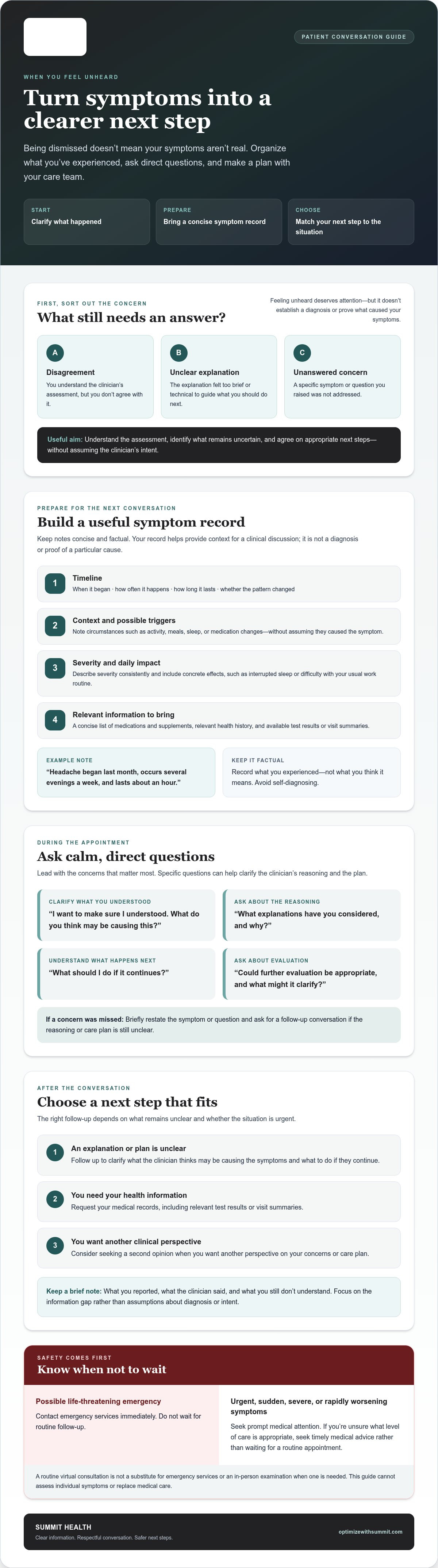
Make a brief, factual note while the conversation is still fresh. Record what you reported, what the clinician said, and what you still don’t understand. For example: “I described recurring dizziness. We discussed hydration, but I’m unclear about what changes should prompt follow-up.” This captures the impact and information gap without making assumptions about the diagnosis or the clinician’s motives.
If the reasoning or care plan wasn’t clear, ask for a follow-up conversation. You could say, “I want to make sure I understood. What do you think may be causing this, and what should I do if it continues?” A direct request for clarification can move the discussion toward a practical plan.
Check whether the situation is urgent
Don’t wait for routine follow-up if symptoms may be life-threatening. Contact emergency services immediately for a suspected emergency. If symptoms are urgent but you’re unsure what level of care is appropriate, seek timely medical advice rather than waiting for a routine appointment. Sudden, severe, or rapidly worsening symptoms warrant prompt attention.
This article can’t assess your individual symptoms or replace medical care. A routine virtual consultation isn’t a substitute for emergency services or an in-person examination when one is needed. Once immediate safety is addressed, you can return to the conversation and decide how to clarify the assessment or pursue the next step.
Prepare for the Next Appointment With a Clear Symptom Record
A concise record can help move the next conversation from a general concern to specific details the clinician can assess. If you’re deciding what to do when your doctor dismisses your symptoms, preparation can help you explain what has changed and pinpoint which questions still need answers. Your notes provide context for a clinical discussion, not a diagnosis or proof of a particular cause.
Use this sequence to prepare. The National Institute on Aging’s Prepare for a Doctor's Appointment guide also offers practical advice on organizing concerns and medical information.
- Build a timeline. Note when the symptom began, how often it occurs, how long it lasts, and whether its pattern has changed. Include possible triggers or circumstances, such as activity, meals, sleep, or medication changes, without assuming they caused the symptom.
- Describe its impact. Record severity consistently and explain what the symptom changes in daily life. For instance, note if discomfort interrupts sleep or fatigue makes your usual work routine difficult. Concrete examples are more useful than labels like “bad” or “constant.”
- Write down your questions. Choose the most important concerns to raise first. Ask what explanations the clinician considered and why, whether further evaluation may be appropriate and what it could clarify, and what changes should prompt follow-up or more urgent care.
- Gather relevant records. Bring a concise list of medications and supplements, relevant health history, and available test results or visit summaries. If you’re unsure whether a record matters, include it or ask the clinic how to share it.
Build a useful symptom timeline
Keep entries brief and factual. Include the date or approximate period, frequency, duration, context, and any associated changes. For example: “Headache began last month, occurs several evenings a week, and lasts about an hour.” Note what you experienced, not what you think it means. Avoid self-diagnosing. The purpose is to make the pattern easier to discuss.
Choose questions that invite a plan
Open-ended, specific questions can clarify the clinician’s thinking without demanding a particular test or diagnosis. Try: “What possibilities are you considering?” or “What would further evaluation help us understand?” Before you leave, ask what to monitor, when to follow up, and which changes call for urgent or emergency care. Write down the agreed plan, including next steps and timing.
A focused record supports a more precise conversation, but it can’t replace clinical judgment. Use it to share your experience and work with a clinician on an appropriate plan.
What to Say When a Doctor Dismisses Your Symptoms
Clear self-advocacy doesn’t require confrontation or certainty about what’s causing a symptom. You can respect the clinician’s expertise while being direct about what you’re experiencing and what you still need to understand. If you’re considering what to do when your doctor dismisses your symptoms, focus the conversation on impact, reasoning, and a workable next step.
Use specific phrases to make concerns clearer
Describe what remains unresolved and how it affects you. For example: “I still have concerns because these symptoms are affecting my daily life. Can we talk about what might explain them?” If the clinician doesn’t recommend further evaluation, ask: “Can you explain what findings make further evaluation unnecessary right now?” This invites a clinical explanation rather than demanding a particular test or diagnosis.
Be specific about what would help you leave with more clarity. You might ask for a follow-up date, written precautions, or guidance about which changes should prompt another call. If time is limited, say, “I understand we may not resolve everything today. What’s the best next step, and when should we revisit this?” A respectful request is still an assertive one.
Ask for shared decisions and clear documentation
Before the visit ends, ask what alternative explanations remain possible and what new information would change the assessment. You can also request that your unresolved concern and the agreed plan be documented in your medical record. Keep the request factual: “Could you note that these symptoms are continuing and summarize what we’ve agreed I should do next?”
Then summarize the plan in your own words and invite corrections. For example: “I’ll follow the steps we discussed, contact your office if the symptom changes in these ways, and schedule a follow-up if it hasn’t improved. Is that right?” Confirm who is responsible for arranging any next steps and when you should expect them. This check can catch misunderstandings before you leave.
Seeking another clinician’s perspective can also be reasonable if important questions remain unresolved. The Patient Advocate Foundation’s Getting a Second Opinion resource offers guidance on approaching that process. You don’t need to prove that anyone acted improperly to ask for clarification or explore another opinion. The aim is a clear, safe plan that accounts for your concerns.
When to Follow Up, Seek a Second Opinion, or Request Your Records
The right next step depends on your symptoms, possible risks, what has already been evaluated, and the clinician’s advice. You might need a clearer explanation of the current plan, a scheduled follow-up to review changes, copies of your records, or another clinician’s perspective. These options can work together. Requesting records, for example, can help you prepare for a follow-up or share relevant history with a new clinician.
Start with the smallest step that addresses the uncertainty. If you understand the assessment but not what to expect, ask the current clinic to clarify the plan. If symptoms persist or change, ask when to follow up and what should prompt an earlier call. If you’re considering another opinion, ask the clinic how to obtain visit notes, test results, and other relevant records. The clinic can explain its process for submitting and fulfilling a request.
Decide whether a second opinion may help
Another clinician’s perspective may be useful if important concerns remain unexplained, communication has stalled, or you want help understanding your options. It’s an additional assessment, not a guarantee of a different diagnosis. Share relevant visit notes and test results, along with a concise symptom timeline, so the next clinician can consider what has already been discussed and evaluated.
Before arranging another appointment, you can ask what the first clinician’s assessment was based on and whether any questions remain open. If you still feel uncertain, seeking another perspective can be a reasonable way to clarify the situation, not an accusation against the first clinician.
Keep follow-up focused and documented
Close the loop on practical details. Ask when follow-up should happen, who is responsible for arranging any next steps, and how you’ll receive test results or instructions. Keep dates, test results, clinician guidance, and questions together in one personal record. If a result or promised follow-up hasn’t arrived, contact the clinic to ask about its status.
If your concern may relate to hormones and lab testing is part of the discussion, ask the clinician what a proposed test could clarify and how its results would inform the assessment. Educational material about hormone blood work can provide background, but it can’t interpret your individual symptoms or determine which tests are appropriate. The decision should be based on your clinical context.
A clear record supports continuity whether you return to the same clinician or consult someone new. Choose the next step that addresses the unanswered question, and follow the medical guidance you receive about timing or changes that need prompt attention.
Choose a Safe Next Step for Your Health
A steady plan can help you move forward without having to settle every question at once. Write down what remains unresolved, contact the clinician or clinic to clarify the assessment, and agree on what changes should prompt follow-up. Make that threshold specific: ask what symptoms or changes warrant a routine call, timely medical advice, or emergency care.
Match the care setting to the concern
Potentially life-threatening symptoms or immediate danger call for emergency services. Don’t wait for a routine appointment or virtual consultation. For ongoing symptoms that need evaluation, follow-up, or another opinion, contact an appropriate clinician and explain what has changed and what questions remain. The right setting depends on your symptoms and clinical advice.
Summit Health offers hormone optimization services, not emergency care or in-person physical exams. A hormone-focused virtual consultation may be an option only for relevant, non-emergency concerns within the practice’s clinical scope. It isn’t a substitute for emergency care or an in-person examination when one is needed.
Prepare for a focused virtual consultation
If your concern relates to hormone health and a virtual consultation seems appropriate, bring a concise symptom timeline, relevant records, and specific questions. Explain what you’ve experienced, how it affects daily life, what has already been evaluated, and what you hope to clarify. This context supports a focused discussion, but it doesn’t determine a diagnosis or treatment.
A clinician may consider comprehensive labwork when appropriate to your individual situation. Testing and treatment decisions require clinical evaluation; hormone therapy isn’t suitable for everyone, and symptoms alone don’t establish that hormones are the cause. Review Summit Health’s hormone therapy information to understand the service and consider whether a non-emergency discussion may fit your concern.
Keep your next step clear: document the concern, contact the right care provider, and confirm when and why to follow up. For concerns that may relate to hormone health, you can explore hormone therapy information before deciding whether to pursue a consultation. If symptoms become severe or potentially life-threatening, use emergency services instead.
Take the Next Step With Clarity
Feeling unheard can make it difficult to know what to do when your doctor dismisses your symptoms. Start with what you can clarify: document what’s happening, ask the clinician to explain the assessment, and agree on when to follow up or what changes should prompt more urgent care. If questions remain unresolved, requesting your records or seeking another opinion may help you decide how to proceed.
Choose care that matches your needs. Potentially life-threatening symptoms require emergency services, not a routine virtual appointment. For non-emergency concerns that may relate to hormones, Summit Health offers virtual consultations and ongoing monitoring. Comprehensive labwork may be considered when clinically relevant, based on an individualized evaluation. These services don’t replace emergency care or an in-person examination when one is needed.
If a hormone-focused discussion may fit your concern, explore appointment options. You don’t need to have every answer before speaking up. A clear record, direct questions, and a practical follow-up plan can help you move forward with greater confidence.
Frequently Asked Questions
What should I do if my doctor dismisses my symptoms?
Write down what you reported, the clinician’s response, and what remains unclear. Ask for the reasoning behind the assessment and agree on a next step, such as follow-up or monitoring specific changes. If you’re deciding what to do when your doctor dismisses your symptoms, focus on getting a clear plan rather than proving a particular diagnosis. Seek emergency services for potentially life-threatening symptoms instead of waiting for a routine appointment.
How do I tell my doctor I feel unheard?
Be calm and specific about both your concern and its impact. You might say, “I’m not sure I explained how much this is affecting my daily life. Can we revisit it?” Then ask what explanations the clinician considered and what changes should prompt follow-up. You don’t need to accuse the clinician or know the cause of your symptoms to request clarification. A direct, respectful question can help keep the conversation focused.
Can I ask my doctor to document that my symptoms were dismissed?
You can ask the clinician to document your symptoms, the concerns you raised, and the plan you discussed. A factual request may be more useful than asking for a particular label: “Could you note that these symptoms are continuing and summarize what we agreed I should do next?” You can also ask how to obtain the visit note afterward. Clear documentation can support continuity if you follow up or consult another clinician.
When should I get a second opinion about my symptoms?
Consider another clinician’s perspective if important questions remain unanswered, symptoms persist, or communication about the plan has stalled. A second opinion is an additional assessment, not a guarantee of a different diagnosis. Ask how to share relevant visit notes and test results so the next clinician can understand what’s already been evaluated. If symptoms are worsening or may be urgent, seek timely medical advice rather than waiting for a routine second-opinion appointment.
Should I request tests if my doctor says they are not needed?
You can ask why a test isn’t recommended and what findings support the current approach. Try: “What would this test help us determine, and what are the reasons to wait?” Testing decisions depend on your symptoms, history, examination when needed, and prior evaluation. Rather than insisting on a specific test, ask what alternatives are appropriate and what new information or changes would lead the clinician to reconsider.
What information should I bring to a follow-up appointment?
Bring a concise symptom timeline with onset, frequency, duration, triggers, changes, and effects on daily activities. Include a current medication and supplement list, relevant health history, prior test results, and visit notes if available. Write down your top questions and any changes since the last appointment. These details help the clinician understand the pattern and guide discussion, but your notes alone can’t establish a diagnosis.
What if my symptoms get worse while I wait for an appointment?
If symptoms become severe, rapidly worsen, or may be life-threatening, contact emergency services rather than waiting for a routine appointment or telehealth consultation. For a concerning change that isn’t an apparent emergency, contact a clinician promptly and explain what has changed, when it began, and how it affects you. If you’re unsure which level of care is appropriate, seek timely medical advice. This article can’t assess your individual symptoms.

Article by
Dr. David Richardson
David Richardson, is the founder and CEO of Summit Health and the author of "Insights from the Summit", where he writes about hormone optimization, metabolic health, thyroid function, longevity, and preventive medicine.
After entering healthcare in 2009, David became increasingly interested in a question that traditional medicine often struggles to answer:
Why do so many people continue to feel terrible despite being told their labs are "normal"?
That question eventually led him into the field of health optimization in 2020, where he became passionate about understanding physiology at a deeper level and helping patients uncover the root causes of their symptoms rather than simply managing them.
Today, David's philosophy is simple: normal and optimal are not the same thing. Every patient is physiologically unique, and meaningful healthcare begins by listening to symptoms, understanding the science, and recognizing that laboratory values are only one piece of a much larger picture.
Through Summit Health and Insights from the Summit, David's mission is to help people better understand their bodies, ask better questions, and make informed decisions that improve both their health span and quality of life.


