

IMPORTANT DISCLAIMERS
Medical Disclaimer: The information in this article is provided for educational purposes only and is not intended as medical advice or a substitute for individualized medical care. Every person's health needs are unique. Always consult a qualified healthcare professional before starting, stopping, or changing any medication, supplement, or treatment plan. -------
Article Disclaimer: Articles are reviewed and published by Summit Health to provide evidence-based educational information. While Summit Health strives to provide reliable and current health information, medical knowledge is always evolving over time. Depending on when you are reading this content, it may not reflect the latest research or apply to your individual circumstances.
What if restless nights are both a signal of changing hormones and a force that can influence them in return? The relationship between hormones and sleep works in both directions, which can make changes in sleep quality difficult to explain. Stress, life stage, daily habits, and health conditions may all play a part. A change in sleep does not automatically mean there is a hormone problem, or that treatment is the only answer.
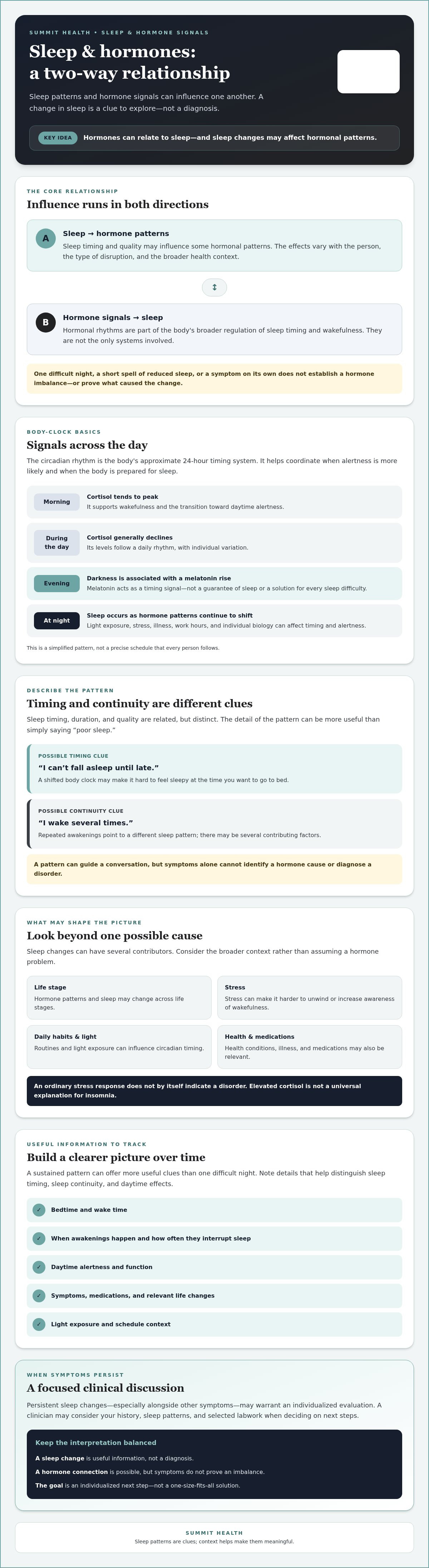
When sleep becomes less restorative, it is natural to want a clear explanation. Hormones such as melatonin and cortisol help coordinate the sleep-wake cycle, while sleep changes may affect other signals involved in appetite, blood sugar, and recovery. Looking at a pattern over time, rather than one difficult night, can offer more useful clues.
This article explains how sleep and hormone signaling influence each other, what may disrupt that balance, and which changes are worth tracking. You will also learn when persistent symptoms may warrant an individualized evaluation and what information can help guide a conversation with a clinician. The goal is a clearer next step, not a one-size-fits-all solution.
Key Takeaways
- Hormones and sleep influence each other, but a change in sleep alone cannot reveal its cause.
- Circadian timing, melatonin, and cortisol help coordinate sleep and wakefulness.
- Life-stage shifts and other hormone systems may relate to sleep patterns, but symptoms are not proof of a hormone imbalance.
- Track sleep times, awakenings, daytime function, symptoms, medications, and relevant life changes to support a focused clinical discussion.
- A clinician may consider your history, sleep patterns, and selected labwork when deciding on individualized next steps.
Hormones and sleep: how the relationship works in both directions
In brief: Hormones and sleep can influence each other, but symptoms alone cannot identify the cause of a sleep change. Hormones are chemical messengers that help coordinate processes throughout the body. Their levels and effects shift across the day and across life stages, so a change in sleep may have several contributing factors rather than one clear explanation.
The relationship works both ways:
Sleep-wake timing and quality can influence some hormonal patterns.
Hormone signals and rhythms can relate to sleep timing and other aspects of sleep.
What does the hormone-sleep connection mean?
Sleep depends on interacting biological systems, not a single “sleep hormone.” The circadian rhythm is the body’s approximate 24-hour timing system. It helps coordinate when we feel more alert and when sleep is more likely. Hormonal signals are one part of this broader regulation. For a foundational overview of sleep stages and functions, see this summary of the hormonal regulation of sleep.
Sleep timing, duration, and quality are related but distinct. Someone may spend enough time in bed yet wake frequently, or sleep soundly but follow a schedule that conflicts with daily demands. Describing the specific pattern can help: “I wake several times” offers a different clue from “I can’t fall asleep until late.”
Can poor sleep change hormone signaling?
Sleep disruption may affect some hormonal patterns, but effects vary with the person, the type of disruption, and the broader health context. A short spell of reduced sleep is not the same as a persistent sleep problem. One difficult night or a brief schedule change does not establish that a hormone has become imbalanced. An association between sleep and a hormone also does not prove that one caused the other for an individual.
Life stage, stress, medications, routines, and health conditions may also shape the picture. A sleep change is useful information, not a diagnosis. A sustained pattern, especially alongside other symptoms, may be worth discussing with a clinician.
Sleep and hormones form a two-way relationship, but a change in one does not automatically mean the other is out of balance.
How circadian rhythm, melatonin, and cortisol relate to sleep
Your body clock helps coordinate when you feel alert and when your body is prepared for sleep. Light is one of its key timing cues. Light exposure can influence circadian signals, while darkness is associated with the evening rise in melatonin. Melatonin acts as a timing signal, not a guarantee of sleep or a treatment for every sleep difficulty.
Melatonin and the body's timing system
A shifted body clock may make it hard to feel sleepy at the time you want to go to bed. That differs from falling asleep readily but waking repeatedly through the night. The first pattern may relate to sleep timing; the second can have other contributing factors. Noting when the difficulty occurs can help clarify what to discuss with a clinician. Magnesium glycinate is a separate sleep topic and should not be treated as a substitute for understanding circadian timing.
Typical daily pattern, with individual variation
Morning: cortisol tends to peak, supporting wakefulness. During the day: cortisol generally declines. Evening darkness: melatonin rises as a circadian timing signal. At night: sleep occurs while hormone patterns continue to shift.
This is a simplified guide, not a schedule every person follows precisely. Work hours, light exposure, stress, illness, and individual biology can affect timing and alertness.
Cortisol, stress, and nighttime alertness
Cortisol follows a daily rhythm, with levels typically higher around morning and lower later in the day. It supports normal body functions, including the transition toward daytime alertness. But the idea that elevated cortisol always causes insomnia is too simple. Stress can make it harder to unwind or increase awareness of wakefulness, yet an ordinary stress response does not by itself indicate a disorder.
Schedules, illness, and other influences can also affect sleep and alertness. A symptom pattern alone cannot diagnose a cortisol disorder. A scientific review of sleep and circadian disturbance discusses links between sleep timing and hormonal regulation, while underscoring the complexity of these systems.
Use timing as a clue, not a conclusion. A log of bedtime, wake time, light exposure, awakenings, and daytime alertness may help show whether the main issue is sleep timing, sleep continuity, or both. If a persistent pattern is affecting daily life, you can contact Summit Health to learn about discussing your concerns with the practice.
Which hormones may be relevant when sleep patterns change?
Several hormone systems may be part of the picture, but sleep symptoms alone cannot identify the cause. The pattern, life stage, health history, medications, and other symptoms all matter. The comparison below offers context, not a way to diagnose a hormone condition.
| Hormone or system | Possible context | Sleep pattern that may occur | Limits of interpretation |
|---|---|---|---|
| Estrogen and progesterone | Hormonal changes during perimenopause or menopause | Night sweats or hot flashes may interrupt rest; some people notice changes in sleep quality | Sleep changes do not prove a hormone deficiency, and people’s experiences vary. |
| Testosterone | May be considered as part of a broader assessment when relevant symptoms or history are present | Sleep concerns may occur alongside other changes | Poor sleep alone is not evidence of low testosterone. |
| Thyroid function | May be considered when the overall clinical picture supports it | Sleep and energy changes can accompany some thyroid-related conditions | It is one possible clinical consideration, not a universal explanation. |
| Other influences | Sleep apnea, medications, mood, pain, or schedule changes | Difficulty falling asleep, waking, or feeling rested | These factors may contribute without a hormone disorder. |
Life stages and changes in estrogen or progesterone
During perimenopause and menopause, changes in estrogen and progesterone may coincide with shifts in sleep. For some people, hot flashes or night sweats lead to awakenings; for others, sleep changes may have different or overlapping contributors. A broader view of the menopause transition can help put symptoms in context, but a life-stage change alone does not confirm the cause.
Testosterone, thyroid function, and other factors
Clinicians interpret hormone results alongside symptoms, health history, medications, and relevant assessment findings. A result in isolation may not explain how someone feels or sleeps. The same principle applies to testosterone and thyroid function: testing is most useful when selected in context, rather than assumed necessary for every sleep concern.
Sleep apnea, medication effects, mood, pain, and an irregular schedule can also disrupt rest. Research discussed by UChicago Medicine on how sleep deprivation impacts hormones adds context to the connection, but findings about groups do not establish an individual cause.
Sleep symptoms alone cannot identify which hormone, if any, is involved. Tracking when symptoms occur and what else changes can help a clinician assess the full pattern.
A practical way to assess sleep changes before assuming hormones are the cause
A clear pattern is more useful than a quick guess. A brief sleep diary can help you and a clinician see what changed, what may be influencing it, and whether further evaluation makes sense. Keep it simple. Continuous tracking that increases anxiety is not necessary.
- Track the pattern. For a short period, note approximate bed and wake times, nighttime awakenings, how rested you feel, and how sleep affects daytime function. Include when the change began and any symptoms that occur alongside it.
- Review potential influences. Record relevant context such as evening light exposure, caffeine timing, alcohol, stress, work schedules, bedroom conditions, medications, and life-stage changes. Look for associations, not proof of a cause.
- Discuss persistent changes. If disrupted sleep continues, affects daily life, or comes with other concerning symptoms, share the pattern with a healthcare professional. Loud snoring, gasping during sleep, or marked daytime sleepiness are also worth discussing because sleep disorders may contribute.
- Follow clinical guidance. A clinician can consider sleep patterns alongside symptoms, health history, medications, and relevant labwork. Hormone blood tests need that context: a result on its own may not explain sleep changes, and testing should be selected for the individual rather than assumed necessary for everyone.
What to track and bring to an appointment
Use brief notes rather than trying to record every detail. Note whether sleep changes with shifts in schedule, stress, symptoms, or medication use. This practical context can make a conversation more focused and help a clinician decide whether further assessment, including labwork, is appropriate.
When professional evaluation makes sense
Consider an individualized review if sleep disruption persists, interferes with daily function, or appears alongside other symptoms. Seek prompt professional assessment for severe or safety-affecting concerns. Urgent or emergency symptoms require appropriate immediate medical care, not guidance from an online article.
If persistent sleep changes leave you unsure about next steps, you can contact Summit Health to discuss your concerns. A measured assessment can put the relationship between hormones and sleep into personal context without assuming a hormone issue is the explanation.
Personalized next steps for hormones and sleep
A useful assessment starts with the whole pattern, not a single symptom or lab result. A clinician may review your sleep timing and awakenings alongside symptoms, health history, medications, life-stage changes, and relevant labwork. Testing is selected according to clinical context; a broad hormone panel is not automatically necessary for every sleep concern.
The aim is to understand what may be contributing and identify appropriate next steps, not to promise a diagnosis or a particular outcome. Hormone therapy may be considered in some situations, but it is not a universal sleep intervention. Any treatment decision should reflect your individual health picture and be guided by a qualified clinician.
What an individualized review can include
Summit Health offers virtual consultations, comprehensive diagnostic labwork, and ongoing monitoring and health coaching. Together, these can support individualized care planning and follow-up without assuming hormones are the source of disrupted sleep. If a clinician determines hormone therapy may be relevant, the potential approach can be discussed in context.
Prepare for a focused conversation
Bring your brief sleep diary, a timeline of symptoms, a current medication list, and questions about what has changed. You might ask which factors could be influencing your sleep, whether any testing is appropriate, and how results would inform next steps. The optional hormone quiz can help organize questions for a conversation, but it is not a diagnostic tool.
Personalized guidance can help clarify the next step without presuming hormone treatment is the answer. To discuss your situation with Summit Health, contact the practice.
Build a clearer path to better sleep
Hormones and sleep can influence each other, but a change in sleep does not point to one cause on its own. Circadian timing, life stage, stress, medications, and other health factors may all shape the pattern. Tracking what is changing and discussing persistent symptoms with a clinician can help replace guesswork with a more individualized view.
That assessment does not automatically mean hormone therapy is the answer. A clinician may consider your sleep history, symptoms, and health context together, using relevant labwork when appropriate. At Summit Health, comprehensive diagnostic labwork can inform individualized care planning, while virtual consultations, ongoing monitoring, health coaching, and sleep and recovery support can help guide next steps without promising a specific outcome.
If sleep changes are affecting your daily life, consider discussing them with a professional. Schedule a personalized consultation to explore your concerns and possible next steps. A measured, informed approach can help you move toward better-rested days with greater clarity.
Frequently Asked Questions
Can hormone imbalance cause insomnia?
Hormonal changes can contribute to sleep disruption, but insomnia has many possible causes. Shifts during perimenopause, for example, may coincide with night sweats or hot flashes that interrupt sleep. Stress, medications, pain, mood, schedule changes, and sleep disorders can also play a role. A sleep symptom alone cannot confirm a hormone imbalance, so consider the full pattern and discuss persistent changes with a clinician.
Which hormones affect sleep the most?
Several hormones and biological systems relate to sleep. Melatonin helps signal circadian timing in response to darkness, while cortisol follows a daily rhythm that supports daytime alertness. Estrogen and progesterone may be relevant during life-stage changes, and growth hormone is associated with deep sleep. These signals work within broader systems, so no single hormone explains everyone’s sleep pattern.
Can poor sleep affect hormone levels?
Yes. Sleep disruption may influence some hormonal patterns, although effects can depend on the type and duration of sleep loss and a person’s health context. Poor sleep may also affect signals related to appetite and blood sugar regulation. A short-lived change does not necessarily mean a lasting hormone problem. If sleep difficulties persist, tracking the pattern can help guide a conversation with a healthcare professional.
Does cortisol rise at night and keep you awake?
Typically, cortisol is higher around morning and declines later in the day, though individual rhythms vary. Stress or other factors can contribute to nighttime alertness, but it is too simplistic to assume high cortisol is always the cause of insomnia. A feeling of being “wired” at night can have several explanations, and symptoms alone cannot diagnose a cortisol disorder.
When should I see a doctor about sleep and hormone changes?
Consider professional evaluation if sleep disruption persists, affects daily functioning, or occurs alongside other concerning symptoms. Loud snoring, gasping during sleep, or marked daytime sleepiness are also worth discussing, since sleep disorders may be involved. Bring a brief record of sleep timing, awakenings, symptoms, and medications. For urgent or emergency symptoms, seek appropriate immediate medical care rather than relying on an online article.
Can hormone therapy improve sleep?
It may improve sleep for some people in specific clinical contexts, but hormone therapy is not a universal sleep treatment. Menopausal hormone therapy may help sleep particularly when hot flashes or night sweats are contributing; menopause guidance also recommends cognitive behavioral therapy for insomnia as a first-line approach to sleep disturbance. A clinician can review your symptoms, health history, and relevant labwork to discuss options suited to your circumstances.

Article by
Dr. David Richardson
David Richardson, is the founder and CEO of Summit Health and the author of "Insights from the Summit", where he writes about hormone optimization, metabolic health, thyroid function, longevity, and preventive medicine.
After entering healthcare in 2009, David became increasingly interested in a question that traditional medicine often struggles to answer:
Why do so many people continue to feel terrible despite being told their labs are "normal"?
That question eventually led him into the field of health optimization in 2020, where he became passionate about understanding physiology at a deeper level and helping patients uncover the root causes of their symptoms rather than simply managing them.
Today, David's philosophy is simple: normal and optimal are not the same thing. Every patient is physiologically unique, and meaningful healthcare begins by listening to symptoms, understanding the science, and recognizing that laboratory values are only one piece of a much larger picture.
Through Summit Health and Insights from the Summit, David's mission is to help people better understand their bodies, ask better questions, and make informed decisions that improve both their health span and quality of life.


