

IMPORTANT DISCLAIMERS
Medical Disclaimer: The information in this article is provided for educational purposes only and is not intended as medical advice or a substitute for individualized medical care. Every person's health needs are unique. Always consult a qualified healthcare professional before starting, stopping, or changing any medication, supplement, or treatment plan. -------
Article Disclaimer: Articles are reviewed and published by Summit Health to provide evidence-based educational information. While Summit Health strives to provide reliable and current health information, medical knowledge is always evolving over time. Depending on when you are reading this content, it may not reflect the latest research or apply to your individual circumstances.
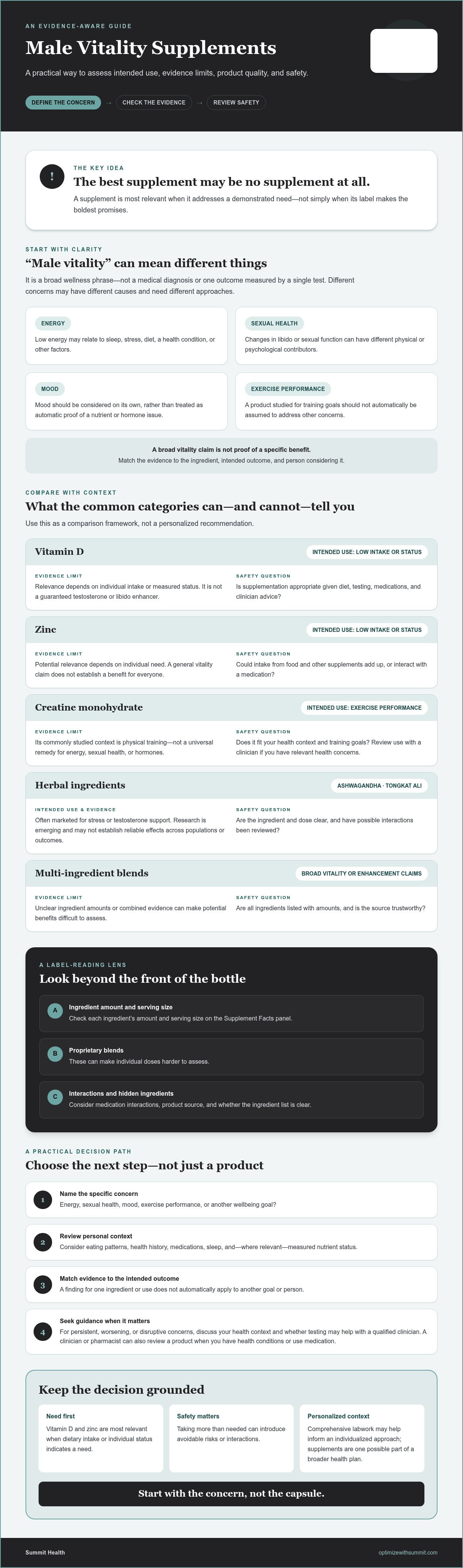
The best supplement for male vitality may be no supplement at all. The best supplements for male vitality address a demonstrated need, not simply make the boldest promises on a label. With claims ranging from testosterone support to improved energy and sexual function, comparing ingredients, evidence, and safety can feel unclear.
This guide offers a practical way to assess your options. You’ll see how commonly discussed supplements compare in their intended uses, evidence limitations, safety considerations, and potential relevance. You’ll also learn why symptoms such as low energy or changes in sexual function can have causes a supplement won’t address.
We’ll cover what to look for in product quality, why interactions and hidden ingredients matter, and when testing or personalized clinical guidance may be more useful than trial and error. Comprehensive labwork can help inform an individualized approach, while supplements remain one possible part of a broader health plan. The goal is a safer, evidence-aware next step, not another bottle chosen on hope alone.
Key Takeaways
- “Male vitality” can refer to several areas of wellbeing. Clarify the specific concern before choosing a supplement.
- Compare the best supplements for male vitality by intended use, evidence limitations, and safety questions, not marketing claims alone.
- Check each ingredient’s amount and serving size on the Supplement Facts panel. Proprietary blends can make doses harder to assess.
- Vitamin D and zinc are most relevant when dietary intake or individual status indicates a need.
- For persistent symptoms, discuss your health context and whether testing may help with a qualified clinician.
Best supplements for male vitality: what the phrase can and cannot mean
“Male vitality” is a broad wellness phrase, not a medical diagnosis or a single outcome that can be measured with one test. It may refer to energy, sexual health, mood, exercise performance, or a general sense of wellbeing. These concerns can overlap, but they don’t necessarily share a cause or respond to the same intervention.
Testosterone is associated with several aspects of male physiology, but it’s only one part of a larger picture. A foundational overview of testosterone can help explain why it features in many supplement claims. A claim about a specific hormone or health outcome still needs evidence for that ingredient and purpose.
A broad vitality claim isn’t proof of a specific benefit. Evidence needs to match the ingredient, the intended outcome, and the person considering it.
Which concerns do people mean by male vitality?
Low energy may relate to sleep, stress, diet, a health condition, or other factors. Changes in libido or sexual function can have different physical or psychological contributors. Exercise performance and mood should also be considered on their own, rather than treated as automatic signs of a nutrient or hormone issue. If a concern persists, worsens, or affects daily life, discuss it with a qualified clinician instead of relying on a supplement list to explain it.
Why a supplement list is not a personalized plan
Whether a supplement fits depends on context, including eating patterns, health history, medications, sleep, and, where relevant, measured nutrient status. A supplement may help address a specific dietary gap, but that doesn’t make it a universal fix for energy, libido, or performance. Taking more than needed can introduce avoidable risks or interactions. If you have health conditions or use medication, review a product with a clinician or pharmacist.
Marketing language and personal anecdotes may suggest a possibility, but they don’t establish clinical effectiveness. Look for evidence tied to the actual ingredient and intended outcome, and consider whether it applies to someone with your circumstances. The best supplements for male vitality are not necessarily the most popular or widely promoted. Their relevance depends on a clearly defined need and a reasonable safety profile.
Start with the concern, not the capsule. Clarify what you want to address, review your health and nutrition context, and consider whether a deficiency or another factor is plausible. That measured approach makes it easier to assess an ingredient on its merits and recognize when clinical evaluation may be more useful than self-directed trial and error.
How to compare male vitality supplements by evidence and intended use
Start with the intended outcome, then ask whether the evidence actually measures it. A supplement studied for exercise performance shouldn’t automatically be treated as a solution for libido, hormone levels, or general energy. Use the table as a starting framework, not a personalized recommendation.
| Ingredient category | Intended use discussed | Evidence limitation | Safety questions |
|---|---|---|---|
| Vitamin D | Addressing low intake or status | Relevance depends on an individual’s intake or measured status. It isn’t a guaranteed testosterone or libido enhancer. | Is supplementation appropriate based on diet, testing, medications, and clinician advice? |
| Zinc | Addressing low intake or status | Potential relevance depends on individual need. A general vitality claim doesn’t establish a benefit for everyone. | Could intake from food and other supplements add up, or interact with a medication? |
| Creatine monohydrate | Exercise-performance goals | Its commonly studied context is physical training, not a universal remedy for energy, sexual health, or hormones. | Does it fit your health context and training goals? Review use with a clinician if you have relevant health concerns. |
| Herbal ingredients, including ashwagandha or Tongkat Ali | Often marketed for stress or testosterone support | Research is emerging and may not establish reliable effects across populations or outcomes. | Is the ingredient and dose clear, and have possible interactions been reviewed? |
| Multi-ingredient enhancement blends | Broad vitality or sexual-enhancement claims | Unclear ingredient amounts or combined evidence can make benefits difficult to assess. | Are all ingredients listed with amounts, and is the source trustworthy? |
Nutrients to consider when intake or status may be low
Vitamin D and zinc are nutrients, not automatic vitality upgrades. Their relevance depends on factors such as diet and individual status. Testing and clinician guidance can help clarify whether supplementation makes sense. Reviewing medications and other products can also identify potential safety concerns. Don’t assume that a symptom alone confirms a deficiency.
Performance-focused ingredients and broader wellness claims
Creatine monohydrate belongs in a discussion of exercise performance, not a catch-all list for male wellness. Evidence for one outcome doesn’t prove benefits for every vitality concern. Herbal products and blends also deserve ingredient-by-ingredient review. The U.S. Food and Drug Administration has warned about a sexual-enhancement product containing hidden, potentially dangerous drug ingredients, underscoring why both claims and product contents matter.
Use this comparison to narrow your questions, not to self-diagnose. The best supplements for male vitality depend on your goal, the evidence for that specific outcome, and your personal safety profile. If a label relies on sweeping promises or obscures ingredient amounts, pause and seek qualified advice before choosing.
Male vitality supplement labels: compare quality, dose, and safety
A polished label can make a product look precise, but read the details before weighing its claims. The Supplement Facts panel shows what’s included and how much is provided per serving. The rest of the label can list directions, warnings, allergens, and other active ingredients.
What to look for on a supplement label
Start with the serving size, then check the amount of each listed ingredient per serving. Compare the ingredient form and amount with current, credible references, or ask a qualified clinician or pharmacist to help interpret them. Keep a tally if the same nutrient or active ingredient appears in more than one product. A proprietary blend may list ingredients without showing each individual amount, making it harder to assess the dose or compare it with available evidence.
- Review the full panel: Check ingredient names, forms, amounts, serving directions, warnings, and allergens.
- Look for independent quality testing: A credible third-party testing program may provide information about identity, purity, or manufacturing quality. Check what the testing actually covers.
- Read claims carefully: Broad promises about vitality don’t establish that a product delivers a specific health benefit.
Purity verification is not proof of clinical benefit. Testing may offer useful information about product quality, but it doesn’t show that an ingredient improves testosterone, sexual health, or another outcome. A quality mark also doesn’t guarantee safety for every person. The FDA has warned about sexual-enhancement products with undeclared drug ingredients. Review its FDA warning on hidden ingredients when assessing products marketed for male vitality.
Interactions and situations that call for extra caution
Before adding a supplement, review the product and ingredient list with a clinician or pharmacist, especially if you take medication or use several supplements. An underlying health condition or a planned medical procedure is another reason to seek individualized advice. Ingredients can affect people differently and may interact with treatments.
Don’t stop prescribed treatment or change how you take it to make room for a supplement. Instead, bring the label and your specific goal to a qualified professional. This makes the discussion more practical: they can consider your health context, review potential risks, and help determine whether the product’s claims are relevant. For the best supplements for male vitality, label transparency is a useful first screen, not a substitute for evidence or personalized guidance.
Practical checklist for choosing male vitality supplements
A deliberate sequence can help separate a plausible need from a persuasive label. Start with the concern, consider your health context, then assess whether evidence supports the ingredient for that specific goal. This process can also reveal when a supplement isn’t the right next step.
A step-by-step decision process
- Define the concern. Write down what you want to address, such as low energy or a change in exercise performance, and how long it has been happening. Note whether it’s persistent, changing, or affecting daily life.
- Review your context. Consider your usual food intake, sleep, activity, health history, and medications. A qualified clinician can help assess whether these factors, a nutrient concern, or something else may be relevant.
- Check the evidence. Look for research on the specific ingredient and the outcome you care about. Evidence for a different use, or a broad marketing claim, may not apply.
- Assess the product. Check the ingredient form, amount per serving, directions, warnings, and quality information. Choose a product only if its contents and intended use fit the need you’ve identified.
Don’t add several products at once or rely on unverified claims to decide what to take. Combining supplements can make it harder to identify what’s causing an effect or interaction. Review a proposed product with a clinician or pharmacist, especially if you use medication or have an underlying health condition. Don’t stop or change a prescribed treatment without guidance.
When a supplement is not the next step
Persistent fatigue, changes in sexual function, or other ongoing symptoms deserve evaluation rather than guesswork. A supplement can’t diagnose or treat an underlying medical condition, and symptoms alone don’t confirm a nutrient deficiency. A qualified clinician can consider your history and whether testing, including comprehensive labwork when appropriate, could help guide the next discussion. If sleep is a concern, review sleep habits as part of that conversation rather than assuming a supplement is the answer.
For a personalized discussion of your health context, you can contact Summit Health about wellness guidance. Summit Health’s telehealth-led services include comprehensive labwork and individualized wellness plans. That evaluation is distinct from simply selecting an over-the-counter supplement. The aim is clarity first, then a considered next step.
When personalized care can guide male vitality decisions
A supplement comparison can help you ask better questions, but it can’t determine what’s driving a symptom or what approach fits your health. A clinician-led review connects your goals with your history and, when appropriate, lab results. The outcome may point toward nutrition changes, further evaluation, monitoring, a supplement discussion, or no supplement at all.
What an individualized review may consider
Bring a clear account of what has changed, when it began, and how it affects daily life. A clinician may also consider your health history, current medications, relevant lifestyle factors, and available lab results. Comprehensive labwork can add useful context, but results need to be interpreted alongside symptoms and other factors. One number on its own doesn’t explain the full picture or automatically determine a treatment.
If hormone-related concerns come up, a clinician can discuss whether further evaluation is appropriate. Summit provides telehealth-led hormone optimization supported by comprehensive labwork and individualized plans. Summit’s hormone therapy overview explains that service. Hormone therapy is a separate clinical consideration, not a substitute for over-the-counter supplements or a guaranteed response to them.
Move from comparison to a personal plan
The best supplements for male vitality depend on a specific goal, credible evidence for that outcome, and individual health context. A personalized review may instead suggest adjusting nutrition, investigating persistent symptoms, or monitoring a concern over time. It may also conclude that a supplement isn’t needed. The purpose is to choose a next step based on relevant information rather than stacking products in response to broad marketing claims.
If you’re unsure whether a further discussion fits your goals, Summit’s hormone quiz is an optional starting point. It doesn’t replace clinical evaluation. For a discussion of your symptoms and appropriate evaluation, book a personalized appointment.
Choose a Clearer Next Step
The best supplements for male vitality aren’t defined by the boldest label. Their relevance depends on a specific goal, evidence for that outcome, and your individual health context. A nutrient may be worth discussing when intake or status suggests a need, while persistent fatigue or changes in sexual health may call for evaluation rather than another product.
Keep the decision focused: review ingredients and safety, consider your diet, medications, and health history, and seek clinical guidance when symptoms persist or the right next step is unclear. Comprehensive diagnostic labwork can inform that discussion, while personalized plans, ongoing virtual monitoring, and health coaching can support a more considered approach. Hormone therapy is a separate clinical option, not a supplement substitute or a guaranteed outcome.
If you’d like to discuss your goals, symptoms, and appropriate evaluation, book a personalized appointment. A measured, individualized next step can help you move forward with greater clarity and confidence.
Frequently Asked Questions
What are the best supplements for male vitality?
There isn’t one best choice for every man. The best supplements for male vitality depend on the specific goal, dietary intake, health history, and evidence for the ingredient and intended outcome. For example, vitamin D or zinc may be relevant when intake or status is low, while creatine is generally discussed in the context of exercise performance. Define the concern first, then review a product’s evidence and safety with a qualified professional.
Do male vitality supplements increase testosterone?
Some ingredients are marketed for testosterone support, but that doesn’t mean every product reliably increases testosterone or improves how you feel. Research on ingredients such as ashwagandha and Tongkat Ali is emerging, and findings may not apply to every person or product. Changes in testosterone can’t be assumed from a label claim. Persistent symptoms or concerns about hormone levels are reasons to seek clinical evaluation rather than trying supplements as a substitute for assessment.
Can vitamin D or zinc improve male vitality?
Vitamin D and zinc may be useful nutrients when a person’s intake or status indicates a need, but they aren’t guaranteed libido, energy, or testosterone enhancers. Relevance depends on your diet and individual circumstances. A clinician can help determine whether testing or changes to your intake make sense. Avoid adding high-dose or duplicate products without guidance, especially if other supplements or medications may affect your overall intake or safety.
Are male vitality supplements safe to take with medications?
Not always. Supplements can interact with medications or be unsuitable in some health situations, and products marketed for sexual enhancement may contain undeclared drug ingredients. Before using one, show the complete label to a clinician or pharmacist and mention your medications, health conditions, and other supplements. Don’t stop or change prescribed treatment on your own. Seek individualized advice before using supplements around a planned medical procedure.
How do I know if a male vitality supplement is high quality?
Read the Supplement Facts panel to confirm ingredient names, forms, and amounts per serving, and review directions, warnings, and allergens. A proprietary blend may obscure individual ingredient amounts. Independent quality testing can offer information about identity or purity, but check what the testing covers. It doesn’t establish that a product works, guarantee safety for every person, or validate broad claims about testosterone, libido, or overall vitality.
Should I get hormone testing before taking supplements for male vitality?
Not everyone needs hormone testing before considering a supplement. But persistent fatigue, sexual changes, or other ongoing symptoms deserve a clinician’s assessment. Testing may be appropriate depending on your health history and symptoms. Results should be interpreted in context, not treated as a diagnosis by themselves. Summit Health offers telehealth-led hormone optimization and comprehensive diagnostic labwork, which can inform clinician-led discussions and personalized plans without assuming a supplement is the right next step.

Article by
Dr. David Richardson
David Richardson, is the founder and CEO of Summit Health and the author of "Insights from the Summit", where he writes about hormone optimization, metabolic health, thyroid function, longevity, and preventive medicine.
After entering healthcare in 2009, David became increasingly interested in a question that traditional medicine often struggles to answer:
Why do so many people continue to feel terrible despite being told their labs are "normal"?
That question eventually led him into the field of health optimization in 2020, where he became passionate about understanding physiology at a deeper level and helping patients uncover the root causes of their symptoms rather than simply managing them.
Today, David's philosophy is simple: normal and optimal are not the same thing. Every patient is physiologically unique, and meaningful healthcare begins by listening to symptoms, understanding the science, and recognizing that laboratory values are only one piece of a much larger picture.
Through Summit Health and Insights from the Summit, David's mission is to help people better understand their bodies, ask better questions, and make informed decisions that improve both their health span and quality of life.


