

IMPORTANT DISCLAIMERS
Medical Disclaimer: The information in this article is provided for educational purposes only and is not intended as medical advice or a substitute for individualized medical care. Every person's health needs are unique. Always consult a qualified healthcare professional before starting, stopping, or changing any medication, supplement, or treatment plan. -------
Article Disclaimer: Articles are reviewed and published by Summit Health to provide evidence-based educational information. While Summit Health strives to provide reliable and current health information, medical knowledge is always evolving over time. Depending on when you are reading this content, it may not reflect the latest research or apply to your individual circumstances.
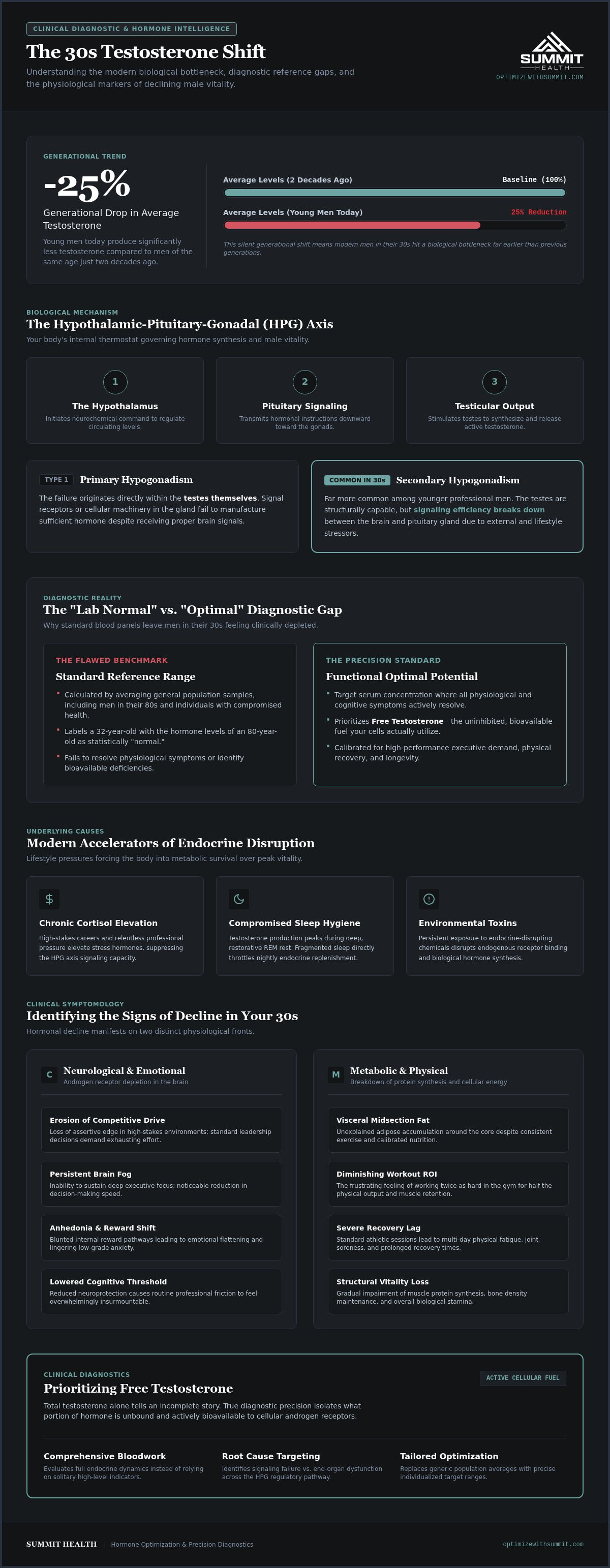
Recent research reveals a 25% generational drop in average testosterone levels among young men compared to just two decades ago. It's a silent shift. For many, the result is a sudden, frustrating plateau in both physical and mental performance. If you've noticed unexplained weight gain around your midsection or a thinning of your competitive edge, you're likely observing the physiological signs of low testosterone in 30s. This isn't an inevitable part of aging. It's a biological bottleneck that you can solve with precision.
You know the feeling of working twice as hard for half the results. It's the slow recovery after a standard workout and the persistent mental fog that clouds your professional focus. You deserve better than just "normal" for your age. This guide identifies the specific markers of hormonal decline and outlines how to restore your biological peak. You'll learn how comprehensive diagnostics and tailored optimization can help you regain youthful energy, improve your body composition, and restore your cognitive drive. Peak performance is within reach. Let's begin the refinement.
Key Takeaways
- Distinguish between "lab normal" ranges and your functional potential to understand why standard averages often mask a true physiological decline.
- Identify the subtle neurological markers of hormonal shifts, including a loss of competitive drive and persistent mental fatigue during high-stakes tasks.
- Recognize the metabolic signs of low testosterone in 30s, specifically visceral fat accumulation and a diminishing return on your efforts in the gym.
- Learn why comprehensive diagnostics must prioritize Free Testosterone to accurately measure the bioavailable fuel your cells actually utilize.
- Discover how data-driven virtual optimization provides a sophisticated, efficient path to restoring your metabolic and cognitive peak.
The 30s Shift: Why Testosterone Declines and Why It Matters
Testosterone is the engine of male vitality. It drives metabolic health, bone density, and muscle protein synthesis. For men in their 30s, it's also the chemical catalyst for ambition and focus. When levels begin to dip, the impact isn't just physical. It's structural. You feel the shift in your energy, your body composition, and your ability to lead. Identifying the early signs of low testosterone in 30s is the first step toward reclaiming your biological peak.
The Biological Bottleneck: Understanding the Decline
Precision starts with the hypothalamic-pituitary-gonadal (HPG) axis. This is your body's internal thermostat for hormone production. The brain signals the pituitary gland, which then stimulates the testes to produce testosterone. Primary hypogonadism occurs when the testes themselves are the issue. Secondary hypogonadism is far more common in younger men, often triggered by lifestyle stressors that disrupt the brain's signaling efficiency. Optimal Testosterone is the serum concentration where all physiological symptoms resolve and individual performance reaches its maximum potential.
Normal vs. Optimal: The Diagnostic Gap
Standard lab results are often misleading. Reference ranges are calculated by averaging the results of the general population, which includes men of all ages and widely varying health profiles. If your results are compared to an average that includes men in their 80s, you might be told you're "normal" while feeling clinically depleted. This diagnostic gap leaves many men struggling with the signs of low testosterone in 30s without a path forward. True optimization requires comprehensive labwork to analyze the nuances of your endocrine system.
Modern living accelerates this biological shift. Chronic cortisol elevation from high-stakes careers, poor sleep hygiene, and environmental toxins act as persistent endocrine disruptors. These factors force your body into a state of metabolic survival rather than peak performance. Hormone optimization isn't about chasing a generic number on a lab report. It's about maintaining a definitive competitive edge in your career and your personal life. It's about precision refinement. By addressing the root cause of decline through data-driven protocols, you move from merely surviving to operating at your highest possible level.
Beyond the Physical: Identifying Subtle Cognitive and Emotional Markers
Cognitive decline is often the first visible crack in a professional man's armor. While physical changes are easier to track, the neurological signs of low testosterone in 30s frequently manifest as a quiet erosion of your competitive edge. You might find that the decisive leadership and high-stakes focus that once felt natural now require immense effort. This shift isn't a personality flaw. It's a bioenergetic failure. When your hormonal foundation weakens, your brain loses the chemical support necessary for mental resilience and executive function.
Society often mislabels this state as "burnout" or "just stress." While high-pressure environments certainly play a role, there are specific reasons for testosterone decline that directly impact your brain's ability to process stress. Attributing your loss of drive solely to your workload ignores the physiological reality that testosterone is a potent neuroprotective agent. Without it, your cognitive threshold drops, making standard professional challenges feel insurmountable.
The Mental Edge: Testosterone and Brain Function
Your brain is dense with androgen receptors, specifically in areas responsible for memory and spatial awareness. As levels decline, decision-making speed slows. You might experience "brain fog," a persistent inability to maintain deep focus during the workday. Resilience suffers, too. Small setbacks that you once dismissed now linger, creating a cycle of low-grade anxiety. Because hormone production is tied to restorative rest, poor sleep hygiene often exacerbates these symptoms. Integrating targeted support like magnesium glycinate for sleep can stabilize the foundation, but it won't replace the need for hormonal balance.
Emotional Resilience and the Loss of Drive
Low testosterone shifts your internal reward system. This often leads to a state known as anhedonia, where previously exciting professional or personal goals begin to feel like heavy burdens. The "fire" that drives ambition is fueled by dopamine signaling, which is heavily influenced by your testosterone levels. When that fuel source dries up, irritability increases and your sense of purpose dims. If you find yourself questioning your ambition, it's time to quantify these subjective feelings. You can take the Hormone Quiz to see if your emotional state aligns with clinical markers.
Operating at a deficit is not a sustainable strategy for long-term success. If you've noticed these subtle signs of low testosterone in 30s, the most efficient path forward is a data-driven assessment. You don't have to accept a diminished version of your mental performance. You can schedule a virtual consultation to begin the process of restoring your cognitive and emotional peak.
Metabolic and Physical Signs: When Workouts Stop Working
Effort no longer equals outcome. For many men, the most visible signs of low testosterone in 30s appear first in the mirror and the gym. You're following the same protocol that yielded results in your 20s, yet your body composition is trending in the wrong direction. This isn't just a matter of getting older. It's a metabolic shift driven by hormonal insufficiency. You might notice that your gym ROI has plummeted; despite lifting heavy and maintaining a clean diet, muscle mass remains stagnant while recovery times stretch from hours into days.
Body Composition and Insulin Sensitivity
Lipid metabolism relies on hormonal balance. When testosterone levels drop, your body loses its ability to efficiently regulate fat storage, leading to visceral fat accumulation around the midsection. This creates a physiological trap. Adipose tissue contains aromatase, an enzyme that converts testosterone into estrogen. As fat increases, testosterone decreases further, accelerating the cycle. Breaking this loop requires a dual approach. Combining weight loss digital healthcare solutions with targeted hormone therapy addresses both the metabolic symptoms and the underlying cause.
Recovery, Vitality, and Physical Stamina
Recovery time is a primary marker of vitality. If you're experiencing a persistent afternoon crash or relying on escalating doses of caffeine just to finish the workday, your systemic stamina is compromised. Testosterone is essential for erythropoiesis, the production of red blood cells. These cells transport oxygen to your muscles and brain. A deficiency here results in slower muscle hypertrophy and chronic fatigue. When your red blood cell count is suboptimal, your muscles can't repair themselves at a rate that matches your output. For those ready to restore their physical baseline, Summit Health’s hormone therapy page provides a pathway to clinical restoration.
Pay attention to the subtle details. Changes in skin elasticity or a noticeable thinning of hair density can signal a broader endocrine shift. Perhaps the most critical physical vital sign is the frequency of nocturnal erections. Morning wood isn't just a sexual metric; it's a window into your cardiovascular and hormonal health. These erections occur during REM sleep and are dependent on sufficient testosterone levels. A consistent absence of these signals is one of the definitive signs of low testosterone in 30s that warrants immediate investigation. When your workouts stop working, it's time to look deeper than your training split.
Clinical Diagnostics: The Biomarkers That Actually Matter
Precision requires data. Many men identify the signs of low testosterone in 30s but stop at a basic screening. Standard blood work often focuses solely on Total Testosterone. This is a mistake. Total T represents the total volume of hormone in your system, but it only tells about 20% of the story. Much of that hormone is bound to proteins, making it biologically inactive. To understand why your performance has plateaued, you must look at what is actually available to your cells.
The Essential Hormone Panel
A comprehensive assessment must include Total T, Free T, SHBG (Sex Hormone Binding Globulin), LH, FSH, and Estradiol. Timing is critical. You must conduct testing in the early morning, ideally before 10:00 AM, to capture your peak natural production. Testing later in the day often results in artificially low readings that lead to inaccurate conclusions. Free Testosterone is the unbound hormone responsible for biological action. It is the only portion of the hormone capable of entering your cells to trigger muscle growth and cognitive clarity.
Interpreting the Data for Optimization
Diagnostic precision is the prerequisite for safety. We monitor Hematocrit to ensure blood viscosity remains within healthy limits, protecting your cardiovascular system while you optimize. Summit Health uses these specific biomarkers to build personalized treatment plans that reflect your unique physiology. We reject the "one size fits all" approach of traditional medicine. There's a profound difference between treating a number and optimizing a human. You can view our pricing and FAQs to see which diagnostic package fits your needs.
Your SHBG levels act as a physiological limiter. If this protein is too high, it effectively hijacks your testosterone before it can reach your tissues. This explains why some men exhibit clear signs of low testosterone in 30s despite having "normal" Total T scores. They have the supply, but they don't have the access. Real optimization looks past the surface to find the biological bottleneck. If you're ready for a data-driven path to peak performance, book your virtual diagnostic consultation to begin the refinement process.
The Path to Peak: Virtual Hormone Optimization
Efficiency defines the high-performance lifestyle. For the modern professional, time is the most valuable asset. Seeking treatment for the signs of low testosterone in 30s shouldn't require compromising your schedule or your privacy. Telehealth-led optimization offers a sophisticated alternative to the traditional clinical model. It's an efficient, data-driven approach that prioritizes your results without the friction of in-person logistics. No sterile waiting rooms. No wasted time.
Summit Health streamlines the path to restoration. The journey starts with precision diagnostics. We move beyond the surface-level checks found in standard primary care. Once your comprehensive labs are complete, you'll meet virtually with a specialist to review your biological markers. This isn't a generic consultation. It's a deep dive into your metabolic health and hormonal architecture. From there, we develop a tailored protocol that may include Bioidentical Hormone Replacement (BHRT). This is a safe, evidence-based intervention when monitored by clinical experts who prioritize biological balance over aggressive dosing.
Precision Medicine via Telehealth
Traditional medicine often relies on annual snapshots. These infrequent checkups miss the nuances of your hormonal fluctuations. Virtual monitoring provides a continuous stream of data, allowing for more precise adjustments to your protocol. Managing your hormone replacement therapy from home ensures that your treatment stays aligned with your lifestyle. Specialized health coaching further enhances this process, providing the guidance needed to maximize your physiological gains and sustain long-term excellence.
Your Next Step Toward Optimization
Recognizing the signs of low testosterone in 30s is the catalyst for change. You've seen the markers: the mental fog, the metabolic plateau, and the loss of drive. Your 30s represent your biological prime, not the beginning of an inevitable decline. Settle for nothing less than excellence. Taking action now prevents a decade of operating at half-capacity. It's time to refine your state and restore your biological peak. Schedule your precision health consultation today to begin your ascent.
Restore Your Peak Performance
Operating at your highest level is a definitive choice. You've identified the signs of low testosterone in 30s, from the sudden mental fog in the boardroom to the metabolic plateau in the gym. These aren't just symptoms of a busy life. They're biological markers that demand a precise, data-driven response. True restoration begins by looking past generic lab ranges and focusing on your unique functional potential.
Summit Health provides the sophisticated path to biological refinement. By combining precision lab-based protocols with the expertise of virtual health coaching, we help you reclaim the energy and cognitive drive that define your prime. Our telehealth convenience ensures that your optimization journey fits seamlessly into a high-performance professional lifestyle. You don't have to settle for a diminished version of your vitality or accept decline as inevitable. The path to sustained excellence is clear, data-driven, and accessible.
Begin your optimization journey: Schedule an appointment. Your evolution toward a peak state starts today.
Frequently Asked Questions
What is considered a "low" testosterone level for a man in his 30s?
Clinical guidelines from the American Urological Association define low testosterone as a total level below 300 nanograms per deciliter. However, a single number doesn't tell the whole story. True deficiency is diagnosed when these low lab readings are accompanied by persistent clinical symptoms. For optimal performance, your Free Testosterone level must also be evaluated, as it represents the bioavailable hormone your body actually uses.
Can lifestyle changes alone fix low testosterone in my 30s?
Lifestyle modifications can improve mild hormonal imbalances, but they rarely correct a clinical deficiency. Optimizing sleep, reducing stress, and adjusting your diet can support your endocrine system. If your baseline production is fundamentally compromised by primary or secondary hypogonadism, lifestyle shifts alone won't restore your biological peak. Comprehensive diagnostics are required to determine if clinical intervention is necessary.
How quickly will I see results from hormone optimization therapy?
Initial improvements in mental clarity and energy levels typically manifest within three to six weeks of starting a protocol. Changes in body composition, such as increased muscle mass and reduced visceral fat, generally take three to six months to become visible. Consistency is paramount. Your individual timeline depends on your baseline markers and how closely you follow your personalized plan.
Are there side effects to starting TRT in your 30s?
Potential side effects exist, but they are minimized through precise clinical monitoring. Some men experience minor skin changes, mild fluid retention, or fluctuations in red blood cell count. Working with a specialist ensures your protocol is calibrated to protect your cardiovascular health and fertility. Regular laboratory monitoring allows for proactive adjustments before minor shifts become clinical problems.
Is low testosterone in my 30s the reason I can’t lose weight?
Hormonal insufficiency is a primary driver of stubborn midsection weight gain. Testosterone directly regulates lipid metabolism and insulin sensitivity. When levels drop, your body naturally shifts toward storing visceral fat, creating a metabolic plateau that resists traditional dieting. Recognizing this pattern as one of the signs of low testosterone in 30s is essential for breaking the fat-accumulation cycle.
What happens if I leave low testosterone untreated?
Leaving low testosterone untreated accelerates long-term systemic decline. Over time, chronic deficiency leads to a progressive loss of bone mineral density, muscle wasting, and increased cardiovascular risks. The cognitive symptoms, such as brain fog and low drive, often worsen, severely impacting professional performance. Addressing the signs of low testosterone in 30s early protects your future health span.
How does Summit Health’s virtual process work for new patients?
Our virtual optimization process is designed for maximum efficiency. New patients begin by completing comprehensive diagnostic labwork at a convenient national partner location. Once your data is ready, you'll participate in a telehealth-led virtual consultation with a specialist to review your markers. If a deficiency is identified, we design a personalized treatment plan that includes ongoing virtual monitoring and coaching.
Will I need to stay on hormone therapy forever?
Hormone therapy is typically a long-term commitment to maintain peak performance. If you discontinue treatment, your body will revert to its baseline production levels, and your original symptoms will likely return. The duration of your protocol depends on your goals and the underlying cause of your decline. We focus on long-term wellness management through continuous data tracking and refinement.

Article by
Dr. David Richardson
David Richardson, is the founder and CEO of Summit Health and the author of "Insights from the Summit", where he writes about hormone optimization, metabolic health, thyroid function, longevity, and preventive medicine.
After entering healthcare in 2009, David became increasingly interested in a question that traditional medicine often struggles to answer:
Why do so many people continue to feel terrible despite being told their labs are "normal"?
That question eventually led him into the field of health optimization in 2020, where he became passionate about understanding physiology at a deeper level and helping patients uncover the root causes of their symptoms rather than simply managing them.
Today, David's philosophy is simple: normal and optimal are not the same thing. Every patient is physiologically unique, and meaningful healthcare begins by listening to symptoms, understanding the science, and recognizing that laboratory values are only one piece of a much larger picture.
Through Summit Health and Insights from the Summit, David's mission is to help people better understand their bodies, ask better questions, and make informed decisions that improve both their health span and quality of life.


