

IMPORTANT DISCLAIMERS
Medical Disclaimer: The information in this article is provided for educational purposes only and is not intended as medical advice or a substitute for individualized medical care. Every person's health needs are unique. Always consult a qualified healthcare professional before starting, stopping, or changing any medication, supplement, or treatment plan. -------
Article Disclaimer: Articles are reviewed and published by Summit Health to provide evidence-based educational information. While Summit Health strives to provide reliable and current health information, medical knowledge is always evolving over time. Depending on when you are reading this content, it may not reflect the latest research or apply to your individual circumstances.
A flagged hormone result is a signal, not a diagnosis. Learning how to read your own hormone lab results can help you understand the report, but a number rarely tells the whole story on its own.
It’s understandable to pause over unfamiliar test names, units, or a high or low marker. Reference intervals can differ between laboratories, and a result’s meaning may depend on when the sample was collected, your symptoms, medications, and broader health context. One result outside the listed range doesn’t automatically explain how you feel or determine what care you need.
This guide walks you through the main parts of a hormone lab report, including the result, units, reference interval, and flags. You’ll also learn what timing and personal context can add, and how to prepare useful questions for a qualified clinician. Treat your results as a starting point for a conversation, not as a standalone diagnosis. A clinician can review them alongside your health history and symptoms to discuss appropriate next steps.
Key Takeaways
- When learning how to read your own hormone lab results, start with the test name, its unit, the report’s reference interval, and the collection date.
- Compare each value with the interval printed on that specific report. An in-range value, a flagged result, and a change over time can each provide different information.
- For a clinician review, gather your complete report, symptom timeline, medication and supplement list, prior results, and sample-collection details.
- Ask what each result may mean in your health context and whether repeat or related testing is appropriate before deciding on next steps.
- Summit Health considers comprehensive labwork as part of a broader personalized assessment, rather than treating an individual lab value as a diagnosis.
How to Read Your Own Hormone Lab Results: Start With the Report
A hormone lab report records measurements from a specific sample. It can help a qualified clinician assess your health, but it isn’t a diagnosis by itself. To understand how to read your own hormone lab results, first identify what each part of the report shows. Then note the circumstances in which the sample was collected.
What each line on a hormone lab report tells you
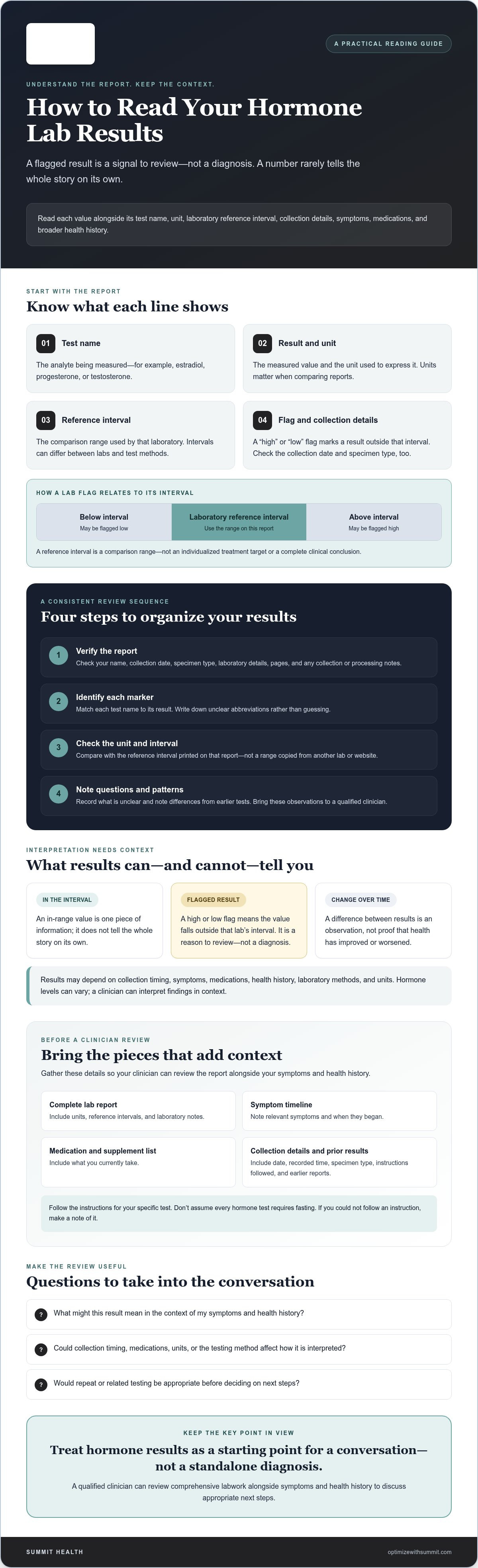
Start with the analyte, or test name, such as estradiol, progesterone, or testosterone. The result is the measured value, and the unit tells you how that value is expressed. The reference interval is the comparison range used by that laboratory. A flag such as “high” or “low” means the result falls outside that interval. It’s a reason to review the result, not a complete clinical conclusion.
A laboratory reference interval describes a comparison range; an individualized treatment target is determined in clinical context. Reference intervals can vary by lab and test method, and hormone results may also be affected by factors such as cycle timing. For an overview of how these intervals are developed and used, see Reference ranges for blood tests. Don’t assume a value can be compared directly with a result from another lab without considering the units and testing methods.
Check the identifying details, too. Confirm that your name, collection date, and specimen type, such as blood or saliva, match the test you had. The date may help a clinician interpret the result in relation to symptoms, medications, or other timing considerations.
What to gather before interpreting hormone results
Gather information that can put the results in context before your review:
- The complete report, including units, reference intervals, and any notes from the lab
- A brief timeline of relevant symptoms and when they began
- Your current medications and supplements
- Collection details, including the date, time if recorded, specimen type, and any instructions you followed
Follow the laboratory’s instructions for your specific test. Don’t assume every hormone test requires fasting. If you couldn’t follow an instruction, make a note of it so the clinician can take it into account. For more background on test selection and preparation, read this hormone blood work guide.
Organizing these details is a useful first step, not a substitute for clinical interpretation. A clinician can consider the report alongside your symptoms and health history, then help identify focused questions or appropriate next steps.
How to Read Hormone Lab Results Step by Step
A consistent review sequence helps you organize the report without turning a flagged value into a conclusion. Use these steps to prepare for a clinician’s interpretation, not to diagnose yourself.
- Verify the report. Confirm that your name, collection date, specimen type, and laboratory details match your test. Check for missing pages or notes about how the sample was collected or processed.
- Identify each marker. Match the test name on each line to the result beside it. If an abbreviation is unclear, write it down rather than guessing what it means.
- Check units and intervals. Read the unit and reference interval printed beside each result. Compare the value with that laboratory’s interval, not a range copied from another lab or website. MedlinePlus offers a patient-friendly overview in How to Understand Your Lab Results.
- Note questions and patterns. Record anything you’re unsure about, along with differences from earlier tests. Bring those observations to a qualified clinician, who can interpret them in your health context.
Check the test, units, and reference interval first
Precision matters. Two reports may show a result for the same hormone but use different units or testing methods, so the values may not be directly comparable. Use the interval on the report in front of you. Note unclear abbreviations, missing units, or absent reference ranges and ask the ordering clinician or laboratory to clarify them.
Compare results over time without overreading changes
Place prior reports in date order and compare the exact test name, unit, method, and collection timing. A difference between two results is an observation, not proof that your health has improved or worsened. Hormone levels can vary, and a clinician can help determine whether the tests are comparable and whether the change matters in context. For background on common markers, see this hormone panel overview.
Review hormone results in sequence, then interpret patterns with a clinician. This keeps the conversation focused on what the report measures and what still needs professional input. As you consider how to read your own hormone lab results, avoid assigning meaning to a single number too soon.
What High, Low, and Normal Hormone Results Can, and Cannot, Tell You
A “normal” result is one piece of information, not a universal measure of health. A reference interval describes how a laboratory’s result compares with a defined comparison group under its testing conditions. It isn’t a universal health cutoff or automatically an individualized treatment target. This distinction is central to how to read your own hormone lab results without overinterpreting a flag.
| Report finding | What it can tell you | What it can’t tell you alone |
|---|---|---|
| In-range value | The result falls within the lab’s printed interval. | It doesn’t necessarily explain symptoms or rule out a health concern. |
| Out-of-range flag | The result falls above or below that lab’s interval. | It doesn’t establish a diagnosis or show what action is needed. |
| Change over time | Two results differ, which may be useful to discuss. | It doesn’t prove improvement or worsening, especially if tests or timing differ. |
Why a flagged result is not a diagnosis
A high or low flag shows how a result compares with the interval printed on that specific report. To assess its significance, a clinician considers why the test was ordered, your health history and symptoms, and any related findings. Age, sex, medications, and other aspects of your health may also shape interpretation. An in-range result can still be worth discussing if symptoms persist; a flagged result may need more context before its significance is clear.
One hormone result cannot independently confirm or exclude a hormone condition. Avoid assigning a diagnosis or changing medication based on a number alone. Note the result and ask how it fits with the rest of your clinical picture.
Why timing and personal context matter
Hormone levels can vary with collection timing. Some are affected by time of day, while others may change across menstrual-cycle phases. Medication use and the reason for testing can also affect how a result is understood. The same value may not mean the same thing for every person, or even for one person tested under different circumstances.
Follow the ordering clinician’s instructions about when and how to collect the sample, and tell them if your timing or preparation differed. For more on scheduling tests in context, see this guide to hormone test timing. Bring questions about flagged or unexpected results to a qualified clinician, who can interpret them alongside your symptoms and health history.
How to Prepare for a Clinician Review of Your Hormone Results
A focused review starts with good context. You don’t need to interpret every marker before speaking with a clinician. Gather the information that can help connect your results with your health history and the reason the testing was ordered.
- Your complete lab report: Include all pages, notes, units, and reference intervals.
- A symptom timeline: Note what you’ve experienced, when it began, and any changes over time.
- Medication and supplement list: Include doses if known, and mention recent changes.
- Prior lab results: Bring earlier reports so the clinician can check whether comparisons are meaningful.
- Collection details: Record the sample date and time, specimen type, and any instructions you followed or couldn’t follow.
Questions to ask about an individual result
Write down questions before the review so you can use the time well. Ask how a specific result relates to your symptoms, health history, and the reason for testing. You can also ask whether collection timing, medication use, or the test method may affect its interpretation, and whether related findings change the overall picture.
Clarify what follow-up is recommended and when your results or symptoms should be reassessed. Ask which changes or symptoms warrant contacting a clinician sooner. For broader background on what hormone testing may assess, read this guide to understanding hormone level tests.
When to seek individualized medical guidance
Consider a clinician review if a result is unclear, falls outside the lab’s interval, or appears alongside persistent symptoms. A flagged value alone doesn’t determine what should happen next. The clinician can explain whether the result needs further context, whether repeat or related testing is appropriate, and what follow-up makes sense for you.
Don’t start, stop, or adjust medication or supplements, or arrange repeat testing, based only on your own reading. Ask for guidance first. Urgent or severe symptoms call for appropriate immediate medical assessment rather than waiting for a routine lab review.
Learning how to read your own hormone lab results can help you arrive prepared, but personalized interpretation belongs in a clinician-led conversation. If you’re seeking support with hormone-related care, explore Summit Health’s hormone therapy and personalized assessment approach.
Turn Hormone Lab Results Into a Personalized Next Step
Your report is most useful when it becomes part of a considered health conversation. Review the test names and ranges, record relevant symptoms and collection details, and keep prior results available. Avoid diagnosing yourself or changing medication or supplements based on a number. A qualified clinician can help interpret the findings and discuss appropriate next steps.
What a personalized review can add
A clinician can consider lab findings alongside your symptoms, health history, medications, and health goals. That broader assessment may help clarify what a result can and can’t indicate, and whether additional information is needed. Care decisions depend on the individual picture, not on one high or low flag in isolation.
Summit Health’s telehealth-led care model uses comprehensive labwork as part of a personalized assessment. The model also includes ongoing virtual monitoring and health coaching. These elements support a broader review over time, without making any single result a diagnosis or promising a particular outcome. Learn more about the hormone therapy approach.
Plan a focused next conversation
Bring the complete lab report and a concise list of questions. You might ask what a result means in your context, whether collection timing or medication use could affect it, and what follow-up is recommended. If you’re unsure how to read your own hormone lab results, point out which parts are unclear. The goal is to understand the findings and agree on a practical path forward with a clinician.
Summit Health offers virtual consultations as part of its care model. If you’re considering personalized hormone care, review the hormone therapy information and consider whether a clinician-led discussion fits your needs.
Make Your Results a Starting Point for Progress
Learning how to read your own hormone lab results can help you approach your report with clarity, but the numbers are only one part of the picture. Check the report details and reference intervals, note relevant symptoms and collection timing, and bring your questions to a qualified clinician. A flagged result isn’t a diagnosis, and an in-range result doesn’t always answer every question.
Personalized interpretation connects lab findings with your health history and goals. Summit Health’s telehealth-led care model uses comprehensive diagnostic labwork as part of a broader assessment, with virtual consultations and ongoing monitoring as elements of its service model. This supports an informed discussion without treating one result as a complete clinical conclusion.
If you’re ready to discuss your results and explore personalized care, schedule a personalized appointment. Bring your report and a short list of questions to help make the conversation focused on a thoughtful next step.
Frequently Asked Questions
What does it mean if my hormone lab result is flagged high or low?
A high or low flag means your result falls outside the reference interval printed by that laboratory. It doesn’t establish a diagnosis by itself. Interpretation depends on the specific test, collection timing, symptoms, medical history, and related findings. Ask the clinician who ordered the test what the flag means in your circumstances and whether follow-up is appropriate. Avoid changing medication or supplements based only on the flag.
Can hormone lab results be normal if I still have symptoms?
Yes. A result within the laboratory’s reference interval doesn’t automatically explain or rule out symptoms. Knowing how to read your own hormone lab results includes recognizing that a lab value is only one part of the picture. Clinicians consider your health history, symptoms, medications, and reason for testing. If symptoms continue, share that information with a qualified clinician rather than relying on one in-range result or changing treatment yourself.
How do I know which reference range to use for my hormone results?
Start with the range printed on the same report as your result. Laboratories may use different testing methods, units, and reference intervals, so copying a range from another report or website can lead to an inaccurate comparison. Check that the test name and unit match the range shown. A clinician can explain how the lab’s interval applies to your result and whether other clinical factors affect its interpretation.
Do hormone lab results change depending on when the test is taken?
Some hormone measurements can vary with timing and individual circumstances. Relevant factors depend on the specific test and may include time of day, menstrual-cycle timing, medication use, or preparation instructions. Follow the ordering clinician’s directions and note when the sample was collected. Before repeating a test, ask whether the timing and method should match the original test or follow different instructions.
Should I change medication or supplements based on my hormone lab results?
No. Don’t start, stop, or change medication or supplements solely because of a lab flag or an online explanation. A clinician should review the result, your health history, and possible interactions before advising a change. If you’re concerned about a medication or supplement, contact the prescribing clinician and share the complete report. Don’t arrange repeat testing or adjust a dose without appropriate guidance.
What should I ask my doctor about hormone lab results?
Ask what each result means alongside your symptoms and why the test was ordered. Clarify whether collection timing, medications, or the laboratory method could affect interpretation. You can also ask whether related testing or follow-up is appropriate, what changes to monitor, and when to check in again. Bring the full report, prior results if available, and a current medication and supplement list to support a focused discussion.

Article by
Dr. David Richardson
David Richardson, is the founder and CEO of Summit Health and the author of "Insights from the Summit", where he writes about hormone optimization, metabolic health, thyroid function, longevity, and preventive medicine.
After entering healthcare in 2009, David became increasingly interested in a question that traditional medicine often struggles to answer:
Why do so many people continue to feel terrible despite being told their labs are "normal"?
That question eventually led him into the field of health optimization in 2020, where he became passionate about understanding physiology at a deeper level and helping patients uncover the root causes of their symptoms rather than simply managing them.
Today, David's philosophy is simple: normal and optimal are not the same thing. Every patient is physiologically unique, and meaningful healthcare begins by listening to symptoms, understanding the science, and recognizing that laboratory values are only one piece of a much larger picture.
Through Summit Health and Insights from the Summit, David's mission is to help people better understand their bodies, ask better questions, and make informed decisions that improve both their health span and quality of life.


