
IMPORTANT DISCLAIMERS
Medical Disclaimer: The information in this article is provided for educational purposes only and is not intended as medical advice or a substitute for individualized medical care. Every person's health needs are unique. Always consult a qualified healthcare professional before starting, stopping, or changing any medication, supplement, or treatment plan. -------
Article Disclaimer: Articles are reviewed and published by Summit Health to provide evidence-based educational information. While Summit Health strives to provide reliable and current health information, medical knowledge is always evolving over time. Depending on when you are reading this content, it may not reflect the latest research or apply to your individual circumstances.
Peptide therapy is a possibility to evaluate, not a proven way to reset aging. If you’re asking what is peptide therapy for anti aging, the answer depends on the specific peptide. These short chains of amino acids act as signals in the body, but that doesn’t mean every product marketed for longevity has demonstrated benefits. The distinction matters.
The appeal is clear. People want better energy, recovery, skin, or healthy longevity, and personalized care can sound more precise than a one-size-fits-all approach. Yet as of September 2026, no peptide is FDA-approved specifically to prevent aging or extend lifespan. A 2026 advisory panel recommendation on some compounded peptides is not FDA approval, and human evidence varies widely by compound and intended use.
This guide distinguishes established clinical uses from preliminary findings and unsupported anti-aging promises. You’ll learn what research does and doesn’t show, why regulation and product quality matter, and which risks warrant a clinician’s attention. It also outlines practical questions to bring to a qualified clinician, including how your goals, health history, labwork, and follow-up may inform a decision. The aim is a clear-eyed assessment of safety and suitability, not a promise of reversal.
Key Takeaways
- To understand what is peptide therapy for anti aging, start by recognizing that it describes varied treatments, not one standard protocol.
- Assess research for the specific peptide and intended outcome. Findings for one use don’t establish benefits for another.
- Compare peptide claims with established health measures by considering evidence strength, intended results, uncertainties, and clinical oversight.
- Before considering treatment, clarify your goal and ask a qualified clinician about the exact peptide, dose, route, risks, and follow-up plan.
- Labwork may inform a personalized assessment, but it can’t guarantee a diagnosis, treatment eligibility, or results.
What Is Peptide Therapy for Anti-Aging?
To understand what is peptide therapy for anti aging, start with the biology, then separate it from the promises attached to the phrase. Peptides are short chains of amino acids, the same basic building blocks found in proteins. Their structures and biological roles differ, so the word “peptide” doesn’t describe one predictable effect or treatment.
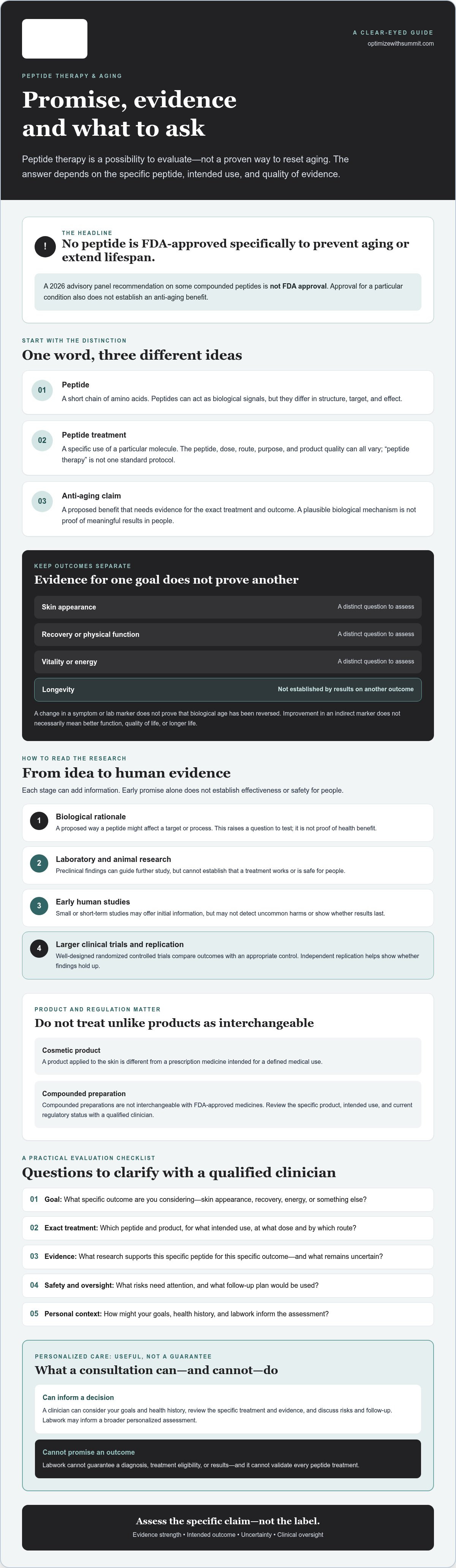
A peptide is a biological molecule; a peptide treatment is a specific use of that molecule; an anti-aging claim is a benefit that still needs evidence for the exact treatment and outcome. That distinction matters because “peptide therapy” is an umbrella term, not a standardized protocol. The peptide, dose, route, purpose, and quality of evidence can all vary.
Aging is complex, too. Skin changes, lower energy, or slower recovery may relate to different biological processes and personal factors. A change in one symptom or biomarker doesn’t prove that a person’s biological age has been reversed.
How peptides act as biological signals
Some peptides bind to receptors, much like a key fitting a particular lock, and can influence specific processes in cells or tissues. The analogy has limits: peptides interact with different targets and don’t all produce the same response. Even a plausible mechanism observed in laboratory research doesn’t establish a meaningful or lasting benefit in people.
What people mean by anti-aging peptide therapy
“Anti-aging” may refer to goals such as improving skin appearance, supporting recovery, or increasing vitality. These are claims to assess, not guaranteed effects. Evidence for one peptide or outcome can’t automatically support claims about another.
The product category matters, too. A cosmetic product applied to the skin differs from a prescription medicine intended for a defined medical use, and both differ from a compounded preparation. FDA approval for a particular condition doesn’t establish an anti-aging benefit. Compounded preparations also aren’t interchangeable with FDA-approved medicines, so review the specific product, intended use, and current regulatory status with a qualified clinician.
Before considering an option, ask what evidence supports the exact peptide, route, and goal, and confirm which treatments are available and appropriate. A clinician-led assessment can consider your goals and health history. Labwork may inform broader personalized care, but it can’t validate every peptide treatment. If hormone-related concerns are part of the conversation, hormone therapy is a separate care category, not another name for peptide therapy.
How Peptide Therapy Is Supposed to Work, and What Research Shows
A proposed biological effect is only the beginning of the evidence. For any peptide promoted for aging, consider how far research has progressed, from a plausible mechanism to results that matter to people.
From biological theory to human evidence
Evidence can be viewed in stages:
- Biological rationale: Researchers propose how a peptide might affect a target or process. This raises a question to test; it isn’t proof of a health benefit.
- Laboratory and animal research: Preclinical studies can reveal possible effects and help guide further research. They can’t establish that a treatment is effective or safe for people.
- Early human studies: Small or short-term studies can offer initial information, but may not identify uncommon harms or show whether results last.
- Larger clinical trials: Well-designed randomized controlled trials compare outcomes with an appropriate control. Replication by independent research teams helps determine whether results hold up.
A promising mechanism explains why a treatment might work; it doesn’t prove that it delivers meaningful anti-aging results in people. Testimonials and changes in a lab marker may be worth investigating, but they don’t replace controlled evidence of a relevant benefit. A surrogate marker is an indirect measure. Improvement in it doesn’t necessarily mean better physical function, quality of life, or longer life.
Which anti-aging outcomes have, and have not, been established?
Evaluate each outcome separately. Skin appearance, physical function, recovery, and longevity are distinct questions, and findings for one peptide or outcome don’t answer the others. A drug approved for a specific disease also can’t be assumed to prevent aging or reverse age-related changes in the general population.
There is some human research on peptides and skin, but the findings shouldn’t be stretched beyond what was studied. A 2026 systematic review of peptide trials for skin reported a modest, statistically significant improvement in wrinkle reduction and a clearer improvement in hydration with oral polypeptides. Those findings don’t establish that injectable peptides improve overall health, physical performance, or lifespan.
For many peptides promoted for anti-aging, human evidence remains limited, indirect, or unavailable, particularly for long-term outcomes. Harvard Health Publishing reviews the potential benefits and safety concerns alongside uncertainty around many marketed uses. The practical question isn’t simply whether a study exists, but whether it tested the same peptide, dose, route, population, and outcome being offered to you. A clinician-led discussion can help clarify the evidence and identify what remains unknown.
Peptide Therapy vs. Established Anti-Aging Care: How to Compare the Claims
A useful comparison starts with the outcome, not the label “anti-aging.” Skin appearance, strength, sleep, and prevention of a diagnosed condition are different goals. Each requires evidence that matches the specific treatment and result. If you’re asking what is peptide therapy for anti aging, keep that distinction in view: a peptide’s proposed benefit for one purpose doesn’t establish a benefit for every aspect of aging.
Separate regulatory status from marketing language, too. As of September 2026, no peptide is FDA-approved specifically to prevent aging or extend lifespan. A peptide medicine may be approved for a particular condition, but that approval doesn’t establish that it promotes general wellness or reverses age-related changes.
What a fair comparison should include
Consider the quality of evidence, intended outcome, known uncertainties, possible harms, and level of clinician oversight together. “Natural” isn’t a safety guarantee. Some peptides occur naturally in the body, but a treatment’s effects depend on its specific properties, dose, route, and context. A naturally occurring substance can still have side effects or interact with other treatments.
| Approach | Evidence maturity | Intended outcome | Uncertainty and oversight |
|---|---|---|---|
| Peptides marketed for anti-aging | Varies by peptide; evidence for many promoted uses is limited or preliminary. | Claims may involve skin, recovery, or vitality. | Check evidence for the exact use, product quality, risks, and clinician supervision. |
| Peptide medicine approved for a specific condition | Evaluated for its approved indication. | Treatment of that defined condition. | Approval doesn’t establish general anti-aging benefits; a clinician assesses suitability. |
| Health foundations and preventive care | Established practices support overall health, though effects vary by person and outcome. | Support wellbeing through sleep, physical activity, nutrition, and appropriate preventive care. | These practices don’t prove or disprove a peptide’s specific clinical effect; care should reflect individual needs. |
Why established health foundations still matter
Consistent sleep, regular physical activity, balanced nutrition, and preventive care remain practical foundations for health. They aren’t substitutes for a prescribed treatment when one is clinically appropriate, and they don’t determine whether a particular peptide works. They do provide useful context for discussing goals and possible next steps.
Diagnostic testing can inform an assessment, but a result isn’t a standalone measure of biological age or proof that a peptide is needed. For more context, see this hormone blood work and optimization guide. The comparison isn’t conventional care versus peptides. It’s whether a specific option fits the individual, the evidence, and the intended outcome.
How to Evaluate Peptide Therapy Safely Before Making a Decision
A careful decision starts with a clear goal, not a product name or promise. If you’re researching what is peptide therapy for anti aging, use this sequence to structure a clinician-led discussion:
- Define the outcome: Be specific about what you hope to address, such as a particular skin concern or recovery goal.
- Review the evidence: Ask whether research studied the same peptide, dose, route, intended outcome, and patient profile.
- Share your health context: Discuss your medical history, current medications, supplements, and relevant health conditions.
- Check risks and source: Ask about known and uncertain harms, product origin, prescribing oversight, and the peptide’s current regulatory status.
- Agree on follow-up: Decide how benefits and adverse effects would be assessed, and when the plan would be reconsidered.
Online availability isn’t proof that a peptide is safe, appropriate, or intended for human use. Be cautious with products sold as “research use only.” Ask whether a proposed preparation comes from a licensed compounding pharmacy and is prescribed under appropriate medical supervision. Labwork and monitoring may inform personalized care, but they don’t establish that a particular peptide is effective or suitable for you.
Questions to ask a clinician
Bring direct questions. What evidence supports this exact treatment for my goal and health profile? What risks, contraindications, or interactions are known, and what remains uncertain? What alternatives should I consider? How will progress and side effects be monitored, and what findings would lead us to stop or revise the plan? A clinician should explain what is known without presenting uncertainty as certainty.
Warning signs in anti-aging treatment claims
Pause if a seller guarantees age reversal, promises universal benefits, or can’t explain the evidence for the specific treatment. Be wary if risks are minimized, product sourcing is unclear, or you’re discouraged from seeking independent medical advice. A responsible discussion leaves room for questions and for deciding not to proceed.
Hormone therapy is a distinct care category, not another name for peptide therapy. If that distinction is relevant to your goals, review Summit Health’s hormone therapy overview. Summit Health’s virtual consultations and comprehensive labwork can support a personalized health assessment and discussion of appropriate next steps.
What a Personalized Peptide Therapy Consultation Can, and Cannot, Do
A consultation is a structured conversation, not a promise of rejuvenation or a predetermined prescription. It can help clarify your goals, review your medical history and current medications, and consider the evidence for a proposed peptide and intended use. A responsible clinician may recommend another approach, gather more information, or conclude that peptide treatment isn’t appropriate.
For anyone asking what is peptide therapy for anti aging, an individual assessment helps move the discussion beyond broad marketing claims. It can’t turn limited evidence into established results, guarantee eligibility, or predict how a treatment will affect you.
How individualized assessment supports informed decisions
Summit Health’s personalized care model includes virtual consultations and comprehensive diagnostic labwork. Testing may inform a broader health assessment, but it doesn’t validate every peptide treatment or guarantee a diagnosis, eligibility, or outcome. Ongoing virtual monitoring and health coaching can support review of a personalized plan over time, without guaranteeing a particular protocol or result.
Peptide therapy and hormone therapy are distinct categories. If you’re comparing them, this hormone replacement therapy guide provides context on hormone care; it shouldn’t be taken as evidence for peptide use.
Preparing for a first conversation
Bring a focused starting point. Sharing the following can help make the discussion more relevant:
- Your health goal and what improvement would mean to you.
- Relevant medical history and current medications or supplements.
- Prior test results, if available, and questions about the evidence for the proposed treatment.
- The exact peptide or preparation you’re considering, including its intended route and use, if known.
Ask whether the specific therapy is currently offered, what clinical purpose it may serve, and whether it’s appropriate for your circumstances. Confirm the clinician’s qualifications and prescribing scope, and discuss what follow-up would involve. A good assessment makes space for uncertainty and an informed decision, including the decision not to proceed.
To discuss your goals and care options, schedule a consultation. The next step is clarity, not a promise of age reversal.
Make Your Next Step Evidence-Led
Peptide therapy isn’t one standardized anti-aging treatment, and evidence for a specific peptide or outcome shouldn’t be generalized to others. If you’re asking what is peptide therapy for anti aging, the most useful answer is a careful assessment of the exact treatment, its evidence, potential risks, and fit with your health goals.
A consultation can help you explore those questions without presuming that a peptide is the right choice. Summit Health’s comprehensive diagnostic labwork can inform an individualized assessment, while virtual monitoring and health coaching support ongoing care. Lab results and follow-up are useful parts of a broader care process, not guarantees of eligibility or results.
Bring your goals, health history, medication list, and questions about the specific therapy you’re considering. A qualified clinician can discuss what’s known, what remains uncertain, and whether another approach, or no peptide treatment, makes more sense for you.
Schedule a consultation to discuss your health goals and explore an informed next step. Progress starts with clear questions and care aligned with your individual needs.
Frequently Asked Questions
Does peptide therapy reverse aging?
No peptide treatment has been shown to reverse aging or extend lifespan. A change in a symptom, skin appearance, or lab marker doesn’t prove that biological age has been reversed. Some proposed uses have a biological rationale or early research, but that isn’t the same as demonstrated, lasting benefits in people. Ask a clinician whether evidence supports the specific treatment for your intended outcome and what remains uncertain.
Are anti-aging peptides FDA-approved?
No peptide is FDA-approved specifically for anti-aging or lifespan extension as of September 2026. Some peptide medicines are approved for specific medical conditions, but those approvals don’t establish benefits for general wellness or age reversal. Compounded preparations are not FDA-approved drugs. Because the regulatory status of individual substances can change, ask a qualified clinician to verify the current status and intended use of the exact peptide under consideration.
Are peptide therapy treatments safe?
Safety depends on the specific peptide, preparation, route, dose, health history, and other medications. Potential risks and long-term effects may not be well understood, particularly for treatments with limited human research. Products sold online as “research use only” aren’t evidence of safety or suitability for people. Discuss known and uncertain risks, product sourcing, prescribing oversight, and monitoring with a qualified clinician before considering treatment.
How long does peptide therapy take to work?
There isn’t one reliable timeline for peptide therapy. The time to any effect, if one occurs, depends on the specific peptide, intended outcome, and individual circumstances. Some marketed benefits haven’t been established in clinical studies. Ask what timeframe was observed in research for the exact treatment and outcome, how progress would be measured, and when the clinician would reassess or change the plan.
Can peptide therapy help with skin, energy, or longevity?
Evidence varies by outcome. Some human research has examined peptides for skin-related measures, but those findings don’t establish benefits for energy, physical function, or lifespan. Claims about longevity require evidence that directly measures meaningful long-term outcomes, not just a proposed mechanism or change in a lab marker. Ask whether studies tested the same peptide, route, and goal you’re considering, and how strong those findings are.
What should I ask before starting peptide therapy?
Ask what evidence supports the exact peptide for your goal and health profile, what risks or interactions are known, and what alternatives may be appropriate. Confirm the product source, clinician’s prescribing oversight, and current regulatory status. Discuss how benefits and adverse effects would be monitored and when treatment would be reconsidered. Share your health history, medication list, and relevant test results so the clinician can assess your circumstances.

Article by
Dr. David Richardson
David Richardson, is the founder and CEO of Summit Health and the author of "Insights from the Summit", where he writes about hormone optimization, metabolic health, thyroid function, longevity, and preventive medicine.
After entering healthcare in 2009, David became increasingly interested in a question that traditional medicine often struggles to answer:
Why do so many people continue to feel terrible despite being told their labs are "normal"?
That question eventually led him into the field of health optimization in 2020, where he became passionate about understanding physiology at a deeper level and helping patients uncover the root causes of their symptoms rather than simply managing them.
Today, David's philosophy is simple: normal and optimal are not the same thing. Every patient is physiologically unique, and meaningful healthcare begins by listening to symptoms, understanding the science, and recognizing that laboratory values are only one piece of a much larger picture.
Through Summit Health and Insights from the Summit, David's mission is to help people better understand their bodies, ask better questions, and make informed decisions that improve both their health span and quality of life.


