

IMPORTANT DISCLAIMERS
Medical Disclaimer: The information in this article is provided for educational purposes only and is not intended as medical advice or a substitute for individualized medical care. Every person's health needs are unique. Always consult a qualified healthcare professional before starting, stopping, or changing any medication, supplement, or treatment plan. -------
Article Disclaimer: Articles are reviewed and published by Summit Health to provide evidence-based educational information. While Summit Health strives to provide reliable and current health information, medical knowledge is always evolving over time. Depending on when you are reading this content, it may not reflect the latest research or apply to your individual circumstances.
What if a health plan reflected your history, goals, and response to care instead of relying on a standard checklist? That’s the promise behind personalized health services, but genuine personalization is more than ordering extra tests or receiving a custom-looking plan. It connects an individual assessment to relevant recommendations and follow-up.
It’s reasonable to want recommendations that fit your health history and to understand what each diagnostic test contributes. It can also be hard to tell where medical care ends and wellness coaching begins. A thoughtful provider explains why a test is being considered, what its results can and can’t show, how findings may inform your options, and who is responsible for each part of care.
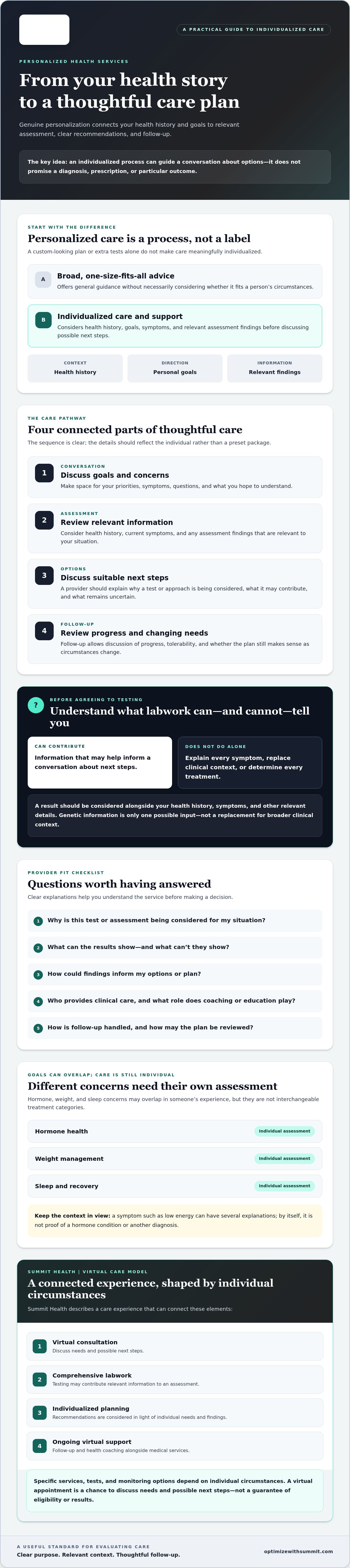
This guide explains the steps involved in individualized care, the questions to ask when evaluating a provider, and what to expect from a data-informed plan. You’ll also learn how Summit Health connects virtual consultations, comprehensive labwork, tailored planning, and ongoing monitoring, with health coaching alongside medical services. The aim is to help you assess fit and choose a sensible next step without assuming every service is appropriate or promising a particular result.
Key Takeaways
- Personalized health services should reflect your health history, goals, and relevant assessment findings, not just broad wellness advice.
- Ask why tests are recommended and how results could inform care before agreeing to an assessment.
- Compare providers by clinical involvement, clarity about how plans are developed, and how follow-up is handled.
- Hormone, weight, and sleep concerns can overlap, but each calls for individual assessment rather than a one-size-fits-all approach.
- With Summit Health, a virtual appointment is a chance to discuss your needs and possible next steps, not a guarantee of eligibility or results.
What Personalized Health Services Include, and What They Do Not
Personalized health services are care or support shaped around an individual’s health history, goals, symptoms, and relevant assessment findings rather than generic recommendations alone. The approach can involve clinical evaluation, diagnostic information, tailored options, and follow-up. The term describes an individualized process, not a promise of a diagnosis, prescription, or particular health outcome.
Personalized medicine is a related concept that describes tailoring prevention or treatment to individual characteristics. In practice, the scope of a service matters. A medical provider may assess health concerns and discuss clinical options, while a health coach can support goal-setting and behavior change. Coaching and general education can complement medical care, but they aren’t substitutes for clinical evaluation or treatment.
How individualized care differs from one-size-fits-all advice
Generic advice offers broad guidance. An individualized plan considers whether that guidance fits a person’s circumstances. A provider may review health history, current symptoms, priorities, and relevant assessment results before discussing possible next steps. For example, a change in energy can have several explanations. On its own, it isn’t proof of a hormone condition or any other diagnosis.
Context matters. Two people with a similar goal may have different medical histories, preferences, or findings, so the same service or intervention may not be suitable for both. Assessment can guide a conversation about options and limitations. It doesn’t guarantee that testing will identify a cause or that a particular approach will produce a specific result.
Which health goals may personalized services address?
Services may focus on distinct areas such as hormone health, weight management, or sleep and recovery. These goals can overlap in someone’s experience, but they aren’t interchangeable treatment categories. A person’s concerns and assessment findings help determine which, if any, area is appropriate to explore with a qualified medical provider.
Before moving forward, clarify what the service includes. Ask whether clinical care is provided, what role coaching or education plays, and how recommendations are made. In a telehealth-led practice such as Summit Health, virtual consultations, comprehensive labwork, individualized planning, and ongoing virtual support can be part of the care experience. The specific services, tests, and monitoring options available depend on individual circumstances. A discussion can clarify potential fit and next steps without establishing eligibility or guaranteeing results.
How Personalized Health Services Move from Assessment to Follow-Up
Good care follows a clear sequence, but the details should reflect the person rather than a preset package. In personalized health services, the process typically begins with a conversation about goals and concerns, continues with a review of relevant health information, and moves to a discussion of suitable options and follow-up. Each step should have a clear purpose.
The sequence is straightforward: discuss goals, review relevant information, consider appropriate options, and plan how progress will be followed. A clinician should explain why they recommend a test or approach, what monitoring may involve, and what remains uncertain. You should have room to ask questions and understand alternatives before making decisions.
What diagnostic labwork can contribute
Labwork can add information to an assessment, but it isn’t a complete explanation on its own. A provider interprets results alongside your health history, symptoms, and other relevant details. A result may help inform a conversation about next steps, but no single panel can explain every symptom or determine every treatment. Ask which tests are being considered, why they are relevant to your situation, and how the findings could affect the plan.
For more background on the role of genetics in one branch of individualized care, the National Human Genome Research Institute explains personalized medicine. Genetic information is only one possible input. It doesn’t replace broader clinical context.
Why follow-up matters after a plan begins
A plan should be reviewed as circumstances change. Follow-up gives a clinician an opportunity to discuss progress, tolerability, and new or changing needs. If an approach isn’t suitable or useful, the plan may need reassessment rather than continuing by default. Ask how progress will be reviewed, what changes you should report, and what options exist if the initial approach needs adjustment.
Summit Health describes ongoing virtual monitoring and health coaching alongside its telehealth-led care. The specific tests and monitoring options available depend on the individual. Readers seeking more detail about hormone testing can also consult a dedicated hormone blood work guide and discuss relevant questions with a provider.
If you’d like to clarify how this process could apply to your goals, you can contact Summit Health to discuss possible next steps. An initial conversation can help establish fit, but it doesn’t promise eligibility or a particular outcome.
How to Evaluate Personalized Health Services Before Choosing
Strong personalized health services make the reasoning behind care visible. You should be able to understand who reviews your information, how recommendations relate to your goals, and what support continues after an initial consultation. A polished intake process or virtual platform isn’t enough on its own. Clarity, appropriate clinical involvement, and realistic expectations matter more.
Use this checklist to compare providers:
- Clinical involvement: Who reviews your health information and explains clinical recommendations? Clarify the roles of medical providers and coaches.
- Assessment: What information or testing may be relevant to your situation, and why? Ask how results could influence decisions.
- Plan rationale: Can the provider explain the purpose, limitations, risks, and alternatives for each proposed option?
- Continued support: How will progress be reviewed, and how can you raise concerns or ask follow-up questions?
Clear answers matter. A credible service should be comfortable explaining uncertainty, including when an assessment may not identify a cause or when a proposed approach may not be suitable. Be cautious of language suggesting a test automatically points to one treatment or promising a particular outcome.
Questions to ask about assessment and clinical oversight
Before choosing, ask who will review your health history, symptoms, and any test results, and who will discuss recommendations with you. Find out which assessments might be considered and what decision each could help inform. You can also ask how changes in your health are handled, how to share concerns, and what follow-up questions the service can address. The answers should make responsibilities and next steps clear.
How to compare virtual care and ongoing support
Virtual care isn’t automatically impersonal or insufficient. The format alone doesn’t tell you whether an assessment is thoughtful or follow-up is meaningful. Compare the actual components: consultations, diagnostic review, monitoring, and coaching. Ask which are available, how they work together, and whether the service provides medical care, coaching, or both. Check that the format can meet your needs, and ask how the provider handles concerns that require care beyond its scope.
Summit Health describes a telehealth-led model that brings virtual consultations, comprehensive labwork, individualized planning, and ongoing virtual monitoring and health coaching together. These elements have distinct roles, and available assessments or monitoring options may vary by person. To understand how the practice describes its approach, visit Summit’s care model. A useful comparison leaves you clear on who supports each part of care and how decisions are reviewed over time.
Match Personalized Health Services to Your Goals and Needs
Start with the outcome you hope to explore, not a treatment you’ve already decided you need. Personalized health services are easier to evaluate when you can explain what matters to you, how your health history may shape the discussion, and what practical factors affect your choices. A consultation can help clarify whether a service category fits your situation, but a goal or symptom alone can’t establish that a treatment is appropriate.
Hormone, weight, and sleep support are not interchangeable
These areas may intersect in a person’s experience, but they call for distinct conversations. Summit Health offers hormone therapy, medical weight loss, and sleep and recovery support as separate service areas. A concern related to sleep, for example, doesn’t automatically point to hormone therapy, and a weight-related goal doesn’t determine which options are suitable. Individual assessment and clinical judgment help guide that discussion.
For details about that service area, see Summit’s hormone therapy information. Readers exploring weight-related goals can review its medical weight loss services. These pages can help you understand the areas offered, but they can’t determine whether a service is right for you.
Turn personal priorities into useful consultation questions
Before a conversation, note your main goal and what meaningful progress would look like in daily life. You might describe what you hope to do more comfortably or which part of your routine you’d like to address. Bring relevant health history, current care, and practical constraints that could affect your options. This context helps keep the discussion grounded in your needs.
Useful questions include:
- Which service area, if any, relates to my goals and history?
- What information or assessment would inform that decision?
- How will we discuss progress, tolerability, and possible plan adjustments?
- What alternatives or limitations should I understand?
Clear answers can help you judge fit without expecting a specific treatment or result. If you’d like to discuss your goals and possible next steps with Summit Health, contact the team. A conversation can help clarify fit; it doesn’t guarantee eligibility or outcomes.
What to Expect from Summit Health’s Personalized Virtual Services
Summit Health’s telehealth-led model brings virtual consultations, comprehensive labwork, individualized planning, and continued virtual support into a connected care experience. It makes space for your goals and health context while keeping expectations grounded: an appointment is a conversation about your needs and possible next steps, not a guarantee of eligibility, a prescription, or a particular result.
How Summit connects assessment, planning, and support
A virtual consultation provides an opportunity to discuss what you’d like help with, relevant health history, and current concerns. If diagnostic labwork is appropriate, results may contribute to the assessment alongside other information. They don’t determine a plan on their own. Your provider can discuss which options may be relevant and what follow-up could involve.
Summit also describes ongoing virtual monitoring and health coaching as part of its support over time. These components serve different purposes: clinical follow-up can help review care, while coaching can support health-related goals. The specific services, lab tests, and monitoring options available depend on individual circumstances.
Take a clear next step
Prepare for an appointment by noting your main concerns, relevant health history, current care, and questions. It may also help to describe what you hope will change in daily life. You can ask what information would guide recommendations, how progress may be reviewed, and what alternatives or limitations to consider.
If your questions are hormone-focused, Summit’s hormone quiz may offer an optional starting point for exploring that area. It doesn’t replace an individual assessment. To discuss personalized health services that may fit your goals, contact Summit Health. A conversation can clarify fit and possible next steps without promising eligibility or outcomes.
For an emergency, contact local emergency services or go to an emergency department. Telehealth support isn’t a substitute for emergency care.
Choose a Care Path That Fits Your Goals
Personalized health services are most useful when recommendations connect your goals and health history to a clear assessment and thoughtful follow-up. Ask what information informs the plan, why a test or option is being considered, and how care may be reviewed over time. The right next step is a conversation, not an assumption that a particular service or outcome is guaranteed.
Summit Health’s telehealth-led care model brings virtual consultations together with comprehensive diagnostic labwork to inform individual health assessments. Ongoing virtual monitoring and health coaching can support care over time, with available services and next steps determined by individual needs.
If you’re ready to discuss your goals and explore whether Summit’s approach may be a fit, schedule a personalized appointment. Bring your questions and relevant health information. A considered first conversation can help you move forward with greater clarity.
Frequently Asked Questions
What are personalized health services?
Personalized health services adapt care or support to a person’s goals, health history, and relevant assessment findings. Depending on the provider and service, this may involve a consultation, diagnostic labwork, an individualized plan, and follow-up. Personalization doesn’t guarantee a diagnosis or a particular result. Before choosing a service, ask who reviews your information, how recommendations are made, and how the plan may be monitored or adjusted over time.
How do personalized health services work?
They usually begin with a discussion of your goals, health history, and current concerns. A provider may review existing information or recommend an assessment, then explain potential options and follow-up. The exact process varies based on the service and your circumstances. Ask what each step involves, how findings might inform decisions, and how to raise questions if your needs or concerns change as care progresses.
Are personalized health services available through telehealth?
Yes, some providers offer virtual consultations and follow-up, though available services depend on your needs and the provider. Summit Health describes a telehealth-led model with virtual consultations and ongoing virtual monitoring. Telehealth doesn’t mean every assessment can happen remotely. Labwork or in-person care may be appropriate in some circumstances. Ask how testing is arranged, what can be managed virtually, and when another type of care may be recommended.
Can personalized health services help with hormones, weight, or sleep?
Some providers offer services focused on hormone health, weight management, or sleep and recovery. Summit Health offers these as distinct service areas. Appropriate options depend on individual assessment and clinical judgment, not just a symptom or desired outcome. Similar concerns can have different causes, and one approach may not suit everyone. Ask what information informs recommendations, what options might be discussed, and how follow-up works.
What should I ask before choosing a personalized health provider?
Ask who reviews your health information, how recommendations are developed, and what follow-up is available. Find out how the provider explains potential risks, limitations, and alternatives, and how test results may inform decisions. Clarify whether the service includes medical care, coaching, or both. Also ask how to contact the care team with questions and what happens if your health needs or circumstances change during the process.
Does personalized healthcare require labwork?
No, labwork isn’t required in every case. Whether testing may be useful depends on the service, your circumstances, and clinical judgment. If labwork is recommended, ask why each test is being considered and how the results could inform decisions. Results should be interpreted alongside other relevant information, not treated as a complete explanation on their own. Ask whether follow-up testing may be relevant to your care.
Is virtual personalized care the same as emergency medical care?
No. Virtual medical or wellness services aren’t a substitute for emergency evaluation. If you may be experiencing a medical emergency, contact emergency services or seek immediate in-person care. For non-emergency concerns, ask the provider what virtual consultations and follow-up can address, and what steps they recommend if your needs call for in-person care. Understanding the service’s scope can help you choose the right setting for support.

Article by
Dr. David Richardson
David Richardson, is the founder and CEO of Summit Health and the author of "Insights from the Summit", where he writes about hormone optimization, metabolic health, thyroid function, longevity, and preventive medicine.
After entering healthcare in 2009, David became increasingly interested in a question that traditional medicine often struggles to answer:
Why do so many people continue to feel terrible despite being told their labs are "normal"?
That question eventually led him into the field of health optimization in 2020, where he became passionate about understanding physiology at a deeper level and helping patients uncover the root causes of their symptoms rather than simply managing them.
Today, David's philosophy is simple: normal and optimal are not the same thing. Every patient is physiologically unique, and meaningful healthcare begins by listening to symptoms, understanding the science, and recognizing that laboratory values are only one piece of a much larger picture.
Through Summit Health and Insights from the Summit, David's mission is to help people better understand their bodies, ask better questions, and make informed decisions that improve both their health span and quality of life.


