

IMPORTANT DISCLAIMERS
Medical Disclaimer: The information in this article is provided for educational purposes only and is not intended as medical advice or a substitute for individualized medical care. Every person's health needs are unique. Always consult a qualified healthcare professional before starting, stopping, or changing any medication, supplement, or treatment plan. -------
Article Disclaimer: Articles are reviewed and published by Summit Health to provide evidence-based educational information. While Summit Health strives to provide reliable and current health information, medical knowledge is always evolving over time. Depending on when you are reading this content, it may not reflect the latest research or apply to your individual circumstances.
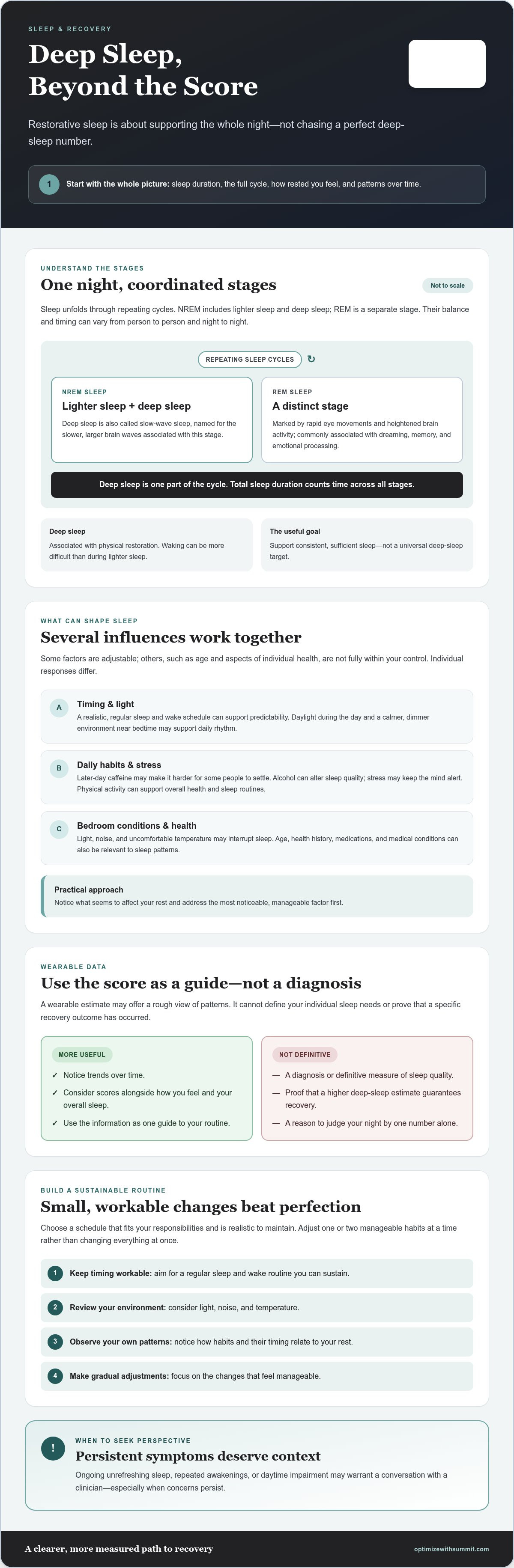
A higher deep-sleep score isn’t always the best measure of a better night. If you’re spending enough time in bed but still waking unrefreshed, it’s understandable to look for answers in your wearable, your supplements, or a new bedtime routine. Deep sleep optimization is less about hitting a perfect number and more about supporting the conditions that help your whole sleep cycle work well.
This guide explains what deep sleep does, how it relates to other sleep stages, and which sustainable habits may support restorative rest. It also clarifies what wearable sleep-stage scores can and can’t tell you, so you can use the data as a guide rather than a diagnosis. You’ll learn how to prioritize sleep timing, daily routines, and your sleep environment, while making sense of advice about exercise and supplements. Finally, we’ll outline when ongoing unrefreshing sleep or other persistent concerns may warrant professional evaluation. The goal is a clearer, more measured path to recovery, without chasing a single score.
Key Takeaways
- Deep sleep is one part of a broader sleep cycle, so recovery isn’t defined by a single stage alone.
- Sleep timing, light, bedroom conditions, stress, and other daily influences may shape sleep patterns.
- Use wearable scores to notice trends, not as a diagnosis or a definitive measure of sleep quality.
- Build a sustainable deep sleep optimization routine by adjusting one or two manageable habits at a time.
- Persistent unrefreshing sleep, repeated awakenings, or daytime impairment may call for a conversation with a clinician.
Deep Sleep Optimization Starts With Understanding Slow-Wave Sleep
Deep sleep is a distinct stage, not another name for a full night’s rest. It occurs during non-rapid eye movement (NREM) sleep, which includes lighter sleep as well as the deepest stage. Deep sleep is also called slow-wave sleep because brain activity during this stage includes slower, larger waves than during lighter sleep.
Deep sleep describes one stage of the sleep cycle; total sleep duration describes how long you sleep across all stages. Both matter. Sleep unfolds through repeating cycles that include NREM stages and rapid eye movement (REM) sleep. The balance and timing of those stages can vary from person to person and night to night, so a single universal deep-sleep target isn’t a sound goal for everyone.
What Happens During Deep Sleep?
During deep sleep, the brain is less responsive to many outside sounds and sensations, so waking someone can be more difficult than during lighter sleep. The brain’s electrical activity shows slow-wave patterns, which give this stage its name. Deep sleep is associated with physical restoration and processes that support the body. That association doesn’t mean that increasing a tracker’s deep-sleep estimate guarantees a specific health or recovery outcome.
For a closer look at NREM stages and terminology, see this overview of slow-wave sleep (SWS). The practical takeaway is simple: deep sleep is one part of a coordinated nightly pattern, not a stand-alone score to maximize.
Deep Sleep, REM Sleep, and Total Sleep Are Different
REM sleep is a separate stage marked by rapid eye movements and heightened brain activity. It’s commonly associated with dreaming and plays a role in memory and emotional processing. NREM sleep, including deep sleep, has a different pattern of brain activity and is associated with physical restoration. These stages serve different roles and contribute to sleep as a whole.
That distinction matters for deep sleep optimization. Focusing narrowly on one stage can distract from whether you’re getting enough sleep overall and whether your sleep feels restorative. A wearable estimate may offer a rough view of patterns, but it can’t define your individual needs. Sleep architecture, meaning the mix and sequence of sleep stages, naturally differs among people. A more useful aim is to support consistent, sufficient sleep and consider persistent symptoms in context rather than judging recovery by one number.
What Shapes Deep Sleep: Circadian Rhythm, Habits, and Health
Deep sleep patterns reflect several influences working together, not one habit or single cause. Some are adjustable, such as sleep timing and bedroom conditions. Others, including age and aspects of individual health, aren’t fully within your control. A useful principle for deep sleep optimization is to refine the routines you can influence without expecting every night, or every person, to follow the same pattern.
How Circadian Rhythm and Sleep Timing Interact
Your circadian rhythm is the internal body clock that helps coordinate sleep and wakefulness across the day. Regular sleep and wake times can support a more predictable routine, while shifting schedules may make it harder to feel ready for sleep at a consistent time. Choose a schedule that fits your responsibilities and is realistic to maintain. A workable routine is more useful than an idealized bedtime you can’t sustain.
Light is one cue the body uses to help set its daily timing. Daylight during the day and a calmer, dimmer environment as bedtime approaches may support a consistent rhythm, though individual responses vary. Cleveland Clinic also outlines practical tips to get more deep sleep, including attention to schedule and sleep environment.
Lifestyle and Health Factors That May Disrupt Rest
Daily choices can influence sleep, but their effects depend on the person and broader context. Caffeine later in the day may make it harder for some people to settle. Alcohol can alter sleep quality even if it initially feels relaxing. Stress may keep the mind alert, while physical activity can support overall health and sleep routines. The timing and intensity that work best can differ, so observe your own patterns rather than assuming one rule fits everyone.
A comfortable bedroom can also make rest easier. Consider whether light, noise, or an uncomfortable temperature is interrupting your sleep, then address the most noticeable factor first. Small adjustments are often more sustainable than changing everything at once.
Age and health history also shape sleep architecture, the pattern of stages across the night. A change in deep-sleep estimates over time doesn’t by itself prove that something is wrong, and no routine can prevent every age-related or health-related change. Medications and medical conditions may affect sleep too. Review possible effects with a clinician rather than stopping or changing a medication on your own.
Sleep timing, light, bedroom comfort, stress, substances, activity, and health can all influence rest, but no single factor explains every person’s sleep. Start with the routines you can adjust, and treat the rest as useful context rather than a personal failure.
Deep Sleep Tracking: What Wearable Scores Can and Cannot Tell You
A wearable can make sleep visible, but a deep-sleep estimate isn’t a clinical measurement. Most consumer devices use signals such as movement, heart rate, or breathing patterns and apply algorithms to estimate when you’re asleep and which stage you may be in. Sensors and methods vary, so accuracy isn’t universal. Check your device’s documentation, and use its score to notice possible patterns rather than diagnose a sleep problem.
Are Deep-Sleep Tracker Readings Accurate?
Think of a tracker as a source of trend data, not a nightly verdict. One unusual score may reflect normal variation or an imperfect estimate. If the number conflicts with how you feel, don’t assume the device is right. For deep sleep optimization, consider whether patterns over time align with your sleep habits and daytime alertness. Avoid changing your routine in response to a single reading.
| Method | Practical use | Limitations |
|---|---|---|
| Consumer wearable | Can help you review estimated sleep timing and stage trends across nights. | Stage information is inferred from device signals and algorithms; estimates vary by device and aren’t a diagnosis. |
| Sleep diary | Records bedtime, wake time, awakenings, routines, and how rested you feel. | Relies on your observations and can’t measure sleep stages directly. |
| Clinical sleep study | Polysomnography records multiple body signals during sleep to support clinical assessment when appropriate. | It’s a medical test arranged based on a clinician’s assessment, not a routine way to verify a consumer score. |
A simple diary can add context to device data. Note your sleep and wake times, nighttime awakenings, relevant routine changes, and daytime energy. Look for repeated patterns rather than reacting to one night. These notes can help you describe your experience more clearly, but neither a diary nor a wearable can diagnose a sleep disorder.
When Sleep Testing May Be More Informative
A clinician may consider polysomnography, a sleep study that records signals such as brain activity, breathing, and oxygen levels, when symptoms and medical history suggest further assessment could help. A tracker score alone doesn’t determine whether testing is appropriate. Discuss persistent sleep concerns with a clinician, who can interpret symptoms and other relevant factors and advise on next steps.
How to Build a Sustainable Deep Sleep Optimization Routine
A useful routine is built in sequence, not all at once. Start with sleep timing, make your bedroom more restful, then review daily influences such as caffeine, alcohol, activity, and stress. Choose one or two manageable adjustments and keep the rest of your routine steady. This makes it easier to notice what feels helpful without turning each night into a test of willpower or a chase for a higher tracker score.
Start With a Stable Schedule and Restful Environment
Set a wake time you can maintain around work, caregiving, and other regular commitments. Choose a bedtime that gives you enough opportunity for sleep, then aim to keep both times reasonably consistent. A realistic schedule is more useful than a perfect one you can’t sustain.
Next, address the most noticeable source of disruption in your bedroom. Reduce unwanted light, limit noise where practical, and adjust bedding or room temperature if you’re uncomfortable. You don’t need to overhaul the space. Begin with the factor most likely to interrupt your rest, then give the change time to become part of your routine.
Review Exercise, Stimulants, Alcohol, and Stress
Once timing and environment feel steady, consider your daytime habits. Regular movement can fit into a sleep-supportive routine, but the right form and timing depend on your schedule and how you feel. Notice whether caffeine later in the day or alcohol near bedtime seems to coincide with difficulty falling asleep or more awakenings. Avoid assuming a single adjustment will affect everyone in the same way.
A wind-down routine can also create a clear transition between the day and bed. Choose a calming activity you’re willing to repeat, such as reading or quiet breathing. Keep it simple enough to work on busy evenings, too.
Track the experience, not just the stage estimate. Record bedtime, wake time, awakenings you remember, the habits you’re testing, and your daytime energy or alertness. Review entries for recurring patterns rather than judging a single night. If you’re changing caffeine timing and bedroom light together, for example, it may be harder to tell which adjustment made a difference. Try one or two changes at a time, and keep what feels sustainable.
If sleep remains unrefreshing or daytime functioning is affected despite reasonable routine changes, a clinician can help consider your symptoms and health context. For personalized sleep and recovery support, schedule an appointment with Summit Health.
When Deep Sleep Concerns Call for Personalized Clinical Support
Reasonable routine changes can support better rest, but they can’t explain every persistent sleep concern. Consider discussing ongoing unrefreshing sleep, repeated awakenings, or daytime impairment with a clinician, especially if these patterns affect your daily life. A low deep-sleep estimate alone doesn’t establish a problem. Symptoms and their effects matter more than a single tracker score.
What to Bring to a Sleep or Recovery Discussion
A few notes can make the conversation more useful. Bring a brief sleep diary if you have one, along with changes you’ve tried and any symptoms you’ve noticed. Include relevant medication and supplement information, and describe how sleep is affecting your daytime energy, focus, or routine. Wearable data may provide context, but it shouldn’t replace your account of how you feel. A clinician can decide whether further evaluation or referral is appropriate.
How Personalized Health Support Fits Into Sleep Optimization
Deep sleep optimization is not a guaranteed outcome of any single plan. Summit Health offers personalized sleep and recovery support, with virtual consultations, comprehensive labwork to assess individual health needs, and ongoing virtual monitoring and health coaching. These services can provide a structured way to consider health context and progress over time. They don’t promise a particular sleep-stage duration, tracker score, or clinical result.
Hormones may be one part of an individual’s broader health picture, but hormone evaluation or treatment decisions belong with qualified clinicians. Hormone therapy is not a diagnosis or treatment for a sleep disorder, and it doesn’t replace appropriate sleep-disorder care. If hormone-related concerns arise in a sleep discussion, a clinician can help determine whether an individualized assessment is relevant. Learn more about clinician-guided hormone therapy.
Persistent symptoms deserve attention even if your wearable reports a reassuring score. Share what you’re experiencing and ask what next steps fit your history and needs. Schedule a personalized appointment.
Build Better Recovery One Step at a Time
Deep sleep optimization works best as a steady practice, not a contest to reach a perfect tracker score. Deep sleep is one part of a larger sleep cycle, and wearable estimates can offer clues about patterns without confirming whether your sleep is clinically healthy.
Start with the foundations you can influence: a realistic sleep schedule, a comfortable bedroom, and daily habits that support rest. Track bedtime, awakenings, and how you feel during the day, then adjust one or two manageable routines at a time. If unrefreshing sleep, repeated awakenings, or daytime effects persist, bring those patterns and your health context to a clinician for guidance.
Better recovery doesn’t require guessing alone. Summit Health offers personalized sleep and recovery support, with care shaped around individual needs rather than a promised score or outcome. Schedule a personalized appointment to discuss your concerns and explore a thoughtful next step. Consistent, informed changes can help you move toward more restorative rest.
Frequently Asked Questions
What is deep sleep, and why is it important?
Deep sleep is the deepest stage of non-rapid eye movement (NREM) sleep, also called slow-wave sleep. During it, brain activity shows slower wave patterns, and a person is less responsive to many sounds or sensations. This stage is associated with physical restoration, but it’s only one part of a complete sleep cycle. REM sleep and lighter stages also contribute to sleep, so overall rest matters more than maximizing one stage alone.
How much deep sleep do adults need each night?
There isn’t one established deep-sleep duration that applies to every adult. Sleep-stage patterns vary by person and night, and consumer devices can only estimate stages. The National Sleep Foundation recommends that adults get 7-9 hours of total sleep per night; that refers to time asleep across all stages, not a deep-sleep target. Focus on sufficient overall sleep and how you function during the day, rather than trying to hit a specific stage score.
Can you increase deep sleep naturally?
You can support conditions that are conducive to restorative sleep, but no habit guarantees more deep sleep or a specific tracker score. A consistent, realistic sleep and wake schedule, a comfortable bedroom, and a calming wind-down routine are reasonable starting points. Review daily habits such as caffeine and alcohol timing, too. For deep sleep optimization, make one or two manageable changes at a time and assess how your sleep and daytime energy feel over time.
Are wearable deep-sleep scores accurate?
Wearable deep-sleep scores are estimates, not clinical measurements or a diagnosis. Devices use signals such as movement and heart rate, along with algorithms, to infer sleep stages. Their methods and validation differ, so one device’s reading may not match another’s. Use scores to look for longer-term patterns, and consider keeping a simple sleep diary. If the numbers conflict with persistent symptoms, discuss the symptoms with a clinician rather than relying on the score.
Does exercise improve deep sleep?
Regular physical activity can be part of a healthy routine and may support sleep for some people, but it doesn’t guarantee an increase in deep sleep. Responses to exercise, including the preferred type and timing, vary. Choose movement that fits your health, schedule, and preferences, then notice whether it affects your ability to settle or how rested you feel. If activity seems to disrupt sleep or causes other concerns, consider adjusting your routine or discussing it with a clinician.
Can stress or alcohol affect deep sleep?
Yes. Stress can make it harder to relax and may contribute to disrupted rest, while alcohol can affect sleep quality even if it initially makes you feel drowsy. The effects vary, so look for patterns rather than assuming either factor explains every difficult night. A calming, repeatable wind-down practice may help ease the transition to bed. If you drink alcohol, notice whether its timing corresponds with awakenings or less-restful sleep.
When should I speak with a doctor about poor sleep?
Talk with a clinician if unrefreshing sleep, repeated awakenings, or daytime impairment persist or interfere with daily life. Bring notes on your sleep schedule, symptoms, routine changes, and relevant medications or supplements. Describe how you feel during the day, not only what a wearable reports. A clinician can consider your symptoms and health history and decide whether further evaluation or referral is appropriate. Summit Health offers personalized sleep and recovery support, but a tracker score alone can’t determine what care you need.

Article by
Dr. David Richardson
David Richardson, is the founder and CEO of Summit Health and the author of "Insights from the Summit", where he writes about hormone optimization, metabolic health, thyroid function, longevity, and preventive medicine.
After entering healthcare in 2009, David became increasingly interested in a question that traditional medicine often struggles to answer:
Why do so many people continue to feel terrible despite being told their labs are "normal"?
That question eventually led him into the field of health optimization in 2020, where he became passionate about understanding physiology at a deeper level and helping patients uncover the root causes of their symptoms rather than simply managing them.
Today, David's philosophy is simple: normal and optimal are not the same thing. Every patient is physiologically unique, and meaningful healthcare begins by listening to symptoms, understanding the science, and recognizing that laboratory values are only one piece of a much larger picture.
Through Summit Health and Insights from the Summit, David's mission is to help people better understand their bodies, ask better questions, and make informed decisions that improve both their health span and quality of life.


