

IMPORTANT DISCLAIMERS
Medical Disclaimer: The information in this article is provided for educational purposes only and is not intended as medical advice or a substitute for individualized medical care. Every person's health needs are unique. Always consult a qualified healthcare professional before starting, stopping, or changing any medication, supplement, or treatment plan. -------
Article Disclaimer: Articles are reviewed and published by Summit Health to provide evidence-based educational information. While Summit Health strives to provide reliable and current health information, medical knowledge is always evolving over time. Depending on when you are reading this content, it may not reflect the latest research or apply to your individual circumstances.
What if the right hormone plan starts with a closer look, not an automatic prescription? Changes in sleep, energy, or mood can have several possible causes. A telehealth hormone specialist considers your symptoms alongside your health history and lab results to assess whether hormone care may be appropriate for you.
It’s reasonable to want clarity before making treatment decisions. A virtual visit should help you understand what information matters, how labwork may contribute, and how your individual needs shape next steps. Care is a process, not a single appointment.
In this guide, you’ll learn what to expect before and during an initial virtual evaluation, how a specialist interprets labwork in context, and how a personalized plan may take shape. You’ll also see how ongoing virtual monitoring and health coaching can help review progress and refine care over time. The goal is a thoughtful, data-informed approach that keeps your health needs at the center.
Key Takeaways
- A telehealth hormone specialist considers symptoms, health history, and relevant labwork together because hormone-related concerns can have more than one possible cause.
- Prepare for your virtual evaluation by noting symptom changes, relevant medical history, medications, supplements, and personal goals.
- Labwork is selected for your situation and interpreted alongside your health context to inform appropriate next steps.
- Personalized care includes clear communication and follow-up, not simply a one-time visit or an automatic prescription.
- Ongoing virtual monitoring and health coaching can help review progress and refine your plan over time.
What Does a Telehealth Hormone Specialist Do?
A telehealth hormone specialist evaluates hormone-related concerns through a virtual consultation, relevant diagnostic testing, and a review of your broader health context. The appointment is a structured clinical assessment, not a promise of a diagnosis or prescription. Fatigue, disrupted sleep, mood changes, or shifts in performance are worth discussing, but each can also have causes unrelated to hormones.
Telehealth uses communication technology to support health services at a distance. In hormone care, a virtual format can make it easier to discuss concerns and review information over time. The quality of care depends on how thoughtfully the clinician connects your symptoms, history, and test results.
What concerns may prompt a hormone-focused evaluation?
Changes in energy, sleep, mood, or physical performance may prompt someone to seek an evaluation. They’re useful discussion points, not diagnostic proof. A clinician may ask when symptoms began, how they vary, and whether other health or lifestyle factors could be relevant. One symptom alone doesn’t identify a specific hormone imbalance.
Context matters. Your health history and symptom patterns help inform which diagnostic details may be useful and how to interpret them. Lab results add another source of information, but they’re considered alongside your individual situation rather than treated as a complete answer on their own.
How is a specialist-led virtual visit different?
A specialist-led visit gives a clinician time to understand your goals, review your health history, and discuss concerns before determining appropriate next steps. A symptom quiz or wellness article can offer general information, but it can’t provide the same individualized clinical conversation. A prescription-only interaction may also leave little room to understand why a treatment is being considered or how progress will be reviewed.
Connected care brings the pieces together: consultation, relevant diagnostics, interpretation, and follow-up. At Summit Health, comprehensive diagnostic labwork informs personalized planning, while virtual monitoring and health coaching support continuity. Evaluation doesn’t guarantee that a hormone condition will be identified or that treatment will be appropriate for everyone. The aim is a reasoned plan based on your health needs, with options discussed in context.
For a broader overview of treatment considerations, see our hormone therapy information.
How Does a Telehealth Hormone Specialist Evaluate Your Health?
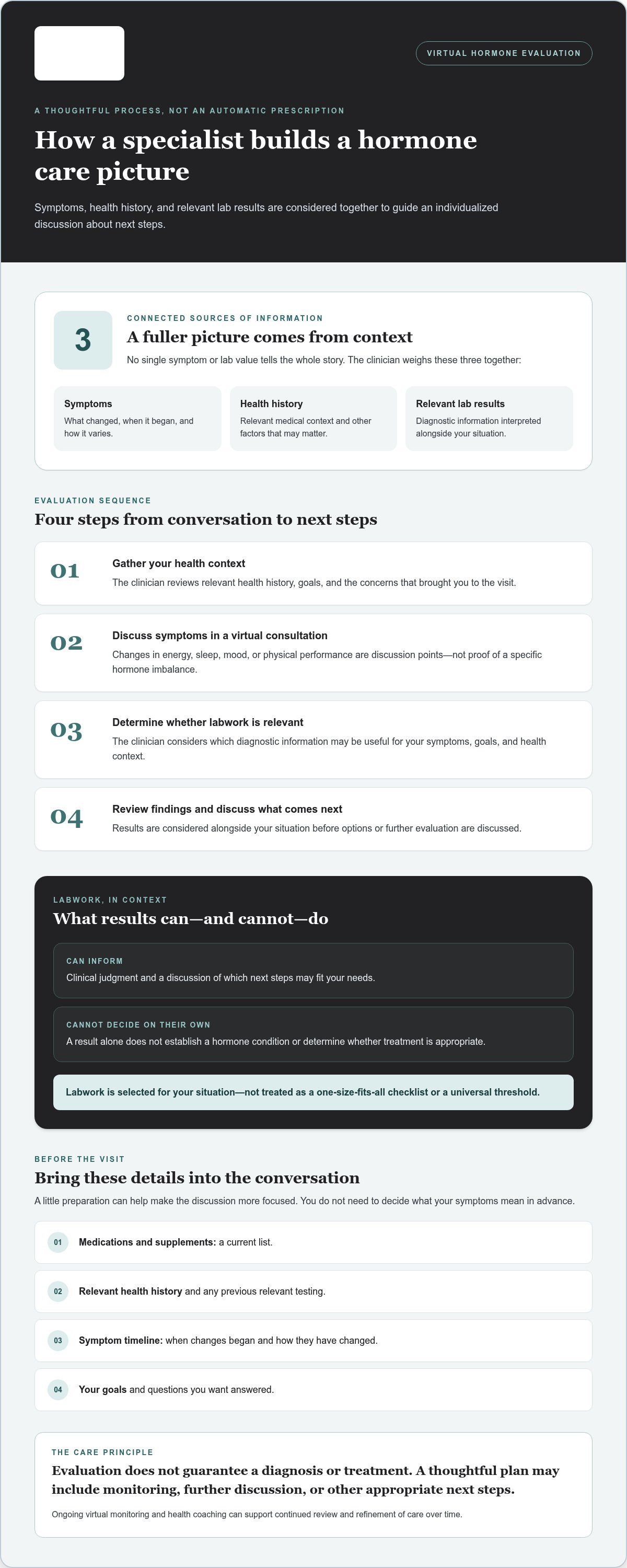
A thorough evaluation follows a clear sequence. Your clinician gathers your health history, discusses your concerns in a virtual consultation, determines whether labwork is relevant, and reviews the findings with you before discussing next steps. The information needed depends on your symptoms, goals, and health context, so the process is tailored to you.
An individualized hormone assessment considers your health history, symptoms, and relevant test results together, rather than treating any one detail as a diagnosis. Lab values can inform clinical judgment, but a result on its own doesn’t establish a hormone condition or determine whether treatment is appropriate.
What should you prepare before the virtual consultation?
A little preparation can make the conversation more focused. Gather a current list of medications and supplements, note relevant health history, and outline when symptoms began and how they’ve changed. Include your goals, such as understanding a change in sleep or reviewing shifts in energy, along with questions you want answered. A hormone health questionnaire can help you organize information before the visit.
Be concise, but include details that could shape the discussion, such as changes in routine or previous relevant testing. You don’t need to decide what your symptoms mean in advance. That interpretation belongs in the clinical conversation.
How do lab results inform a personalized plan?
After reviewing your history and concerns, the clinician determines which diagnostic information may be useful for your situation. Comprehensive labwork can add measurable data to the evaluation, but it isn’t a one-size-fits-all checklist. The clinician interprets findings alongside your symptoms and other relevant health factors, rather than applying a universal threshold or making a treatment decision from a single number.
Once results are reviewed, the next step is to discuss what they may mean, whether further evaluation is appropriate, and which options fit your needs. A thoughtful plan may involve monitoring or additional discussion, not necessarily hormone treatment. For more detail on testing considerations, read this hormone blood work guide.
At Summit Health, comprehensive diagnostic labwork informs personalized care planning, while ongoing virtual monitoring and health coaching support continued review. To organize your health information before a virtual evaluation, start with the hormone health questionnaire.
What Should You Look for in Telehealth Hormone Care?
Quality virtual care has structure. A telehealth hormone specialist should connect your concerns with relevant evaluation, explain how findings inform options, and make follow-up part of the care process. Use these elements to assess the care experience, rather than focusing only on convenience or whether a particular treatment is offered.
| Care element | What it means for you |
|---|---|
| Evaluation | Your concerns, health history, and goals are discussed in a clinical consultation, not assessed through a symptom quiz alone. |
| Relevant labwork | Diagnostic testing is selected based on your situation, and results are explained in context rather than treated as a diagnosis by themselves. |
| Personalization | Recommendations reflect your individual health needs. A hormone diagnosis or treatment isn’t assumed in advance. |
| Follow-up | There’s an opportunity to revisit concerns, your experience, and changing goals, rather than ending care with a single interaction. |
| Clear communication | You can understand what findings may mean, which next steps are being considered, and why they fit your circumstances. |
Responsible hormone care connects test findings to individual context and follow-up, so decisions draw on more than a lab value alone. Virtual care can be structured and ongoing. At Summit Health, virtual monitoring and health coaching support continuity, creating opportunities to review progress and refine care without promising a particular result. Follow-up is shaped around individual circumstances.
Why does ongoing follow-up matter?
Your health needs and goals may shift, and a follow-up conversation brings those changes into the care plan. It can also give you space to discuss your experience with a plan, revisit questions, and consider whether next steps remain appropriate. Monitoring isn’t based on one universal calendar. Its role and timing depend on individual circumstances.
How do you assess whether a virtual model fits?
Suitability depends on the concern being evaluated, the clinician’s assessment, and whether the situation requires an in-person evaluation. A virtual consultation can support discussion and review of diagnostic information, but it doesn’t replace every kind of assessment. The clinician should explain when a different setting is needed. Telehealth isn’t a substitute for emergency services or urgent in-person care.
How to Prepare for a Telehealth Hormone Specialist Appointment
A little preparation helps make your consultation more focused. Before meeting with a telehealth hormone specialist, gather the details that give the clinician a clearer view of your health and what you hope to understand. You don’t need to diagnose yourself or decide whether treatment is right for you.
- Symptom timeline: Note what you’ve noticed, when it began, and whether it has changed over time.
- Relevant health history: Gather details about past or current health concerns and any previous relevant testing.
- Medications and supplements: Write down what you take, including supplements, so the clinician can consider them in context.
- Personal goals: Identify what you’d like to address, such as changes in sleep, energy, or mood.
- Questions: Keep a short list nearby so you can ask about the evaluation, testing, and possible next steps.
Choose a private, reliable setting where you can speak comfortably and focus on the conversation. If you have past test results or health records that may be relevant, have them accessible. The clinician can help determine whether additional information or labwork is appropriate before discussing a care plan.
Which questions can make the consultation more useful?
Clear questions can help you understand how decisions are made. Consider asking: How will my symptoms and health history inform the evaluation? What can relevant labwork clarify, and what can’t it tell us on its own? How will follow-up and progress review fit into the process? These questions keep the discussion centered on your circumstances rather than assumptions about a particular diagnosis or treatment.
What happens when treatment is not the immediate next step?
The clinician may need more information before discussing treatment options. That could mean reviewing relevant labwork or monitoring your health context over time. This is part of personalized care, not a reason to assume the consultation has reached a dead end. A plan can include further evaluation and follow-up, and hormone therapy isn’t appropriate or necessary for everyone.
Summit Health connects virtual consultation with comprehensive diagnostic labwork, individualized planning, ongoing monitoring, and health coaching. Learn more about Summit Health’s hormone therapy approach.
Summit Health's Telehealth Hormone Care: From Evaluation to Ongoing Support
Effective hormone care is a connected process. At Summit Health, the pathway brings together a virtual consultation, comprehensive diagnostic labwork, individualized planning, and ongoing virtual monitoring. This gives the clinician a fuller basis for discussing your health needs and gives you opportunities to revisit questions as your care progresses.
Health coaching supports that continuity. Follow-up can help you discuss how your plan fits your goals and whether new information or changing circumstances should inform next steps. It’s a measured approach, not a promise of a particular change in energy, symptoms, or performance. Learn more about Summit Health in this Summit Health hormone care overview.
What makes the care pathway personalized?
Recommendations are shaped by individual health needs and relevant diagnostic findings, rather than a preset plan applied to everyone. A telehealth hormone specialist considers those findings in the context of your history, concerns, and personal circumstances. Treatment decisions depend on the clinician’s assessment, and hormone therapy may not be appropriate for every person.
The focus is on informed progress. Consultation, labwork, and follow-up each contribute to understanding what may be suitable, while monitoring creates space to review and refine the plan over time. The aim is thoughtful care, not a quick fix or a guaranteed result.
What is the next step?
Bring a concise symptom timeline, relevant health history, and a current list of medications and supplements to your initial virtual appointment. It also helps to note your goals and questions, including what you’d like to understand about testing, possible options, or follow-up. You don’t need to arrive with a diagnosis or a treatment decision already made.
Use the conversation to share what matters to you and understand how the evaluation will proceed. If you’re ready to begin, schedule a telehealth appointment for a personalized conversation about your health needs.
Take a Thoughtful Next Step
Choosing a telehealth hormone specialist means looking beyond a single symptom or lab result. A considered evaluation brings your health history, concerns, and relevant diagnostic findings together, then uses that context to guide next steps. Comprehensive diagnostic labwork can inform individualized care planning, while ongoing virtual monitoring and health coaching help support continuity as your needs and goals evolve.
The right plan isn’t necessarily a prescription. It’s a clear, personalized process that gives you room to understand findings, discuss options, and review progress over time. Come prepared to share your questions and what you hope to address.
Start with a conversation. Schedule a personalized telehealth appointment to discuss your health needs and explore an individualized approach with Summit Health.
Frequently Asked Questions
Can a hormone specialist diagnose an imbalance through telehealth?
A clinician can assess your symptoms and health history virtually and may use relevant labwork as part of the evaluation. Whether telehealth is suitable depends on your concern and the clinician’s assessment. Lab results alone don’t establish every diagnosis, and some situations may require an in-person evaluation. The clinician can explain what findings suggest, what they don’t establish, and whether additional steps are appropriate for your circumstances.
Do I need lab tests before seeing a telehealth hormone specialist?
No, you don’t necessarily need lab tests before your appointment. The clinician can first discuss your health history and concerns, then determine whether diagnostic labwork is relevant to your situation. If you have existing results that may help, bring them to the conversation. Testing should be interpreted alongside symptoms and clinical context, not used as a substitute for care or as a basis for self-diagnosis.
What should I expect at an online hormone consultation?
Expect a conversation about your health history, symptoms, goals, and relevant medications or supplements. The clinician may discuss whether labwork or another evaluation step makes sense based on your circumstances. Any proposed plan should reflect your individual findings rather than assume hormone therapy is right for everyone. Before the visit, note when your concerns began and write down questions you want to discuss.
Is telehealth hormone therapy safe?
Safety depends on an appropriate clinical evaluation, treatment decisions suited to your circumstances, and follow-up as needed. Telehealth doesn’t make every concern suitable for remote care, and hormone therapy isn’t appropriate for everyone. A clinician should consider your health context and explain relevant risks and next steps. For urgent symptoms, seek emergency help rather than waiting for a scheduled virtual appointment.
How often will I follow up with a telehealth hormone specialist?
Follow-up needs vary based on your evaluation, individual circumstances, and any care plan. Check-ins can provide opportunities to review your experience, discuss concerns, and consider whether next steps need adjustment. There’s no single schedule that fits everyone. Summit Health’s ongoing virtual monitoring and health coaching support continuity, with follow-up shaped around individual needs as part of a longer-term approach to health.

Article by
Dr. David Richardson
David Richardson, is the founder and CEO of Summit Health and the author of "Insights from the Summit", where he writes about hormone optimization, metabolic health, thyroid function, longevity, and preventive medicine.
After entering healthcare in 2009, David became increasingly interested in a question that traditional medicine often struggles to answer:
Why do so many people continue to feel terrible despite being told their labs are "normal"?
That question eventually led him into the field of health optimization in 2020, where he became passionate about understanding physiology at a deeper level and helping patients uncover the root causes of their symptoms rather than simply managing them.
Today, David's philosophy is simple: normal and optimal are not the same thing. Every patient is physiologically unique, and meaningful healthcare begins by listening to symptoms, understanding the science, and recognizing that laboratory values are only one piece of a much larger picture.
Through Summit Health and Insights from the Summit, David's mission is to help people better understand their bodies, ask better questions, and make informed decisions that improve both their health span and quality of life.


