
IMPORTANT DISCLAIMERS
Medical Disclaimer: The information in this article is provided for educational purposes only and is not intended as medical advice or a substitute for individualized medical care. Every person's health needs are unique. Always consult a qualified healthcare professional before starting, stopping, or changing any medication, supplement, or treatment plan. -------
Article Disclaimer: Articles are reviewed and published by Summit Health to provide evidence-based educational information. While Summit Health strives to provide reliable and current health information, medical knowledge is always evolving over time. Depending on when you are reading this content, it may not reflect the latest research or apply to your individual circumstances.
Peak performance. It's not a luxury. It's a biological requirement for the life you've built. If you're experiencing unexplained fatigue or watching your muscle mass fade despite consistent training, you're likely facing a systemic imbalance rather than a simple lack of discipline. Understanding how to increase testosterone is no longer about guesswork or trend-chasing. It's about precision. You've likely sensed that your drive and competitive edge aren't what they used to be, and you're right to expect a higher standard of health.
This 2026 Precision Hormone Guide is your roadmap to mastering the science of optimization through clinical data and targeted lifestyle shifts. Precision diagnostics. Data-driven results. We'll bridge the gap between feeling average and achieving a state of elite vitality. You'll learn how to leverage comprehensive labwork, bioidentical hormone replacement, and advanced metabolic strategies to restore mental clarity. We're moving beyond symptoms to focus on long-term health. We'll explore the intersection of medical science and high-performance living, providing you with a clear, medical-grade plan to reclaim your peak and refine your biological potential.
Key Takeaways
- Define the critical distinction between standard reference ranges and the optimal hormone levels required for elite cognitive and physical performance.
- Discover the specific micronutrients and sleep architecture protocols that define how to increase testosterone through evidence-based lifestyle refinement.
- Understand the HPTA feedback loop and how Leydig cell signaling dictates your body's natural ability to maintain a hormonal baseline.
- Identify the biological ceiling of natural optimization and the clinical role of Bioidentical Hormone Replacement (BHRT) in restoring systemic vitality.
- Learn how to establish a medical-grade baseline through comprehensive diagnostic labwork and telehealth-led virtual monitoring.
The Modern Vitality Crisis: Why Testosterone Matters
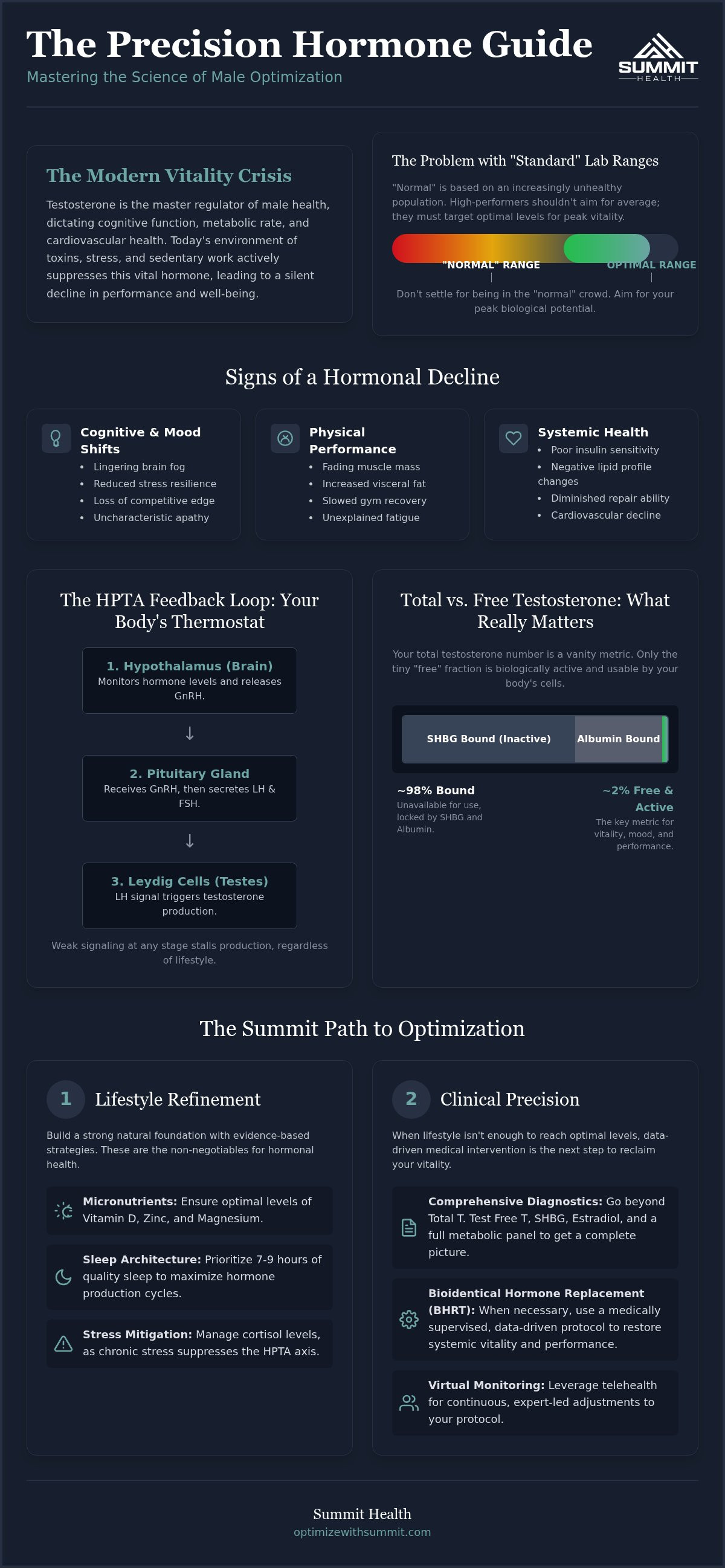
Biological foundation. Testosterone is the master regulator of male health. It’s far more than a muscle-building agent; it’s a systemic signaling molecule that dictates cognitive function, metabolic rate, and cardiovascular health. When these levels are optimized, your body operates with high-fidelity precision. When they aren't, the entire system begins to stutter. In the current 2026 landscape, men are fighting an uphill battle. Environmental toxins, persistent stress, and sedentary work cultures have created a quiet crisis of hormonal suppression. Understanding how to increase testosterone is now a prerequisite for anyone seeking a high-performance life.
Hormonal precision influences every major system. It supports insulin sensitivity and lipid profiles, protecting the heart from long-term decline. It sharpens the mind by enhancing neurotransmitter balance. Without this hormonal anchor, the body's ability to repair itself diminishes. You aren't just losing strength; you're losing the biological infrastructure that supports longevity and drive.
Signs of Sub-Optimal Hormone Levels
Hormonal decline is rarely a sudden crash. It's a slow erosion of vitality. You might notice "silent" symptoms first. Brain fog that lingers well after your morning coffee. A reduced resilience to daily stressors that once felt manageable. Physical markers follow shortly after. You'll see changes in body composition, specifically an increase in visceral fat that doesn't respond to traditional training. Recovery speed drops. A heavy session at the gym leaves you drained for days rather than hours. The psychological shift is often the most profound. You lose that competitive edge. The ambition that once defined you feels replaced by a heavy, uncharacteristic apathy.
The Problem with Standard Reference Ranges
Standard lab reports are a trap for the uninformed. Most clinics use a "normal" range based on a bell curve of the general population. This population is becoming increasingly unhealthy. A "normal" score for a man in 2026 is significantly lower than the averages recorded thirty years ago. If you fall within this range, a traditional provider might tell you you're healthy. But "healthy" isn't the goal for a high-performer. You're looking for the peak. Researching how to increase testosterone means ignoring the average and focusing on your specific biological potential. An optimal range is a personalized metric derived from clinical data and symptom resolution that prioritizes peak performance over the mere absence of clinical disease. Establishing a baseline through hormone therapy evaluation is the first step toward true correction.
Biological Levers: The Mechanisms of Hormone Production
The command center. Your hormonal health begins in the hypothalamus, not the testes. This complex feedback loop, known as the Hypothalamic-Pituitary-Testicular Axis (HPTA), acts as a biological thermostat. The brain monitors circulating levels and releases Gonadotropin-Releasing Hormone (GnRH), which prompts the pituitary gland to secrete Luteinizing Hormone (LH) and Follicle-Stimulating Hormone (FSH). LH is the primary trigger for the Leydig cells in the testes to produce testosterone. If this signaling is weak, production stalls regardless of your physical potential. Understanding these pathways is essential when evaluating how to increase testosterone effectively.
Production is only the first stage. Once testosterone enters the bloodstream, it faces two primary regulators: aromatase and Sex Hormone Binding Globulin (SHBG). Aromatase is an enzyme that converts a portion of your testosterone into estrogen. While some conversion is necessary for health, excessive aromatase activity, often driven by high body fat, can deplete your levels. Meanwhile, SHBG acts as a biological sponge. It binds tightly to testosterone molecules, rendering them "locked" and unable to enter your cells to do their work. Establishing your baseline via comprehensive diagnostic labwork is the only way to identify which of these levers is failing.
Total vs. Free Testosterone
Your Total T number is often a vanity metric. It represents the entire pool of testosterone in your system, but it doesn't account for what's actually bioavailable. Most of your hormone is bound to SHBG or albumin. Free testosterone is the tiny fraction, usually about 2 percent, that remains unbound and active. For the high-performer, optimizing the ratio between Total and Free T is the real goal. High SHBG can make a "normal" Total T score feel like a clinical deficiency because the usable hormone never reaches your tissues.
The Estrogen Balance
Balance is mandatory. A common myth suggests that estrogen is the enemy of male vitality, but over-suppressing it can be disastrous for bone density, libido, and brain health. The goal isn't to eliminate estrogen; it's to manage the conversion process. Dominance occurs when the ratio shifts too far, leading to water retention and mood instability. Precision diagnostics allow for the fine-tuning of this balance, ensuring you maintain the anabolic benefits of testosterone without the side effects of hormonal spillover. Mastering how to increase testosterone requires this nuanced, data-driven approach to systemic harmony.
Lifestyle Refinement: Natural Strategies That Actually Work
Strategic foundation. Natural optimization isn't about generic wellness. It's about biochemical leverage. To understand how to increase testosterone, you must address the systemic drains that suppress your endogenous production. Most men focus on supplements while ignoring the physiological environment that dictates their success. You don't just need more hormone; you need a system capable of producing and utilizing it.
Nutrition acts as the raw material for the hormonal engine. Micronutrients like Zinc, Vitamin D, and Boron are essential precursors for steroidogenesis. Without these building blocks, the HPTA axis cannot function at peak capacity. Training provides the necessary stimulus. High-intensity resistance training, specifically compound movements like squats and deadlifts, triggers a vital spike in signaling. This isn't just about aesthetics. It's about signaling the body that high-performance output is the new biological requirement.
The Foundation of Restorative Sleep
Sleep is the primary driver of your hormonal rhythm. Most testosterone production occurs during REM cycles, which means your morning peak is a direct reflection of your sleep quality. Seven hours is the non-negotiable floor. Anything less disrupts the architecture of your recovery and blunts the pulse of LH release. For those seeking to refine their rest, magnesium glycinate sleep protocols offer a way to improve neural relaxation and sleep depth. We also monitor for sleep apnea. Recurrent hypoxic events during the night act as a hard brake on production. If your oxygen levels are dropping, your testosterone will follow.
Body Composition and Aromatization
Visceral fat is an active endocrine organ. It's rich in aromatase, the enzyme that converts your testosterone into estrogen. This creates a destructive feedback loop where fat accumulation further suppresses your levels, leading to more fat storage and less drive. Breaking this cycle requires a synthesis of clinical and lifestyle strategies. The synergy between online medical weight loss with GLP-1 and hormone health allows for the rapid reduction of the fat that drives aromatization. While data suggests strategic fasting improves insulin sensitivity, chronic caloric restriction can actually lower T. You must balance metabolic efficiency with adequate fuel to maintain an anabolic state.
Cortisol is the final antagonist. Chronic stress diverts resources away from the HPTA axis to prioritize survival over performance. This biological competition can tank your levels regardless of your diet. Mastering how to increase testosterone requires managing these systemic stressors through data-driven recovery and clinical precision.
Clinical Precision: When Lifestyle Is Not Enough
Biological ceilings exist. For many high-performers, even the most disciplined approach to diet and sleep cannot overcome a baseline that has fallen below the threshold of vitality. Clinical intervention isn't a failure of discipline; it's a strategic choice to restore a system that has lost its ability to self-regulate. Bioidentical Hormone Replacement (BHRT) represents the gold standard in modern endocrinology, using molecules that are chemically identical to those your body naturally produces. This ensures a seamless biological fit and minimizes the risk of side effects often associated with synthetic alternatives. We've moved beyond the era of simple injections. Modern protocols now leverage precision-dosed creams, subcutaneous pellets, and therapeutic peptides to mimic natural hormonal pulses.
Safety is the primary metric of success. Any clinical plan must prioritize long-term health over short-term gains. This requires consistent monitoring of specific markers, including hematocrit levels to manage blood viscosity and Prostate-Specific Antigen (PSA) to ensure prostate health remains stable. By maintaining a data-driven approach, you can learn how to increase testosterone while simultaneously protecting your cardiovascular system and systemic integrity. This is the difference between reckless supplementation and medical-grade optimization.
The Telehealth Advantage
Accessing world-class expertise no longer requires navigating the friction of a sterile clinic waiting room. For the busy professional, online hormone replacement therapy provides a sophisticated, efficient entry point to care. Virtual monitoring allows for consistent digital touchpoints, ensuring your protocol is adjusted in real-time based on your evolving biological data. This model respects your time while providing a level of customization that traditional primary care often lacks.
The Diagnostic Protocol
Precision begins with comprehensive data. You cannot optimize what you don't measure with absolute accuracy. A detailed hormone blood work panel is the non-negotiable prerequisite for any clinical plan. We look beyond the surface to analyze:
- Total and Free Testosterone levels to determine bioavailable hormone.
- Estradiol and SHBG to manage the conversion and binding process.
- LH and FSH to assess the health of the HPTA axis.
- PSA and Hematocrit to establish a safety baseline.
The Summit Path: Starting Your Optimization Journey
Systematic progression. Reclaiming your vitality isn't a one-time event; it's a structured journey toward biological excellence. You've explored the mechanisms and the lifestyle levers. Now, you need a framework to execute. The Summit Path is designed for the individual who demands precision and refuses to settle for standard reference ranges. It's a four-stage process that prioritizes data, safety, and results. When you commit to learning how to increase testosterone through a clinical lens, you're moving from guesswork to certainty.
The process begins with the Virtual Consultation. This is where we define your specific performance goals and identify the friction points in your current state. We don't just look at symptoms; we look at the life you want to lead. This is followed by Comprehensive Diagnostics. By establishing your biological baseline, we remove the ambiguity from your treatment. From there, we move to Bespoke Protocol Design. This isn't a cookie-cutter prescription. It's a synthesis of bioidentical medicine, targeted coaching, and lifestyle refinement tailored to your unique chemistry. Finally, we engage in Continuous Optimization. Your biology is dynamic, which means your protocol must be iterative. We use ongoing data and feedback to make fine-tuned adjustments that ensure you stay at the peak.
Data-Driven Health Coaching
Habit formation is the bridge between a prescription and a lifestyle. At Summit Health, we understand that medical intervention is only one part of the equation. Our data-driven coaching provides the ongoing support necessary to move from theory to practice. We track your progress through objective metrics, such as body composition and lab markers, alongside subjective measures of well-being and drive. This dual-layered approach ensures that your optimization is felt as much as it is measured. We bridge the gap between the clinic and your daily life, providing the expertise of a high-performance coach with the authority of a medical provider.
Take the First Step
Proactive management. The most successful individuals don't wait for a crisis to act; they optimize their health while they're still in the game. Reactive treatment is about fixing what's broken, but precision health is about refining what's already there. If you've been searching for how to increase testosterone and want a clear, medical-grade plan, the path starts here. You don't have to navigate this complexity alone. Gain immediate insight into your hormonal status by taking the Summit Health Hormone Quiz. It's a fast, efficient way to see where you stand. When you're ready for a bespoke strategy, schedule your precision health consultation today. Your peak version is waiting.
Reclaim Your Biological Edge
Hormonal health is the bedrock of your high-performance lifestyle. We've established that mastering how to increase testosterone requires more than surface-level habits; it demands a synthesis of clinical data and intentional refinement. By prioritizing comprehensive diagnostic labwork, you move beyond the limitations of standard reference ranges and into the realm of true biological optimization. Peak performance isn't a destination. It's a continuous state of refinement. Precision matters. Data wins.
Summit Health provides the medical-grade infrastructure you need. Our telehealth-led hormone optimization combines personalized treatment plans with ongoing coaching to ensure your progress is both measurable and permanent. You don't have to settle for a gradual decline in drive or vitality. It's time to align your biology with your ambitions. Your potential is waiting for a more sophisticated approach.
Ready to ascend? Optimize your performance with a precision health consultation today.
Your journey toward excellence starts with a single, data-driven decision. We're here to guide the way.
Frequently Asked Questions
How long does it take to see results from testosterone optimization?
Initial improvements in libido and mental clarity often manifest within three to six weeks of starting a protocol. Physical shifts, such as increased muscle mass and reduced visceral fat, typically require three to six months of consistent optimization. This timeline depends on your unique biological baseline and adherence to lifestyle refinements. Regular virtual monitoring allows us to calibrate your plan for peak efficiency and long-term results.
Is testosterone replacement therapy safe for my heart?
Current clinical data suggests that testosterone optimization is safe for the heart when managed with precision. We prioritize safety by monitoring key cardiovascular markers, including hematocrit and lipid profiles, to manage blood viscosity. Maintaining levels within an optimal physiological range avoids the risks associated with both deficiency and excessive, unmonitored use. This data-driven approach ensures your long-term cardiovascular health remains a primary focus.
Can I increase my testosterone naturally without medication?
Natural strategies are the foundation of hormonal health. Prioritizing seven hours of restorative sleep and engaging in high-intensity resistance training are effective ways to improve your baseline. Reducing visceral fat also limits the aromatase enzyme, which prevents the conversion of testosterone into estrogen. While these habits are essential, some individuals reach a biological ceiling where clinical support is required to understand how to increase testosterone beyond a suppressed state.
What is the difference between TRT and performance-enhancing drugs?
The primary distinction lies in the dosage and the goal. Testosterone replacement therapy (TRT) is a medical protocol designed to restore your hormones to an optimal physiological range for health and vitality. Performance-enhancing drugs often utilize supra-physiological doses that exceed natural limits, frequently ignoring systemic safety markers. Optimization focuses on refinement and long-term wellness rather than the reckless pursuit of unnatural growth.
Will increasing testosterone help me lose weight faster?
Testosterone is a potent metabolic regulator. By improving insulin sensitivity and increasing lean muscle tissue, optimization helps your body burn calories more efficiently. This creates a powerful synergy with medical weight loss programs. Higher levels of free testosterone make it easier to shed stubborn fat while preserving the muscle mass that dictates your metabolic rate. It's a critical component of a comprehensive body composition strategy.
How often do I need to get blood work done during optimization?
Precision requires consistent data. Most optimization journeys begin with comprehensive labwork every three months during the initial calibration phase. This allows for iterative adjustments to your protocol based on real-time feedback. Once your levels have stabilized within the optimal range, monitoring typically shifts to a bi-annual schedule. This frequency ensures your safety markers, such as PSA and hematocrit, remain within healthy parameters.
Does insurance typically cover hormone optimization programs?
Insurance coverage is often limited to cases of extreme clinical deficiency. Many high-end optimization programs operate outside the traditional insurance model to provide a more bespoke, performance-oriented experience. This allows for a focus on "optimal" ranges rather than the broad, declining "normal" averages used by standard providers. Direct-pay models often ensure more frequent access to specialists and a higher quality of diagnostic precision.
What happens if I stop a testosterone optimization protocol?
If you discontinue a protocol, your hormone production will eventually return to its pre-treatment baseline. This transition can lead to a return of previous symptoms, including unexplained fatigue and reduced mental clarity. It's essential to work with a clinical guide to manage this process safely. We use specific recovery protocols to help your body's natural feedback loop reset effectively if you choose to pause your optimization journey.

Article by
Dr. David Richardson
David Richardson, is the founder and CEO of Summit Health and the author of "Insights from the Summit", where he writes about hormone optimization, metabolic health, thyroid function, longevity, and preventive medicine.
After entering healthcare in 2009, David became increasingly interested in a question that traditional medicine often struggles to answer:
Why do so many people continue to feel terrible despite being told their labs are "normal"?
That question eventually led him into the field of health optimization in 2020, where he became passionate about understanding physiology at a deeper level and helping patients uncover the root causes of their symptoms rather than simply managing them.
Today, David's philosophy is simple: normal and optimal are not the same thing. Every patient is physiologically unique, and meaningful healthcare begins by listening to symptoms, understanding the science, and recognizing that laboratory values are only one piece of a much larger picture.
Through Summit Health and Insights from the Summit, David's mission is to help people better understand their bodies, ask better questions, and make informed decisions that improve both their health span and quality of life.


