
IMPORTANT DISCLAIMERS
Medical Disclaimer: The information in this article is provided for educational purposes only and is not intended as medical advice or a substitute for individualized medical care. Every person's health needs are unique. Always consult a qualified healthcare professional before starting, stopping, or changing any medication, supplement, or treatment plan. -------
Article Disclaimer: Articles are reviewed and published by Summit Health to provide evidence-based educational information. While Summit Health strives to provide reliable and current health information, medical knowledge is always evolving over time. Depending on when you are reading this content, it may not reflect the latest research or apply to your individual circumstances.
Your cellular engine isn't just slowing down; it's structurally fraying. Many high-performers face persistent fatigue and metabolic resistance even when their standard lab work returns "normal." This disconnect often stems from mitochondrial decay, a process that saps your vitality long before a clinical diagnosis appears. Understanding SS-31 and Mots-C: What each peptide does for mitochondrial health is the first step toward reclaiming your edge. While SS-31, recently FDA-approved in 2025 as FORZINITY for specific structural repairs, focuses on the mitochondrial membrane, MOTS-c acts as a metabolic signaling agent to drive efficiency.
You deserve a strategy that matches your ambition. This guide explores a dual-track approach to cellular optimization. We'll look at how these peptides target energy at the source to reverse decay and enhance physical performance. You'll discover how structural restoration and metabolic flexibility work together to provide faster recovery and sharper cognitive clarity. It's time to stop managing symptoms and start refining your biological foundation. Let's examine how these precise tools can move you toward a premium, optimized version of your life.
Key Takeaways
- Identify the root cause of persistent fatigue. Recognize mitochondrial decay as the primary biological barrier to maintaining peak performance and metabolic efficiency.
- Restore cellular structure. SS-31 targets the inner mitochondrial membrane to stabilize cardiolipin, which helps reverse structural damage and reduce oxidative stress.
- Optimize your metabolism. Discover SS-31 and Mots-C: What each peptide does for mitochondrial health, specifically how MOTS-c mimics exercise benefits by activating the AMPK pathway.
- Select a protocol based on your specific goals. Compare the restorative focus of SS-31 with the performance-driven signaling of MOTS-c to determine the best fit for your lifestyle.
- Leverage precision diagnostics. Learn how Summit Health uses comprehensive labwork and national telehealth access to design a personalized peptide strategy tailored to your biology.
Mitochondrial Decay: The Silent Barrier to Peak Performance
Energy defines the boundary of your potential. Inside every cell, mitochondria act as the primary drivers of ATP production and cellular longevity. They're the engines of your existence. However, as we age or face environmental stressors, these engines begin to sputter. Mitochondrial dysfunction manifests as oxidative stress and membrane leakage. This results in a significant reduction in energy output that leaves you feeling depleted despite adequate rest. It's not just a lack of sleep; it's a lack of cellular power.
This decline is the root cause of what many experience as "getting older." Symptoms like persistent brain fog, exercise intolerance, and metabolic stalling are early indicators of cellular aging. Mitochondrial Medicine is emerging as the next frontier in health optimization. It shifts the focus from treating symptoms to restoring the very source of biological power. Understanding the nuances of SS-31 and Mots-C: What each peptide does for mitochondrial health allows for a precision approach to reversing this decay and reclaiming your peak state.
The Anatomy of Cellular Energy
To appreciate how these peptides work, you must visualize the inner mitochondrial membrane. This is where the electron transport chain resides, a complex series of reactions that generates ATP. A specific lipid called cardiolipin is essential for maintaining this structure. It acts as the glue for the mitochondrial architecture. Over time, ATP production declines due to oxidative damage and toxins, leading to a "leaky" engine. Research into Elamipretide (SS-31) has shown that stabilizing this membrane is key to restoring peak cellular function and preventing the spill of reactive oxygen species into the cell.
Why Traditional Labs Miss the Mark
Most patients are told they're "fine" because their results fall within a standard reference range. This creates a gap between feeling healthy and achieving an optimized state. The "Normal vs. Optimal" debate is central to modern diagnostics. Standard tests rarely measure biomarkers of oxidative stress or systemic inflammation that signal early mitochondrial failure. True optimization requires a deeper look into your biological data.
Integrating comprehensive hormone blood work with cellular diagnostics provides a clearer picture of your biological age. By identifying these sub-clinical deficiencies, you can apply targeted interventions like peptide therapy before performance begins to plateau. We focus on biomarkers that reflect your actual energy capacity, ensuring your protocol is built on data rather than guesswork.
SS-31 (Elamipretide): Restoring the Structural Integrity of the Cell
SS-31 represents a paradigm shift in mitochondrial medicine. It isn't just a metabolic booster. It's a structural architect. For those exploring SS-31 and Mots-C: What each peptide does for mitochondrial health, the distinction lies in how SS-31 addresses the physical foundation of the cell. While other interventions focus on signaling, SS-31 targets the hardware itself. It provides the stability required for all other cellular processes to function at their peak.
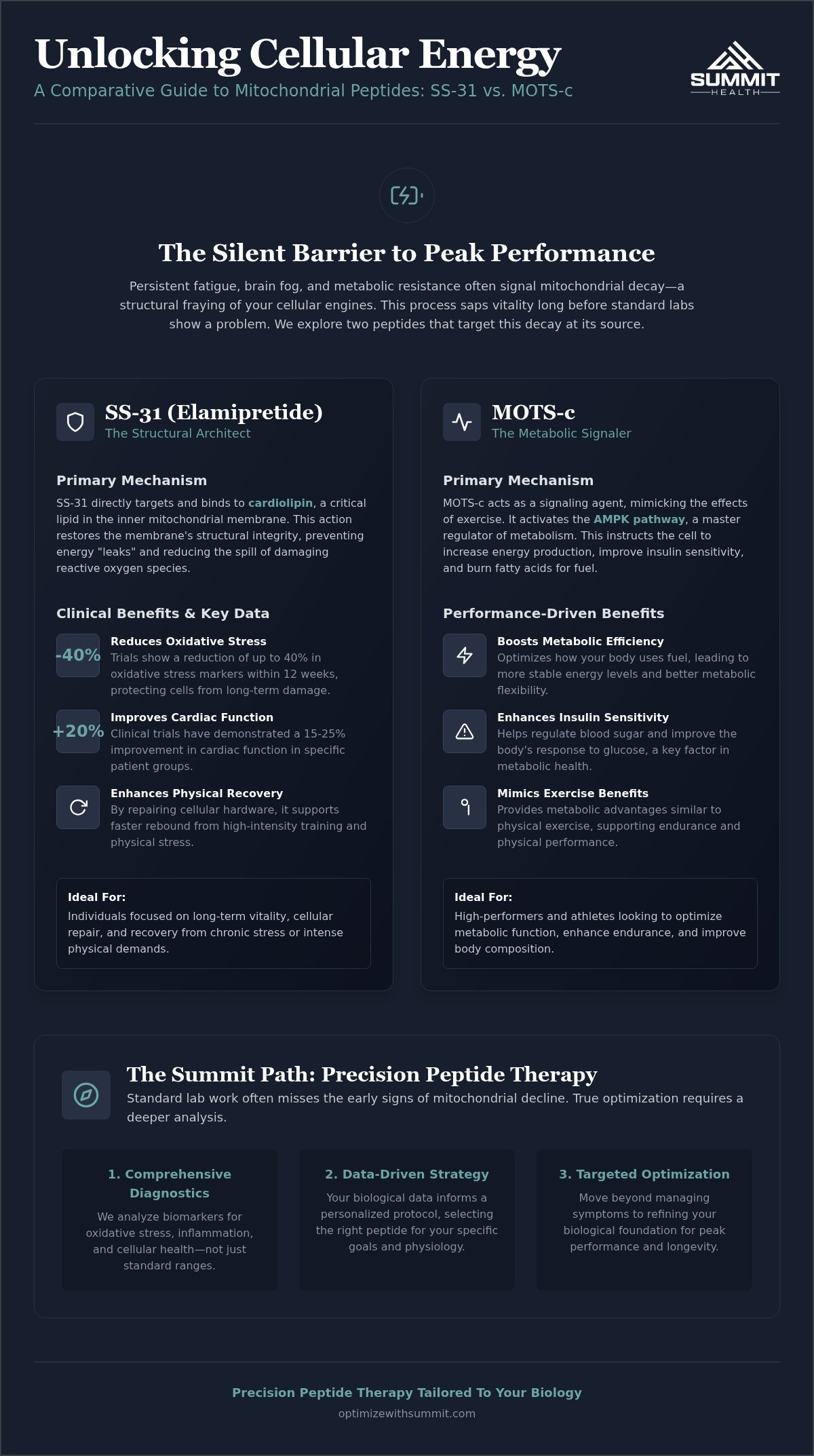
Its primary mechanism involves binding to cardiolipin. This is a unique phospholipid found exclusively in the inner mitochondrial membrane. When cardiolipin is damaged, the membrane loses its tight curvature. This leads to "leaky" electrons. SS-31 stabilizes this structure. It prevents the electron transport chain from spilling reactive oxygen species into the cell. Trials have demonstrated a reduction in oxidative stress markers by up to 40 percent within 12 weeks of treatment. This reduction in damage is essential for long-term vitality.
Clinical benefits of this structural restoration include:
- Enhanced Recovery: Faster rebound from high-intensity training sessions.
- Improved Organ Function: Targeted support for high-energy organs like the heart and kidneys.
- Cardiovascular Support: Clinical trials have shown improvements in cardiac function by 15 to 25 percent in specific patient groups.
Cardiolipin: The Key to SS-31's Efficacy
Cardiolipin is responsible for cristae formation. These are the deep folds that maximize the surface area available for energy production. When cardiolipin degrades, the mitochondria lose their efficiency. SS-31 prevents cardiolipin peroxidation and preserves the integrity of these folds. It ensures the electron transport chain remains organized and productive. SS-31 acts as a structural stabilizer for cellular engines.
Performance Benefits of Structural Repair
The results of structural repair translate directly to physical performance. By fixing the internal "leaks," SS-31 improves oxygen consumption during high-intensity efforts. It also offers a defense against sarcopenia, the age-related loss of muscle mass. Beyond physical traits, it provides neuroprotection and enhances cognitive endurance by maintaining energy levels in the brain. This comprehensive approach ensures your biological hardware can support your highest ambitions.
Integrating these structural repairs into your routine can be discussed during a virtual consultation to ensure the protocol aligns with your specific biological data.
MOTS-c: The Mitochondrial-Derived Peptide for Metabolic Signaling
MOTS-c is a biological outlier. Most peptides are encoded by the cell's nucleus, but MOTS-c originates within the mitochondrial genome itself. This unique lineage allows it to function as a systemic communicator. It travels from the mitochondria to the nucleus to regulate gene expression and metabolic homeostasis. When we examine SS-31 and Mots-C: What each peptide does for mitochondrial health, it's clear that while SS-31 repairs the engine, MOTS-c dictates how that engine burns fuel. It's the metabolic executor of the cellular world.
The primary power of MOTS-c lies in its ability to activate the AMPK pathway. This is the body's master switch for energy regulation. By triggering this pathway, MOTS-c enhances glucose uptake in skeletal muscle and promotes fatty acid oxidation. It effectively signals the body to prioritize fat burning and energy efficiency. This process is essential for reversing insulin resistance and promoting the development of lean body mass. It's a sophisticated tool for those seeking to refine their body composition and metabolic flexibility.
The AMPK Connection: Signaling for Efficiency
MOTS-c is often described as an "exercise mimetic" because it stimulates the same metabolic pathways as intense physical activity. Research suggests it can mimic the cellular effects of a 45-minute workout. This doesn't replace the need for movement, but it significantly enhances nutrient partitioning. By improving insulin sensitivity in the muscle, MOTS-c ensures that the calories you consume are used for performance rather than stored as adipose tissue. This creates a powerful synergy with medical weight loss protocols, providing a data-driven path to a leaner, more resilient physique.
Beyond the Gym: Systemic Benefits of MOTS-c
The influence of MOTS-c extends far beyond metabolic rate. It plays a critical role in supporting bone density by promoting osteoblast differentiation, which helps prevent osteoporosis as we age. It also assists in regulating the systemic stress response. By modulating inflammatory pathways, MOTS-c helps the body maintain balance during periods of high physical or mental exertion. This systemic reach ensures that your recovery is as comprehensive as your performance. MOTS-c acts as a metabolic messenger that optimizes fuel usage across every system in the body.
This peptide represents a shift toward proactive health management. It moves beyond the simple "calories in vs. calories out" model and addresses the signaling failures that often lead to metabolic stalling. By restoring these mitochondrial signals, you can unlock a level of energy and performance that feels both sustainable and effortless. It's about working with your biology, not against it.
SS-31 vs. MOTS-c: Choosing the Right Protocol for Your Goals
Precision is paramount. Choosing between these two powerhouses requires an understanding of SS-31 and Mots-C: What each peptide does for mitochondrial health relative to your current physiological state. SS-31 acts as the cellular mechanic. It repairs structural damage within the mitochondrial membrane. In contrast, MOTS-c acts as the high-performance driver. It signals for metabolic efficiency and fat oxidation. While both enhance vitality, their points of entry differ significantly.
The ideal candidate for SS-31 often struggles with recovery-focused issues. This includes persistent fatigue, slower healing after exertion, or high markers of oxidative stress. MOTS-c is tailored for the fat-loss focused individual. It's for the high-performer facing metabolic resistance or looking to maximize their output during training. However, the most sophisticated approach is the "Better Together" strategy. Structural repair should ideally precede or accompany metabolic signaling. You wouldn't push a high-performance engine if the hardware was compromised. Stabilizing the membrane with SS-31 ensures that when MOTS-c signals for more energy, the cell can actually deliver it without creating further damage.
Strategic Selection: A Comparison Framework
Success requires a structured roadmap. SS-31 focuses on Membrane Repair, while MOTS-c drives Metabolic Signaling. To maintain peak responsiveness, we recommend cycling these peptides. Typical protocols involve 4 to 8 week cycles followed by a rest period to prevent receptor desensitization. Progress is tracked through subjective energy markers like mental clarity and objective labs that monitor inflammatory levels. This data-driven approach ensures your protocol evolves with your needs. Administration is typically handled via subcutaneous injection, providing high bioavailability and consistent results.
Synergy with Hormone Optimization
Mitochondrial health is the foundation for hormone therapy success. Your cells must be capable of processing the signals that hormones send. Optimized testosterone and thyroid levels significantly enhance peptide responsiveness. When your cellular engines are structurally sound and metabolically flexible, your body can utilize optimized hormone levels more effectively. For a deeper look at this integration, explore The Sophisticated Guide to HRT. This holistic view ensures every system moves in an upward trajectory toward your peak state.
Every individual biology is unique. To determine which protocol aligns with your performance goals, you can schedule a virtual consultation with our team for a personalized assessment.
The Summit Path: Precision Peptide Therapy via Telehealth
Summit Health provides a premium telehealth experience. We move beyond the generic. While many turn to one-size-fits-all supplements, we prioritize data-led precision. Our protocols are designed for the high-performer who demands measurable results. Understanding SS-31 and Mots-C: What each peptide does for mitochondrial health is only half the battle. The other half is ensuring these tools are applied correctly to your specific biological profile. We provide the expertise required to navigate these advanced therapies with confidence.
The transition to peak performance requires a shift in perspective. It's not about treating an ailment; it's about refining your current state. By targeting cellular energy at the source, we help you overcome the silent barriers of fatigue and metabolic stalling. This is the essence of upward movement. We speak to you as an equal partner in your health journey, providing the clinical authority and aspirational guidance necessary to reach your summit.
Diagnostics First: The Foundation of Precision
Precision begins with data. We require comprehensive labwork before any protocol is initiated. This isn't just a safety check; it's a blueprint for your optimization. By monitoring specific biomarkers of oxidative stress and metabolic function, we ensure your peptide therapy remains both safe and effective over the long term. You can learn more about our commitment to excellence on our About Summit Health page. We don't guess. We measure. This data-driven foundation allows for a bespoke experience that respects your unique biology.
A Comprehensive Ecosystem
Peptide therapy doesn't exist in a vacuum. It is a sophisticated adjunct to a broader health optimization plan. When you address mitochondrial health, you create a ripple effect across all other systems. We integrate these protocols with targeted strategies for Sleep & Recovery, medical Weight Loss, and Bioidentical Hormone Replacement. This holistic approach ensures that your structural repair and metabolic signaling work in harmony with your hormonal foundation. The goal is a seamless transition from sub-clinical fatigue to peak performance.
Starting Your Journey to Optimization
The process is streamlined for your convenience. You'll begin with a virtual consultation from the comfort of home. Our experts will guide you through your lab panel results and help you visualize your path forward. This isn't a one-time transaction. It's an ongoing partnership. You'll receive continuous health coaching and protocol adjustments based on your progress and evolving data. We focus on the refinement of your current state, moving you steadily toward a premium version of your life.
Reclaiming your vitality requires cellular-level intervention. It's about more than just feeling better. It's about achieving a state of biological excellence. To begin your cellular assessment and discover your path to optimization, Take the Hormone Quiz today. Your upward movement starts here.
Reclaim Your Cellular Edge
Mitochondrial decay is a silent barrier to your highest potential. It saps your energy long before standard labs show a problem. By mastering the synergy of SS-31 and Mots-C: What each peptide does for mitochondrial health, you transition from managing fatigue to cultivating peak vitality. SS-31 restores the structural foundation of your cellular engines. MOTS-c then optimizes the metabolic signaling required for fat loss and physical endurance. This dual-track approach ensures your biological hardware supports your most ambitious goals.
Summit Health provides the clinical authority and precision diagnostics necessary for this level of optimization. We offer evidence based health solutions delivered with national telehealth convenience. Every protocol we design is personalized and driven by comprehensive labwork to ensure your safety and success. You don't have to accept a decline in performance as an inevitability of aging; you can choose a path of refinement and upward movement.
Optimize Your Cellular Performance. Schedule Your Consultation.
Your journey toward biological excellence starts with a single data-driven step. We are here to guide your progress and help you reach your summit.
Frequently Asked Questions
What is the primary difference between SS-31 and MOTS-c?
SS-31 targets the physical architecture of the mitochondria, while MOTS-c focuses on metabolic communication. SS-31 stabilizes the inner membrane by binding to cardiolipin, which reduces oxidative damage. MOTS-c activates the AMPK pathway to enhance fat oxidation and glucose uptake. Understanding SS-31 and Mots-C: What each peptide does for mitochondrial health helps you choose between structural restoration and metabolic signaling based on your specific performance goals and diagnostic data.
Can I take SS-31 and MOTS-c together in the same protocol?
Yes, these peptides are often used together to create a comprehensive cellular optimization protocol. Structural repair with SS-31 provides a stable foundation, ensuring the mitochondrial membrane is sound. Once the hardware is repaired, MOTS-c can more effectively signal the software to increase metabolic output. This combined approach prevents metabolic stress on damaged cells, leading to more sustainable energy improvements and faster physical recovery after periods of high exertion.
How long does it take to feel the energy-boosting effects of these peptides?
Noticeable improvements in energy and recovery typically emerge within four to eight weeks of consistent use. While some individuals report sharper cognitive clarity within the first fourteen days, structural repair is a cumulative process. SS-31 requires time to stabilize membranes and reduce systemic oxidative stress. MOTS-c effects are often most apparent during physical activity, where you may notice increased stamina and a more efficient metabolic response to your training sessions.
Are SS-31 and MOTS-c considered safe for long-term use?
These peptides are generally considered safe when administered under medical supervision and used in structured cycles. Most protocols involve four to eight weeks of therapy followed by a rest period to maintain receptor sensitivity. Continuous virtual monitoring and comprehensive labwork are essential to ensure your biomarkers remain within optimal ranges. This diagnostic-led approach prioritizes long-term safety while pursuing peak performance and biological advancement through evidence based health solutions.
Do I need a prescription for SS-31 and MOTS-c peptide therapy?
Yes, a prescription from a licensed provider is required to access high-quality, clinical-grade peptide therapy. Summit Health provides these through a telehealth-led model that begins with comprehensive diagnostic labwork. This ensures the protocol is medically appropriate for your unique biology. Using research-grade products without oversight carries significant risks, as they lack the quality controls and personalized dosing necessary for safe and effective human optimization and performance enhancement.
Will MOTS-c help me lose weight without exercise?
MOTS-c is an exercise mimetic, but it's most effective when paired with an active lifestyle. While it enhances glucose uptake and fat oxidation at a cellular level, it's designed to amplify the results of movement rather than replace it. For those facing metabolic resistance, it can provide the edge needed to see progress. It works best as part of a comprehensive plan that includes medical weight loss support and precision diagnostics.
How do mitochondrial peptides interact with hormone replacement therapy (HRT)?
Mitochondrial peptides and hormone replacement therapy share a powerful biological synergy. Hormones like testosterone and thyroid rely on healthy mitochondria to execute their metabolic signals. If your cellular engines are frayed, HRT responsiveness may be diminished. By restoring mitochondrial integrity, you create a more receptive environment for hormone optimization. This leads to better results in muscle retention, fat loss, and cognitive endurance as your cells process hormonal signals more efficiently.
What happens if I stop taking mitochondrial peptides?
Stopping peptide therapy doesn't cause a biological crash, but you may notice a gradual return to your previous baseline energy levels. The structural repairs made by SS-31 and the metabolic signaling activated by MOTS-c provide lasting benefits, yet they don't stop the underlying aging process. Maintaining your results requires a continued focus on sleep, nutrition, and hormone balance. Ongoing health coaching helps you transition between cycles while preserving your hard-won performance gains.

Article by
Dr. David Richardson
David Richardson, is the founder and CEO of Summit Health and the author of "Insights from the Summit", where he writes about hormone optimization, metabolic health, thyroid function, longevity, and preventive medicine.
After entering healthcare in 2009, David became increasingly interested in a question that traditional medicine often struggles to answer:
Why do so many people continue to feel terrible despite being told their labs are "normal"?
That question eventually led him into the field of health optimization in 2020, where he became passionate about understanding physiology at a deeper level and helping patients uncover the root causes of their symptoms rather than simply managing them.
Today, David's philosophy is simple: normal and optimal are not the same thing. Every patient is physiologically unique, and meaningful healthcare begins by listening to symptoms, understanding the science, and recognizing that laboratory values are only one piece of a much larger picture.
Through Summit Health and Insights from the Summit, David's mission is to help people better understand their bodies, ask better questions, and make informed decisions that improve both their health span and quality of life.


