

IMPORTANT DISCLAIMERS
Medical Disclaimer: The information in this article is provided for educational purposes only and is not intended as medical advice or a substitute for individualized medical care. Every person's health needs are unique. Always consult a qualified healthcare professional before starting, stopping, or changing any medication, supplement, or treatment plan. -------
Article Disclaimer: Articles are reviewed and published by Summit Health to provide evidence-based educational information. While Summit Health strives to provide reliable and current health information, medical knowledge is always evolving over time. Depending on when you are reading this content, it may not reflect the latest research or apply to your individual circumstances.
Precision matters. Most men chasing peak performance are currently gambling with unverified botanical stacks. You've seen the claims. You've heard the podcasts. But your biology deserves more than a trend. It's exhausting to navigate conflicting reviews while your energy and libido remain stagnant. You want results, not another bottle of expensive dust. This leads to a critical inquiry: tongkat ali and fadogia agrestis: Natures testosterone booster or marketing hype?
We understand the drive to reclaim your edge without immediately jumping to pharmaceuticals. It's a valid path, provided it's paved with data. You deserve a strategy that prioritizes safety as much as strength. You're seeking the objective truth about herbal efficacy and a clear understanding of the risks involved. We'll provide that clarity by separating evidence-based optimization from digital noise.
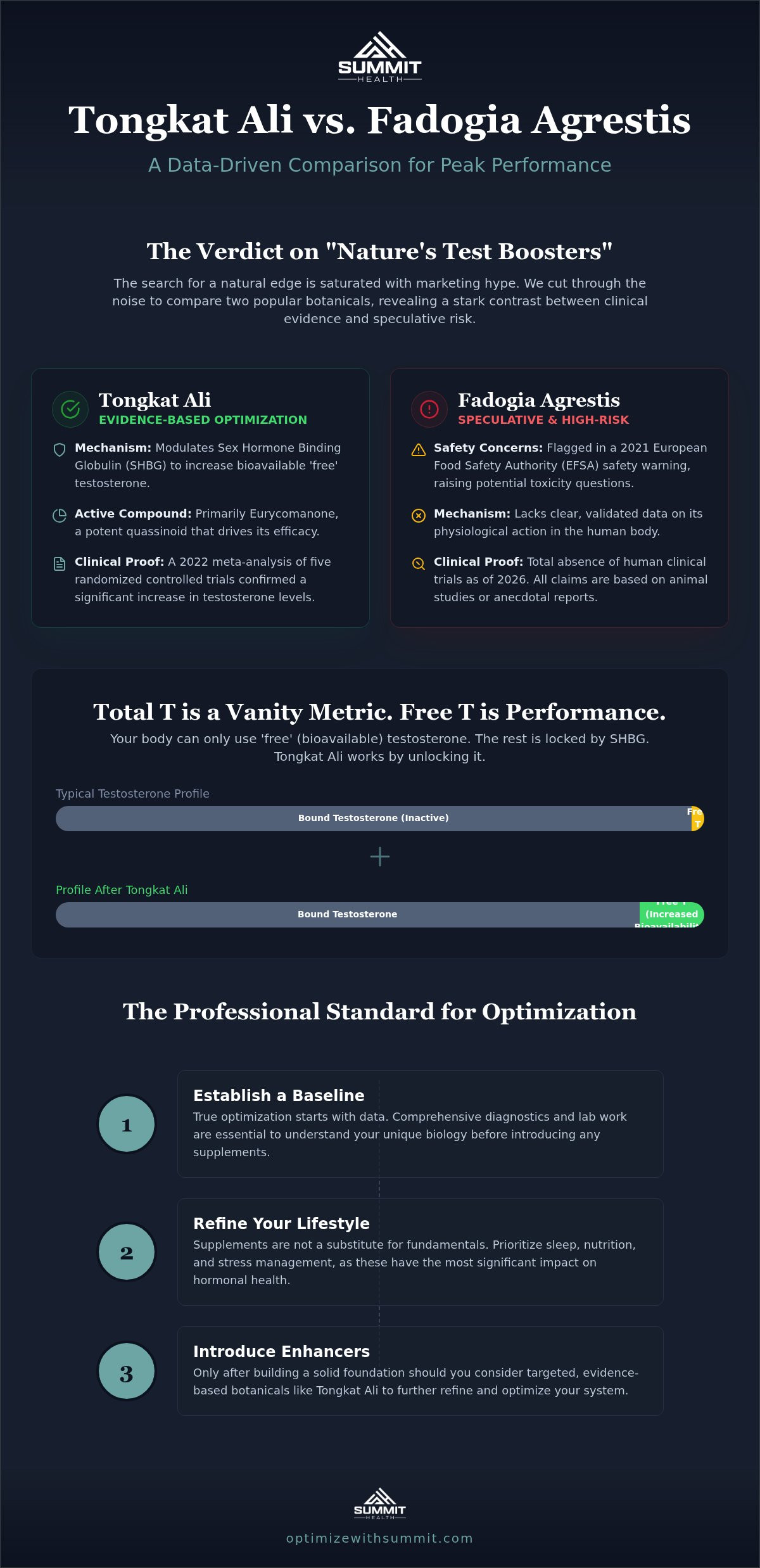
This guide bridges the gap between marketing and clinical reality. You'll discover why Tongkat Ali shows promise in 2022 meta-analyses while Fadogia Agrestis remains scientifically speculative. We'll examine the 2021 EFSA safety warnings and the total absence of human clinical trials for Fadogia as of 2026. By the end, you'll have a roadmap to measurable hormonal optimization that moves beyond guesswork and into professional standards.
Key Takeaways
- Clinical reality. Identify the specific quassinoids that drive hormonal refinement and distinguish them from marketing narratives.
- Bioavailable power. Understand how Tongkat Ali modulates SHBG to unlock your existing testosterone potential and improve performance.
- Risk assessment. Analyze the safety profile of the popular "Huberman Stack" to determine if you've found tongkat ali and fadogia agrestis: Natures testosterone booster or marketing hype?
- Data first. Learn why comprehensive diagnostics are the professional standard for distinguishing between true optimization and expensive guesswork.
- Foundational protocol. Establish a baseline through lab work and lifestyle refinement before introducing botanical enhancers into your routine.
The Modern Quest for Peak Testosterone
Peak performance is no longer a niche pursuit. Men are increasingly focused on biological refinement, seeking to reclaim the vitality of their youth through precise hormonal management. This shift has moved beyond the gym and into the mainstream, fueled by a growing awareness of declining average testosterone levels across the population. In this environment, the search for "natural" solutions has reached a fever pitch. This leads to a central debate: tongkat ali and fadogia agrestis: Natures testosterone booster or marketing hype?
The transition from traditional herbalism to aggressive biohacking has been swift. What were once regional remedies are now global commodities. While ancient practitioners used these roots for general vitality, today's user seeks a specific, measurable increase in serum testosterone. This demand has created a marketplace where marketing claims often outpace clinical validation. We must distinguish between the "Nature's Booster" narrative and the actual physiological impact these substances have on the human endocrine system. Authenticity in health requires a commitment to data over trends.
The Testosterone Crisis and the Digital Health Boom
The decline is documented. Modern lifestyles, characterized by high stress and sedentary habits, often compromise endocrine health. This has led to a surge in digital health content designed to offer quick fixes. Social media algorithms have significantly amplified the "Huberman stack," making it a household name in wellness circles. Specifically, Eurycoma longifolia (Tongkat Ali) has transitioned from a traditional Southeast Asian remedy to a staple in modern biohacking protocols. The "natural" label offers a psychological safety net. It appeals to men who are hesitant to commit to pharmaceutical Hormone Therapy but still want to see an improvement in their baseline performance. But popularity is not a proxy for safety or clinical efficacy.
The Problem with the "Pill-First" Approach
Supplements are adjuncts. They aren't foundations. Many men experience brain fog or low energy and immediately reach for a bottle of "test boosters." This approach is fundamentally flawed. Herbs cannot solve systemic issues like chronic sleep deprivation, thyroid dysfunction, or iron deficiency. Self-diagnosing based on subjective symptoms is a gamble with your health. There's a definitive difference between "boosting" a number and "optimizing" a system. Optimization requires objective data. Without comprehensive lab work, you're simply guessing. You risk wasting money on ineffective products or, worse, ignoring a serious underlying condition. True advancement begins with a diagnostic baseline, not a supplement order. As we peel back the layers of marketing, we find a stark contrast between the clinical evidence for Tongkat Ali and the speculative nature of Fadogia Agrestis.
Tongkat Ali: The Science of Free Testosterone
Precision is paramount. To understand Tongkat Ali, we must look beyond the marketing labels and focus on its chemical constituents. The primary bioactive compounds in Eurycoma longifolia are quassinoids, specifically eurycomanone. This isn't a blunt instrument that simply forces the body to produce more. Instead, it acts as a sophisticated modulator. It optimizes the endocrine environment, allowing your body to utilize its natural resources more efficiently.
The evidence is compelling. A 2022 meta-analysis of five randomized controlled trials concluded that Tongkat Ali supplementation is associated with a significant increase in testosterone levels. This is not mere speculation. It's a documented physiological response. When evaluating tongkat ali and fadogia agrestis: Natures testosterone booster or marketing hype?, Tongkat Ali firmly occupies the category of evidence-based optimization. It bridges the gap between traditional herbalism and modern clinical standards.
Understanding SHBG and Bioavailability
Total testosterone is a vanity metric. Free testosterone is the performance metric. Most of the testosterone in your body is bound to Sex Hormone Binding Globulin (SHBG), rendering it biologically inactive. It's essentially "shackled." Tongkat Ali works by modulating SHBG levels, effectively freeing up more bioavailable testosterone for your tissues to use. This distinction is vital. You don't necessarily need more total production; you need more usable hormone. This is particularly effective for men experiencing age-related decline or chronic stress. High cortisol is a known testosterone killer. One specific clinical study on Tongkat Ali demonstrated that 200mg of extract per day resulted in a 37% increase in testosterone and a 16% decrease in cortisol in stressed adults. By lowering stress markers, you create a sanctuary for hormonal production.
Dosage, Standardization, and the DNA Damage Debate
Potency requires standardization. The 200:1 extract ratio has become the industry benchmark, ensuring a consistent concentration of eurycomanone. However, professional optimization requires caution. In 2021, the European Food Safety Authority (EFSA) issued a warning regarding the potential for DNA damage and genotoxicity from certain root extracts. While human trials at recommended dosages haven't replicated these concerns, the warning shouldn't be ignored. Safe protocols often involve cycling the supplement. A common strategy is five days of use followed by two days of cessation. This prevents receptor desensitization and mitigates long-term risk. If you're ready to move beyond supplements and establish a clinical baseline, you can schedule a professional consultation to review your comprehensive lab work. Data-driven decisions are always superior to supplement-only guesswork.
Fadogia Agrestis: High Reward or High Risk?
Fadogia Agrestis is the high-stakes variable in the modern hormonal equation. While Tongkat Ali offers a degree of clinical reassurance, Fadogia operates in a much more speculative territory. It's often the second half of the popular "Huberman Stack," paired with Tongkat to create a perceived synergistic effect. One modulates; the other signals. But this signaling comes with significant caveats that most marketing narratives conveniently omit. When asking if we've found tongkat ali and fadogia agrestis: Natures testosterone booster or marketing hype?, the answer for Fadogia leans heavily toward the latter until human data emerges.
Luteinizing Hormone Mimicry
Fadogia Agrestis functions by mimicking Luteinizing Hormone (LH). This is the primary signal sent from the pituitary gland to the Leydig cells in the testes, instructing them to produce testosterone. By artificially amplifying this signal, Fadogia attempts to override the body's natural regulatory set point. It's an upstream intervention. Unlike exogenous testosterone, which suppresses the brain-testes axis, Fadogia seeks to stimulate it. However, this carries the risk of desensitization. Constant "over-signaling" can lead to a reduced response from the Leydig cells over time as the body attempts to maintain homeostasis. This is a fundamental difference from the controlled, monitored environment of clinical Hormone Therapy.
The Toxicity Reality Check
The most significant concern regarding Fadogia Agrestis is its safety profile. As of August 2026, there are still no published human clinical trials to validate its efficacy or safety. All current knowledge stems from animal models. These studies have revealed a troubling trend: dosage-dependent toxicity. Specifically, researchers observed increased testicular weight and markers of cellular damage in the liver and kidneys of rat subjects. "Natural" is not a proxy for "benign."
Using unverified botanicals without organ-support monitoring is a precarious strategy. The potential for testicular toxicity is a definitive red flag for any man seeking long-term health optimization. Without human data, the therapeutic window—the gap between an effective dose and a toxic one—remains unknown. Consider these verified facts:
- Testicular weight changes and cellular damage observed in animal models.
- Elevated liver enzymes indicating potential organ stress during supplementation.
- A complete absence of human safety data to establish a tolerable upper limit.
Precision requires moving beyond the hype. If you aren't monitoring your internal biomarkers while using these substances, you aren't optimizing; you're experimenting. True advancement relies on data, not digital trends.
Beyond the Bottle: Why Supplementing Without Diagnostics Fails
Diagnostics are the foundation. Supplementing without data is simply expensive guesswork. Many men attempt to resolve fatigue or low libido by purchasing the latest trending stack, but they ignore the underlying biological reality. When you ask if you've found tongkat ali and fadogia agrestis: Natures testosterone booster or marketing hype?, you're asking the wrong question. The real question is: what is actually happening inside your body?
Masking symptoms is a significant risk. Low energy might be attributed to low testosterone, but it could easily be driven by obstructive sleep apnea, thyroid dysfunction, or a simple iron deficiency. Herbs won't fix those. They only provide a temporary, often negligible, lift while the root cause persists. Precision medicine requires a move beyond the bottle and into the lab. We prioritize clarity over trends.
The Essential Hormone Panel
Data provides protection. A comprehensive panel is the only way to ensure your efforts are yielding results rather than side effects. You must monitor more than just a single number. Objective monitoring prevents the complications of over-supplementation and ensures your endocrine system remains in balance. Critical markers include:
- Total and Free Testosterone
- Estradiol to monitor aromatization
- LH and FSH to assess pituitary function
- SHBG to understand bioavailability
You can understand your markers with our Hormone Blood Work guide to see how these variables interact. This level of detail is the only way to distinguish between marketing noise and physiological progress.
When Herbs Aren’t Enough
Botanicals have a clinical ceiling. While Tongkat Ali may provide a modest percentage increase for some, it rarely addresses clinically significant hypogonadism. There is a point where optimization requires the professional standard. If your diagnostics reveal a systemic deficiency that lifestyle and supplements cannot bridge, it's time to consider medical-grade Hormone Therapy.
The Summit Health Protocol integrates these clinical interventions with personalized Health Coaching. This ensures your foundation, specifically sleep, nutrition, and stress management, is as robust as your hormonal profile. We transition you from guessing to precision. If you are ready for a definitive look at your biology, book your diagnostic lab work today. Stop experimenting and start optimizing.
Designing a High-Performance Optimization Protocol
Action requires a framework. Knowing the science behind individual herbs is only the first step. To achieve sustainable results, you must integrate these tools into a structured protocol that prioritizes long-term health over short-term spikes. This methodical approach ensures you aren't just reacting to symptoms but actively refining your biological state. It's the difference between a random supplement stack and a professional optimization strategy.
The process begins with data. Establishing a baseline through comprehensive lab work is non-negotiable. Without it, you cannot determine if you're looking at tongkat ali and fadogia agrestis: Natures testosterone booster or marketing hype? within the context of your own unique physiology. Once the baseline is set, you move through foundational pillars, strategic interventions, and continuous monitoring. This iterative cycle is the hallmark of high-performance health management.
The Foundational Pillars of Testosterone
Foundations first. No botanical extract can compensate for a broken lifestyle. Sleep is the primary driver of hormonal production; five hours of rest is a physiological deficit that no pill can fix. You must prioritize restorative recovery to manage the cortisol-testosterone seesaw. Magnesium plays a critical role here, specifically in its highly bioavailable forms. You can explore the benefits of Magnesium Glycinate for Sleep to understand how it supports the parasympathetic nervous system. Beyond micronutrients, stress management is a performance requirement. Chronic stress creates a hormonal environment where testosterone cannot thrive.
Your Path to Peak Performance
Strategic choices matter. Once your foundation is secure, you can evaluate the role of supplements versus clinical intervention. For some, Tongkat Ali serves as a "Stage 1" enhancer, offering a modest lift in bioavailable T. However, for those seeking the professional standard, Hormone Therapy remains the most effective path to measurable optimization. A telehealth-led model provides the efficiency busy professionals require, offering expert guidance without the friction of traditional clinics.
The final verdict? The answer to tongkat ali and fadogia agrestis: Natures testosterone booster or marketing hype? is a hybrid truth. Tongkat Ali has clinical merit as an adjunct; Fadogia Agrestis remains a speculative risk. Peak performance isn't found in a single bottle but in a data-driven journey. You can Take the Hormone Quiz to see where you stand and begin your transition from guesswork to precision. Your biology is an asset. Manage it with the same discipline you apply to your career.
Elevating Your Biological Standard
Optimization is a discipline. It requires moving beyond the noise of trending stacks and into the realm of clinical precision. You've seen the data. Tongkat Ali offers a documented path to modulating SHBG, while Fadogia Agrestis remains a speculative risk lacking human validation. This distinction is the definitive answer to tongkat ali and fadogia agrestis: Natures testosterone booster or marketing hype? True advancement isn't found in a bottle alone; it's found in the data derived from your own biology.
We provide the professional standard for men who refuse to settle for average. Our telehealth-led medical expertise removes the friction of traditional care, giving you direct access to comprehensive performance-focused lab panels. Combined with personalized health coaching, we ensure your protocol is as unique as your DNA. Stop guessing and start measuring. Optimize Your Performance with Precision Diagnostics.
Your peak state is within reach. Take the first step toward a more refined version of yourself today. You have the tools; now you need the data to use them effectively.
Frequently Asked Questions
Is it safe to take Tongkat Ali and Fadogia Agrestis together?
Safety is relative to the current lack of human data. While the "Huberman Stack" is popular, combining these substances increases your risk profile because Fadogia Agrestis lacks human safety trials as of August 2026. Tongkat Ali has more established clinical backing, but stacking it with unverified botanicals is an experiment. Always prioritize professional diagnostics before introducing multiple stimulants to your endocrine system. This ensures you aren't overwhelming your natural regulatory pathways.
How long does it take for Tongkat Ali to start working?
Clinical evidence, including a 2022 meta-analysis, suggests that physiological changes typically begin within 2 to 4 weeks. Most men report improvements in stress resilience and energy within this initial timeframe. However, the modulation of SHBG and bioavailable testosterone is a gradual process. Achieving peak results usually requires consistent use for at least one month alongside optimized sleep and nutrition. Individual response times vary based on your starting hormonal baseline.
Does Fadogia Agrestis cause permanent kidney or liver damage?
Current animal studies have demonstrated dosage-dependent toxicity in both the liver and kidneys. Whether this translates to permanent damage in human subjects is unknown because human clinical trials don't exist as of August 2026. This uncertainty makes it difficult to determine if you're using tongkat ali and fadogia agrestis: Natures testosterone booster or marketing hype? safely. Without human data, the potential for organ stress remains a significant concern for long-term users.
Can women take Tongkat Ali for libido and energy?
Women can utilize Tongkat Ali to support hormonal balance and vitality. It works by modulating SHBG, which is present in both sexes. By freeing up bioavailable testosterone, women may experience improved energy and sexual health. However, dosages for women are typically lower than those used by men to avoid excessive androgenic effects. Professional guidance is recommended to ensure it doesn't disrupt delicate estrogen and progesterone ratios during your cycle.
Do I need to cycle Tongkat Ali and Fadogia Agrestis?
Cycling is a standard safety protocol used to prevent receptor desensitization and mitigate potential toxicity. A common rhythm is 5 days of use followed by 2 days of cessation. Some practitioners suggest longer cycles, such as 3 weeks on followed by 1 week off. This practice is especially critical for Fadogia Agrestis due to the red flags regarding organ stress found in animal models. Constant stimulation can lead to diminished returns over time.
What happens if I stop taking these supplements?
Your hormonal levels will likely return to their original baseline once the compounds leave your system. Unlike exogenous Hormone Therapy, these supplements don't typically shut down your natural production. However, any benefits gained in energy, mood, or libido will diminish. If the underlying causes of your low testosterone, such as poor sleep or high stress, haven't been addressed, your symptoms will resurface. They are tools for refinement, not permanent cures.
Is Tongkat Ali as effective as TRT?
No, Tongkat Ali is not a replacement for clinical Testosterone Replacement Therapy. While it can provide a modest lift in bioavailable testosterone for some, it cannot bridge the gap for men with clinically significant hypogonadism. TRT remains the professional standard for precision and significant results. Tongkat is better viewed as a "Stage 1" tool for mild optimization or stress management rather than a medical-grade solution for serious deficiency.
Should I get blood work done before starting these supplements?
Diagnostics are a mandatory requirement for anyone serious about biological refinement. You must know if you're engaging with tongkat ali and fadogia agrestis: Natures testosterone booster or marketing hype? based on your specific internal markers. Comprehensive lab work identifies if your symptoms are actually driven by low testosterone or an underlying issue like thyroid dysfunction. It also provides a vital baseline to ensure that these supplements aren't negatively impacting your kidney or liver function.
Article by
Dr. David Richardson
David Richardson, is the founder and CEO of Summit Health and the author of "Insights from the Summit", where he writes about hormone optimization, metabolic health, thyroid function, longevity, and preventive medicine.
After entering healthcare in 2009, David became increasingly interested in a question that traditional medicine often struggles to answer:
Why do so many people continue to feel terrible despite being told their labs are "normal"?
That question eventually led him into the field of health optimization in 2020, where he became passionate about understanding physiology at a deeper level and helping patients uncover the root causes of their symptoms rather than simply managing them.
Today, David's philosophy is simple: normal and optimal are not the same thing. Every patient is physiologically unique, and meaningful healthcare begins by listening to symptoms, understanding the science, and recognizing that laboratory values are only one piece of a much larger picture.
Through Summit Health and Insights from the Summit, David's mission is to help people better understand their bodies, ask better questions, and make informed decisions that improve both their health span and quality of life.


