

IMPORTANT DISCLAIMERS
Medical Disclaimer: The information in this article is provided for educational purposes only and is not intended as medical advice or a substitute for individualized medical care. Every person's health needs are unique. Always consult a qualified healthcare professional before starting, stopping, or changing any medication, supplement, or treatment plan. -------
Article Disclaimer: Articles are reviewed and published by Summit Health to provide evidence-based educational information. While Summit Health strives to provide reliable and current health information, medical knowledge is always evolving over time. Depending on when you are reading this content, it may not reflect the latest research or apply to your individual circumstances.
Eight hours of sleep is no longer the gold standard; the depth of your cellular recovery is. Peak optimization. You've likely experienced the frustration of waking up unrefreshed despite a full night in bed. The morning fog feels heavy. If you're considering peptide therapy for sleep, you already know that standard supplements often fail to deliver. Melatonin frequently leads to a persistent hangover effect that compromises your clarity. You're seeking more than just a way to drift off. You're looking for a return to peak vitality.
It's a common struggle for those pushing their limits. We agree that traditional sleep aids often mask symptoms rather than fixing the underlying biological signals. This guide reveals how advanced signaling acts as a sophisticated recalibration of your sleep-wake axis. By using clinical precision to rebuild your sleep architecture, you can finally access the deep, restorative Stage 3 NREM sleep required for physical and mental repair. You'll regain the morning edge that defines high performance.
We'll break down the specific signaling molecules used in 2026 to optimize recovery. You'll learn how personalized, lab-driven protocols move you away from guesswork and toward measurable performance gains. It's time to transform your rest into a strategic asset.
Key Takeaways
- Biological signaling. Move beyond sedatives to rebuild your natural sleep-wake axis through targeted peptide therapy for sleep.
- Deep recovery. Understand how Stage 3 NREM sleep serves as the brain's essential "clean-up" phase for peak cognitive performance.
- Targeted tools. Discover the specific benefits of secretagogues like Sermorelin and Ipamorelin for optimizing nighttime growth hormone release.
- Scientific foundation. Learn why comprehensive diagnostic labwork is required to map your hormonal landscape before starting any protocol.
- Strategic synergy. See how integrating peptide signaling with micronutrients like magnesium glycinate accelerates your path to restorative recovery.
Beyond Sedation: Defining Peptide Therapy for Sleep
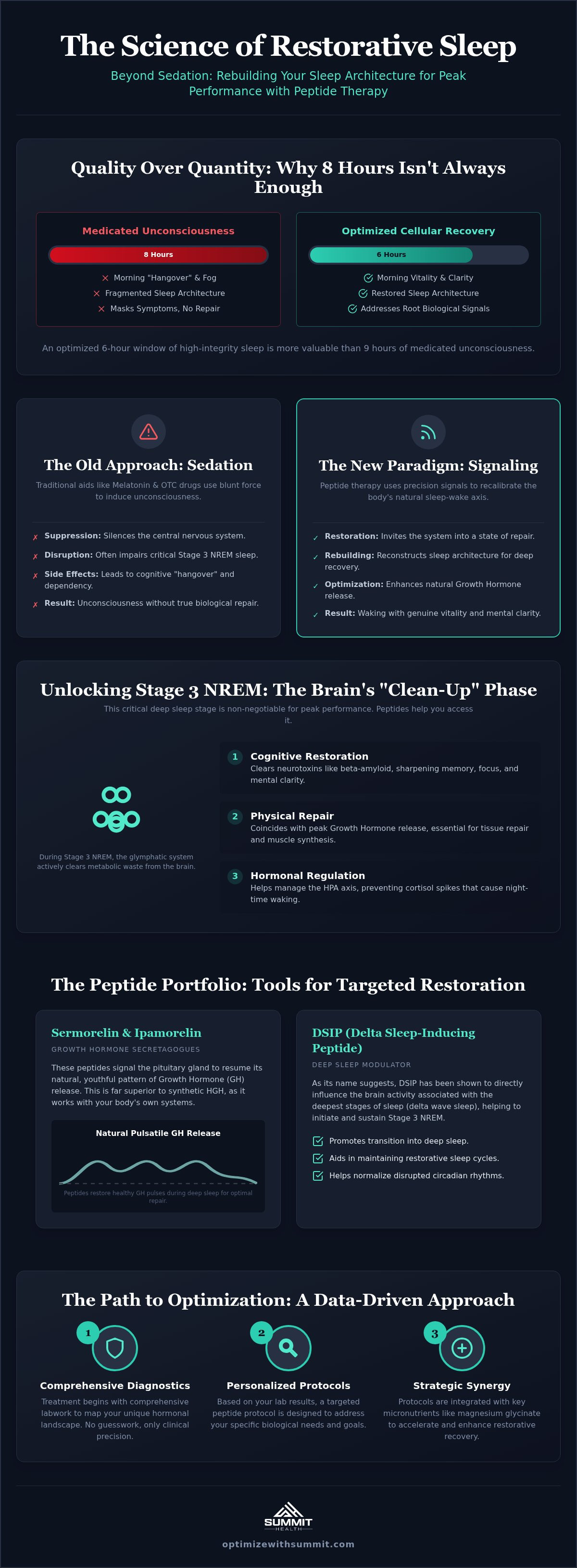
True rest. Biological precision. Beyond the blackout. Most people confuse unconsciousness with recovery. They aren't the same. Traditional sleep aids target the central nervous system with blunt force, effectively silencing the brain to induce a state of pharmacological sedation. Peptide therapy for sleep represents a fundamental shift in methodology. Instead of suppression, we utilize signaling. Peptides are short-chain amino acids that serve as the body's internal messengers. They don't force the brain into a state of sedation; they invite the system into a state of repair.
In the 2026 landscape of health optimization, sleep is viewed as the cornerstone of precision recovery. We no longer settle for "knocking out" the nervous system. We focus on restoring natural rhythms that have been eroded by stress, age, or environmental factors. This approach treats sleep as a dynamic biological process rather than a passive state of being.
The Signaling Advantage
Peptides work through clinical precision. They communicate directly with receptors in the pituitary gland and hypothalamus to trigger natural hormonal pulses. This is endogenous restoration. Unlike exogenous drugs that override your biology, peptides encourage your body to produce its own restorative hormones. It's the difference between a loud alarm and a subtle whisper. Peptide therapy for sleep functions as a biological recalibration tool that optimizes the body's innate recovery signals. By restoring these natural rhythms, we ensure the nervous system transitions smoothly into deep recovery rather than just shutting down.
Peptides vs. Melatonin and OTC Aids
The reliance on melatonin has reached a saturation point. While useful for short-term adjustments, chronic use often leads to receptor downregulation and a morning "hangover" that impairs cognitive performance. It's a temporary fix for a structural problem. Traditional over-the-counter aids frequently disrupt the delicate balance of sleep architecture, specifically Stage 3 NREM sleep. This deep phase is non-negotiable for anyone seeking peak performance.
Quality outweighs duration. An optimized six-hour window of high-integrity sleep is more valuable than nine hours of medicated unconsciousness. Peptides specifically address the age-related decline in Growth Hormone (GH) pulses, which are essential for nighttime cellular repair. By utilizing targeted interventions, we can reverse the biological friction that prevents restorative rest. The goal is a refined state of morning vitality that begins the moment you open your eyes.
Restoring Biological Rhythms: How Peptides Rebuild Sleep Architecture
Biological architecture matters. Sleep isn't a monolithic block of time; it's a precisely sequenced series of stages designed for specific recovery tasks. Most people who wake up unrefreshed are suffering from fragmented architecture. Their brains never reach the critical "clean-up" phase known as Stage 3 NREM sleep. During this deep sleep stage, the glymphatic system becomes active, physically clearing metabolic waste and neurotoxins from the brain. If you miss this window, cognitive performance and physical recovery remain stalled. Peptide therapy for sleep focuses on restoring these essential cycles by aligning your internal clock with your biological needs.
Circadian synchronization is the goal. Modern life, with its blue light and chronic stress, desynchronizes the pineal gland. This leads to shallow sleep and frequent interruptions. By utilizing precision signaling, we can encourage the body to enter and remain in deep restorative states longer. This isn't about more sleep; it's about higher integrity sleep.
The Growth Hormone Connection
Repair happens in the dark. Human Growth Hormone (HGH) is primarily released in pulsatile bursts during the first half of the night. This hormone is the master key for tissue repair, muscle protein synthesis, and neural maintenance. As we age, these pulses diminish, leading to slower recovery and decreased morning vitality. Peptides like Sermorelin or Ipamorelin signal the pituitary gland to resume its natural, pulsatile GH release. This is far superior to synthetic HGH, which can suppress your body's own production. By optimizing IGF-1 levels through these natural pathways, we ensure the body has the raw materials required for deep, cellular restoration.
Managing the Stress Axis
The "3 AM wake-up" isn't a mystery; it's a cortisol spike. When the Hypothalamic-Pituitary-Adrenal (HPA) axis is overactive, your body perceives a threat in the middle of the night. This triggers a rise in core temperature and a drop in Heart Rate Variability (HRV), pulling you out of deep sleep cycles. Peptide therapy for sleep acts as a biological buffer for this stress response. It helps lower nighttime systemic inflammation and stabilizes the HPA axis, allowing for a steady, cool core temperature throughout the night. When your stress hormones are managed with clinical precision, your body can finally commit to the deep recovery it needs. To see how these protocols fit your specific biological profile, you can schedule a virtual consultation to begin your optimization journey.
The Peptide Portfolio: Sermorelin, Ipamorelin, and DSIP
Clinical precision. Targeted signaling. The success of any recovery protocol depends on the specific molecules used to recalibrate the system. Peptide therapy for sleep utilizes a diverse portfolio of short-chain amino acids, each designed to address a different facet of the sleep-wake axis. We don't use a one-size-fits-all approach. We select the peptide that matches your specific diagnostic profile to ensure maximum efficacy without the interference of side effects.
Sermorelin remains a primary choice for architecture repair. It functions as a GHRH analog, mimicking the natural hormone that signals the pituitary gland to release growth hormone. This restoration of youthful signaling helps rebuild the structure of your sleep cycles from the ground up. CJC-1295, particularly in its "No DAC" form, provides sustained support for hormonal balance. It ensures that the growth hormone pulses remain steady and predictable throughout the evening, mirroring the body's natural nocturnal rhythms.
Ipamorelin is the preferred "clean" secretagogue. It is highly selective, meaning it stimulates GH release without triggering hunger hormones or stress markers like cortisol and prolactin. This makes it an ideal tool for those focusing on pure recovery and lean body composition. It's a sophisticated solution for those who require the benefits of growth hormone without the metabolic noise associated with older generations of peptides.
GHRH vs. GHRP: Choosing Your Mechanism
Understanding the distinction between these two classes is vital for optimization. GHRH molecules, such as Sermorelin, provide the constant signal for hormone production. GHRP molecules, such as Ipamorelin, act as the trigger for the pulsatile release. In 2026 protocols, we often combine these mechanisms. This synergy creates a more robust and natural hormonal response. It ensures that your body doesn't just produce the hormone, but releases it at the optimal time for neural repair and muscle recovery.
Tactical Peptides for Circadian Alignment
Beyond growth hormone, tactical peptides address the immediate mechanics of rest. DSIP, or Delta-Sleep-Inducing Peptide, specifically targets sleep latency. It encourages the brain to enter the delta-wave state, which is the hallmark of deep, restorative sleep. It's a precise tool for those who struggle to quiet their mind at night. Epitalon serves a broader role in longevity and circadian health. It works directly on the pineal gland to normalize melatonin production and supports long-term cellular health. Most of these protocols are administered through subcutaneous delivery, ensuring maximum bioavailability and precision dosing for a bespoke recovery experience.
Precision Protocols: Why Diagnostics Precede Treatment
Data defines results. Precision is paramount. Attempting to optimize your recovery without a clear biological map is a high-risk strategy that often leads to suboptimal outcomes. Blindly initiating peptide therapy for sleep ignores the intricate nuances of your endocrine system. Every individual's hormonal landscape is unique. What works for a high-performance athlete may be entirely inappropriate for an executive managing chronic occupational stress. In 2026, we prioritize diagnostics to ensure every intervention is justified by data.
We don't guess. We measure. Identifying the specific "why" behind your sleep disturbances is the only way to select the correct signaling molecules. Is your struggle rooted in a growth hormone deficiency, or is it a result of circadian dysregulation? Only comprehensive diagnostics can provide the answer. This clinical baseline allows us to move from symptom management to true biological refinement.
The Hormone Blood Work Protocol
Precision begins with a needle. Comprehensive hormone blood work serves as the foundation for your entire optimization journey. We analyze critical biomarkers that dictate your sleep architecture and recovery speed. These include:
- IGF-1: A stable indicator of your daily growth hormone production.
- Cortisol: Mapping the stress curve to identify inappropriate nighttime spikes.
- DHEA-S: Assessing your body's raw materials for cellular repair and resilience.
- Testosterone: Evaluating the primary driver of physical and neural restoration.
Identifying these gaps allows us to match peptide selection to your unique needs. If cortisol is elevated at midnight, a tactical tool like DSIP might be prioritized. If IGF-1 is clinically low, we focus on secretagogues like Ipamorelin to restore youthful pulses. It's a bespoke approach to biological balance.
The Telehealth Journey
Expertise delivered virtually. Our model leverages telehealth-led virtual monitoring to provide high-end care without the friction of traditional medical visits. During your virtual consultation, we interpret your labs to design a bespoke protocol tailored to your specific hormonal gaps. This isn't a static plan. It's a dynamic process. We utilize ongoing biofeedback and follow-up labs to adjust dosages and ensure long-term safety. This methodical approach protects receptor sensitivity and prevents the diminishing returns often seen in unmonitored protocols. You deserve a recovery strategy that evolves with you. To begin your data-driven transformation, book your precision diagnostic review today.
Elevating Performance: The Summit Health Optimization Model
Peak vitality. Total integration. Restorative sleep is the foundation, but it doesn't exist in a vacuum. To move from baseline recovery to elite performance, we must address the entire endocrine system. This is where the Summit Health model excels. We don't just provide peptide therapy for sleep; we engineer a comprehensive environment for biological excellence. Our concierge-level approach treats you as a high-performance athlete, regardless of your profession. We focus on the refinement of your current state to ensure your recovery matches your ambition.
Peptides act as the signal, but your hormones provide the substrate. Integrating these with bioidentical hormone replacement ensures that your body can actually execute the repair orders it receives. For example, optimizing your growth hormone pulses is far more effective when your testosterone and thyroid levels are already balanced. It's a compounding effect. We also utilize targeted micronutrients to remove biological friction. Incorporating magnesium glycinate sleep support provides the enzymatic cofactors necessary for neural relaxation. This synergy creates a deeper, more resilient sleep state that supports hormonal health and cognitive clarity.
A Holistic Recovery Framework
Our approach combines clinical precision with behavioral discipline. We integrate your peptide protocol with evidence-based lifestyle adjustments that maximize your investment in your health. We often implement the 10-5-3-2-1 rule to protect your sleep architecture. No caffeine ten hours before bed. No food three hours before. No work two hours before. No screens one hour before. Our online coaching provides the accountability required to turn these protocols into permanent habits. This isn't just about a prescription. It's about a total lifestyle recalibration that bridges the gap between medical science and daily execution.
Your Optimization Roadmap
The journey to peak performance is methodical and data-driven. It begins with a clear assessment of your baseline. Your first step is the Summit Health Hormone Quiz. This assessment provides an initial snapshot of your biological state and identifies potential areas for optimization. From there, your virtual consultation serves as the deep dive into your lab work and performance goals. We move beyond the treatment of fatigue toward the pursuit of an optimized life. This is elite-level recovery for 2026. Long-term vitality is the objective. Precision is the method. We guide you from your current state to a version of yourself that is restored, resilient, and ready for peak performance.
Architecting Your Elite Recovery
Biological mastery. Restorative precision. You've moved beyond the era of blunt-force sedatives and entered the age of signaling. By leveraging peptide therapy for sleep, you're not just closing your eyes; you're initiating a sophisticated sequence of cellular repair and neural optimization. We've established that true recovery requires more than duration. It demands the high-integrity architecture of Stage 3 NREM sleep and the pulsatile release of growth hormones that define youthful vitality.
The path forward is defined by data. Our telehealth-led hormone optimization model replaces guesswork with clinical certainty. Through data-driven treatment plans and expert virtual health coaching, we ensure your protocol evolves alongside your performance goals. You deserve a recovery strategy as ambitious as your daily pursuits. It's time to transform your rest into a competitive advantage and reclaim the morning edge.
Begin your precision recovery journey with a Summit Health consultation and discover the power of biological recalibration. Your peak performance starts with the depth of your rest.
Frequently Asked Questions
Is peptide therapy for sleep safe for long-term use?
Peptide therapy for sleep is generally safe for long-term use when managed through clinical oversight and strategic cycling. Unlike traditional hypnotics that lead to dependency, peptides focus on biological signaling to restore natural rhythms. We utilize virtual monitoring to track your biomarkers and adjust protocols to prevent receptor desensitization. This ensures the therapy remains an effective tool for your recovery without compromising your body's innate hormonal production over time.
How long does it take to see results from sleep peptides?
The timeline for results varies based on the specific signaling molecules used in your protocol. Tactical peptides like DSIP often provide noticeable improvements in sleep latency within the first few nights. However, architecture-repair peptides such as Sermorelin typically require three to six weeks of consistent use to fully recalibrate growth hormone pulses and Stage 3 NREM depth. This is a progressive biological restoration rather than a temporary sedative effect.
Do I need a prescription for sleep-optimizing peptides?
You must have a medical prescription to access high-quality, clinical-grade peptides. These are sophisticated biological tools that require a precise diagnostic baseline to ensure safety and efficacy. Our process involves a virtual consultation where we review your comprehensive lab results before authorizing any treatment. This professional oversight protects you from the risks associated with unregulated, "research-grade" substances found on the gray market, ensuring you receive only verified, pharmacy-grade products.
Can I take peptides if I am already on hormone replacement therapy?
Peptides are frequently used alongside hormone replacement therapy to create a synergistic recovery effect. While hormone replacement addresses foundational deficiencies, peptides provide targeted signaling to optimize specific functions like nighttime tissue repair. This combination is a core component of our performance model. We monitor your IGF-1 and testosterone levels through ongoing lab work to ensure both therapies work in harmony to elevate your total vitality and recovery speed.
Will sleep peptides make me feel groggy in the morning?
You won't experience the morning grogginess typical of over-the-counter sleep aids or melatonin. Peptide therapy for sleep focuses on restoring natural architecture rather than pharmacological sedation. Because these molecules encourage your body's own restorative processes, you typically wake up with increased mental clarity and physical vitality. The goal is a refined state of morning alertness that allows you to perform at your peak immediately upon waking from deep rest.
What is the best peptide for deep sleep (Stage 3 NREM)?
Growth hormone secretagogues like Ipamorelin and Sermorelin are the most effective options for enhancing Stage 3 NREM deep sleep. These peptides signal the pituitary gland to release natural pulses of growth hormone; this is the primary driver of nighttime cellular clean-up and neural repair. By increasing the integrity of these deep cycles, you ensure that your brain and body complete the essential recovery tasks required for long-term cognitive health and physical performance.
How does DSIP differ from traditional sleeping pills?
DSIP differs from traditional sleeping pills by acting as a biological modulator rather than a central nervous system depressant. Traditional sedatives often rely on GABAergic pathways to silence the brain, which bypasses natural sleep architecture. DSIP encourages the brain to enter the delta-wave state naturally, facilitating a transition into deep rest without the risk of addiction or respiratory suppression. It's a precision tool for recalibrating your existing sleep-wake axis safely.
Are there any side effects to peptide therapy for sleep?
Side effects from sleep-optimizing peptides are typically mild and transient when administered under medical supervision. Some individuals report minor redness or irritation at the subcutaneous injection site or brief facial flushing immediately after administration. Because these are bio-identical signaling molecules, they don't carry the heavy side-effect profiles of pharmaceutical hypnotics. We use your diagnostic data to customize dosages, which significantly reduces the likelihood of any adverse reactions during your optimization journey.

Article by
Dr. David Richardson
David Richardson, is the founder and CEO of Summit Health and the author of "Insights from the Summit", where he writes about hormone optimization, metabolic health, thyroid function, longevity, and preventive medicine.
After entering healthcare in 2009, David became increasingly interested in a question that traditional medicine often struggles to answer:
Why do so many people continue to feel terrible despite being told their labs are "normal"?
That question eventually led him into the field of health optimization in 2020, where he became passionate about understanding physiology at a deeper level and helping patients uncover the root causes of their symptoms rather than simply managing them.
Today, David's philosophy is simple: normal and optimal are not the same thing. Every patient is physiologically unique, and meaningful healthcare begins by listening to symptoms, understanding the science, and recognizing that laboratory values are only one piece of a much larger picture.
Through Summit Health and Insights from the Summit, David's mission is to help people better understand their bodies, ask better questions, and make informed decisions that improve both their health span and quality of life.


