

IMPORTANT DISCLAIMERS
Medical Disclaimer: The information in this article is provided for educational purposes only and is not intended as medical advice or a substitute for individualized medical care. Every person's health needs are unique. Always consult a qualified healthcare professional before starting, stopping, or changing any medication, supplement, or treatment plan. -------
Article Disclaimer: Articles are reviewed and published by Summit Health to provide evidence-based educational information. While Summit Health strives to provide reliable and current health information, medical knowledge is always evolving over time. Depending on when you are reading this content, it may not reflect the latest research or apply to your individual circumstances.
Precision defines progress. You've likely hit the plateau where sleep no longer resolves fatigue and disciplined habits don't shift stubborn midsection weight. It's the frustrating space between "clinically normal" and actually feeling optimal. You deserve data that matches your ambition. By integrating at-home hormone testing into your routine, you replace biological guesswork with clinical certainty without the inconvenience of traditional doctor visits.
Data drives results. We understand that generic wellness protocols often fail because they ignore your unique chemical signature. This guide promises to show you how to leverage diagnostic data to move beyond basic health and into a state of clinical peak performance. We will explore the 2026 landscape of precision diagnostics, provide a clear roadmap for interpreting your biomarkers, and explain how to access telehealth specialists who turn raw data into a personalized optimization strategy.
Key Takeaways
- Beyond normal. Shift from reactive symptom management to a proactive strategy focused on clinical peak performance.
- Data integrity. Evaluate the precision of at-home hormone testing and learn how CLIA-certified labs maintain diagnostic excellence.
- Endocrine mapping. Identify the essential biomarkers that provide a comprehensive view of your biological health beyond basic sex hormones.
- Precision protocols. Master the collection requirements, including timing and fasting, that ensure your labwork is accurate and actionable.
- Integrated strategy. Discover how to transition from raw diagnostic data to a personalized medical roadmap with elite telehealth oversight.
Beyond the Symptoms: Why At-Home Hormone Testing is the New Standard
The era of reactive healthcare is ending. For decades, the medical model relied on a wait-and-see approach; you waited for symptoms to become debilitating before seeking help. Modern performance standards demand more. At-home hormone testing has emerged as the primary tool for those who refuse to settle for the "absence of illness" as a health goal. It offers a sophisticated, private, and efficient method to audit your internal chemistry without the logistical burden of traditional clinical environments.
Efficiency drives this transition. High-performers value their time, and the ability to collect samples at home removes the friction of scheduling and travel. Privacy is equally paramount. Discussing sensitive issues like libido or cognitive decline is often easier when the data collection happens in your own space. Efficiency and privacy are the primary drivers of the at-home diagnostic boom, which saw the global market valued at $14.9 billion in 2025. By utilizing at-home hormone testing, you gain the data necessary to move beyond generic advice and into a state of clinical precision. Telehealth then bridges the gap between these diagnostics and elite medical oversight. You gain direct access to specialists who view your health through the lens of optimization rather than just survival.
The Problem with "Normal" Lab Ranges
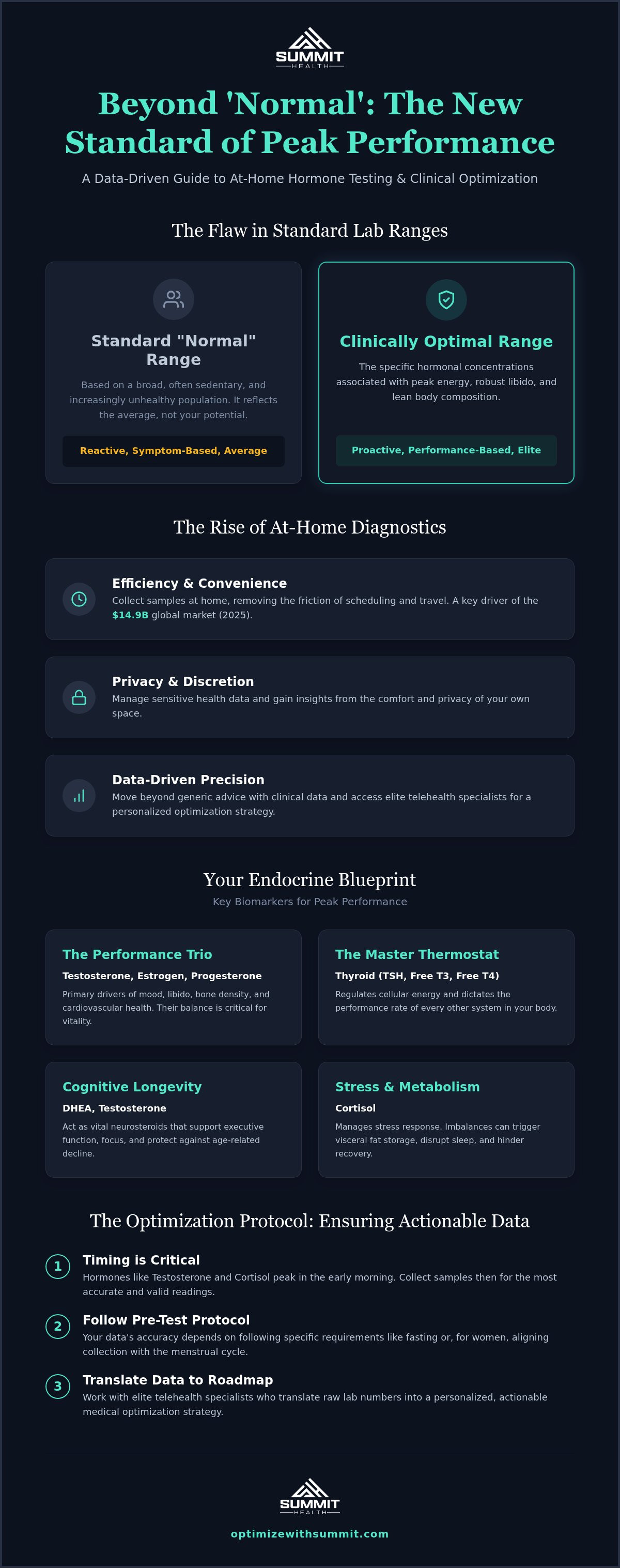
Standard reference ranges are inherently flawed. These benchmarks are calculated based on a broad, often sedentary, and increasingly unhealthy population. If you fall within the "normal" range, it simply means your results align with the average of the general public. It does not mean you are performing at your best.
Optimal levels are the true target. These are the specific hormonal concentrations associated with peak energy, robust libido, and lean body composition. The clinical validity of blood testing remains the gold standard for identifying these nuances. It allows for a precise mapping of your endocrine health that standard screenings often overlook. Hormonal optimization is the pursuit of peak biological function, not just the absence of disease.
Identifying the Silent Indicators of Imbalance
Biological decline is often quiet. It manifests as a gradual loss of your competitive edge rather than an acute crisis. You might notice stubborn midsection weight gain that resists traditional dieting or a persistent brain fog that disrupts your professional focus. These aren't just inconveniences; they are clear indicators of a system under stress.
Cortisol plays a central role in this decline. Elevated stress hormones frequently trigger visceral fat storage around the midsection, regardless of your caloric intake or exercise volume. Sleep disturbances and decreased recovery capacity further signal that your endocrine system is struggling to maintain homeostasis. To begin your journey toward biological clarity, Take the Hormone Quiz to identify your baseline and understand which markers require immediate intervention.
Decoding the Panel: Essential Biomarkers for Peak Performance
Data requires context. A single biomarker is a snapshot; a comprehensive panel is a blueprint for action. Effective at-home hormone testing must look at the whole endocrine system rather than isolated sex hormones. Hormones do not work in silos. They function as a complex web of feedback loops where one deficiency inevitably triggers a cascade of imbalances elsewhere. If you only measure testosterone while ignoring cortisol or thyroid function, you are viewing your health through a keyhole.
Precision relies on timing. Clinical accuracy depends heavily on when you collect your sample. Testosterone and cortisol, for example, peak in the early morning hours, making morning collection non-negotiable for a valid reading. For women, testing must align with specific phases of the menstrual cycle to provide an accurate assessment of progesterone and estrogen ratios. Without this temporal precision, your data is merely noise that cannot support a clinical strategy.
Cognitive longevity is the new frontier of health optimization. Markers like DHEA and Testosterone are often associated with physical strength, yet their role in brain health is equally critical. These hormones act as neurosteroids that support executive function, focus, and protection against age-related decline. Similarly, thyroid markers like TSH, Free T3, and Free T4 are essential to the hormone conversation. They serve as the master thermostat for cellular energy, dictating how every other system in your body performs.
The Performance Trio: Testosterone, Estrogen, and Progesterone
Vitality is a ratio. Testosterone, estrogen, and progesterone are the primary drivers of mood, bone density, and cardiovascular health in both men and women. While their concentrations differ by gender, their necessity for peak performance is universal. Balance between these markers is more important than any single number. An elevated testosterone level is less effective if estrogen is too low to protect the heart or too high to prevent unwanted side effects. Understanding these nuances is the core of The Sophisticated Guide to Hormone Replacement Therapy, which outlines how to maintain this delicate biological equilibrium.
Metabolic Markers: Insulin and Thyroid Health
Metabolism is a chemical process. Your thyroid function dictates your overall metabolic rate, determining how efficiently your cells convert oxygen and calories into energy. When T3 levels are sub-optimal, you face a biological uphill battle with weight management and recovery. Insulin sensitivity is the other half of this equation. It acts as the gatekeeper for weight loss optimization. If your insulin levels are chronically elevated, your body remains in storage mode, making fat loss difficult regardless of your activity level. Modern interventions like GLP-1s and Tirzepatide focus on restoring this metabolic flexibility, allowing your body to process fuel with precision. To see how these markers align with your goals, you can explore our comprehensive diagnostic approach.
Clinical Validity: At-Home Kits vs. In-Person Labwork
Precision is the foundation of any optimization strategy. While the convenience of at-home hormone testing has revolutionized personal health management, the clinical validity of the data remains a primary concern for high-performers. You need to know that the numbers driving your treatment plan are beyond reproach. Diagnostic reliability in 2026 depends on two factors: the method of collection and the certification of the processing facility. Most reputable at-home solutions now utilize CLIA-certified laboratories, ensuring they meet the same federal standards for quality and accuracy as hospital-based labs. This certification is a non-negotiable requirement for anyone seeking a professional-grade health audit.
Logistics have evolved to meet these high standards. Shipping sensitive biological samples in 2026 involves advanced, temperature-controlled kits that protect the molecular structure of your biomarkers. These kits are designed to withstand transit fluctuations, ensuring that the sample arriving at the lab is as stable as the moment it was collected. While at-home testing is often sufficient for routine monitoring or initial screenings, certain complex scenarios still require the depth provided by a traditional clinical environment. Understanding the distinction between these methods is essential for maintaining a state of peak biological function.
The Finger-Prick vs. Venous Draw Debate
Methodology matters. Finger-prick tests collect capillary blood, which is a mixture of blood from arterioles, venules, and capillaries. While highly effective for markers like glucose or certain thyroid antibodies, capillary blood can sometimes be influenced by interstitial fluid. This can lead to slight variances in high-sensitivity hormone readings. Venous draws, which collect blood directly from the vein, provide a larger and more stable volume for analysis. Summit Health prioritizes this level of accuracy by utilizing comprehensive hormone blood work to ensure every data point is actionable. While kits offer unmatched convenience for many, venous draws remain the gold standard for comprehensive optimization and long-term clinical management.
Ensuring Sample Integrity
Data is only as good as the collection process. To avoid contamination, best practices include thorough hand washing and ensuring the collection site is free of topical hormones or creams. Integrity is also maintained through the diagnostic chain. A test result in isolation is incomplete; it requires physician review to interpret the findings within the context of your symptoms and lifestyle. This human oversight is the final safeguard in the diagnostic process. It ensures that the transition from raw data to a personalized roadmap is handled with the clinical authority your health requires. By combining precise collection with expert interpretation, you eliminate the guesswork inherent in generic wellness products.
The Optimization Protocol: How to Prepare for Your Test
Preparation ensures precision. To move beyond generic health and into clinical excellence, your collection process must be flawless. At-home hormone testing provides the data, but your adherence to protocol guarantees its accuracy. Biological markers are highly sensitive to environmental and lifestyle variables. Without a standardized approach, you risk introducing noise into your results, which can lead to sub-optimal treatment strategies.
Timing is non-negotiable. Most hormones follow a circadian rhythm, peaking in the early morning. For markers like testosterone and cortisol, collection should occur within 30 minutes of waking, ideally before 9:00 AM. Fasting is equally critical for metabolic accuracy. You should maintain an 8 to 12 hour fast, consuming only water. Hydration is essential; it ensures adequate blood flow for collection and prevents concentrated readings that can skew data. For women, cycle tracking is mandatory. To capture the peak of the luteal phase, testing typically occurs between days 19 and 21 of a standard 28 day cycle.
Pre-Test Requirements for Accuracy
Your 24 hour countdown determines the quality of your data. Success requires a controlled environment to establish a true endocrine baseline. Follow this checklist for maximum reliability:
- 48 Hours Prior: Cease intense physical exercise. High-intensity training causes acute spikes in cortisol and testosterone that do not reflect your resting state.
- 24 Hours Prior: Avoid alcohol and excessive caffeine. These substances disrupt the delicate balance of the hypothalamic-pituitary-adrenal axis.
- Supplement Management: Consult your specialist regarding biotin. High doses can interfere with thyroid and cardiovascular assays.
- Restorative Recovery: Prioritize deep sleep. Understanding the role of magnesium glycinate sleep protocols can help stabilize test-day cortisol levels for a more accurate reading.
Post-Test: What to Expect After Mailing Your Sample
Efficiency follows collection. Once you mail your sample in the provided temperature-controlled packaging, high-end diagnostic labs typically provide results within 3 to 5 business days. Your data is delivered through a secure digital portal, ensuring both privacy and immediate access. However, a report is not a solution. The transition from receiving your biomarkers to achieving peak performance happens during your telehealth consultation. This is where raw numbers are translated into a bespoke medical strategy. To begin this transition, schedule your clinical review with an optimization specialist.
Summit Health: Transforming Diagnostic Data into Peak Performance
Data without direction is noise. While at-home hormone testing provides a critical biological baseline, the raw numbers on a laboratory report cannot prescribe a path forward. Many diagnostic providers treat the delivery of a results PDF as the final step. At Summit Health, we view the lab report as the beginning of a sophisticated medical dialogue. A test result without a professional medical consultation is an incomplete solution that leaves you to navigate complex endocrine variables alone.
Our approach integrates comprehensive labwork with elite medical oversight. We don't just identify deficiencies; we engineer a state of clinical peak performance. This transition from data to refinement requires a specialist who understands how your unique biomarkers interact with your lifestyle and performance goals. By combining precise diagnostics with personalized medical strategies, we ensure that every intervention is grounded in evidence and tailored to your specific chemical signature. This is the difference between generic wellness and biological optimization.
The Virtual Consultation Advantage
Interpretation requires expertise. Our doctors analyze your panels to identify sub-optimal levels that standard screenings often ignore. Through our national telehealth platform, you receive direct access to specialists in hormone therapy from the comfort of your home. These consultations are not generic reviews; they are deep dives into your physiology. We translate complex endocrine data into a bespoke roadmap, adjusting variables with surgical precision to restore your energy, focus, and vitality. This virtual model removes the friction of traditional clinic visits, allowing you to prioritize your health without disrupting your schedule.
Beyond Hormones: A Holistic Optimization Ecosystem
Peak performance is multi-dimensional. While hormonal balance is the foundation, true optimization involves a broader ecosystem of metabolic health and recovery. Our protocols extend into medical weight loss, utilizing advanced interventions like Semaglutide and Tirzepatide to restore metabolic flexibility and body composition. We also address sleep and recovery, ensuring your system has the resources to rebuild and perform at its limit.
Support is continuous. Ongoing health coaching serves as the bridge between your medical plan and your daily habits, providing the accountability needed to maintain a "peak" state long-term. This holistic integration ensures that your optimization journey is safe, sustainable, and effective. To understand the experts behind your journey, you can Learn more about the Summit Health team and our commitment to biological excellence. We don't just treat symptoms; we refine your potential.
Master Your Internal Chemistry
Precision is the only path to peak performance. You've learned that standard lab ranges are often insufficient for those seeking an optimized life. By utilizing at-home hormone testing, you gain the diagnostic clarity needed to identify sub-optimal markers before they become chronic issues. This data serves as the foundation for a life defined by energy, focus, and physical excellence. It's about moving beyond the simple absence of disease and into a state of biological mastery.
Raw data is merely the first step. True transformation requires the integration of clinical expertise and personalized strategy. Summit Health provides the telehealth-led medical oversight necessary to translate your results into customized treatment roadmaps. You gain national access to performance specialists who understand the nuances of biological refinement and long-term health management. Every protocol we design is as unique as your own chemical signature, ensuring your journey is both safe and effective.
Start your optimization journey with Summit Health diagnostic labwork. Your peak state is within reach. It's time to stop guessing and start optimizing with clinical precision.
Frequently Asked Questions
How accurate is at-home hormone testing compared to a doctors office?
At-home hormone testing is clinically accurate when processed by CLIA-certified laboratories. These facilities meet the same federal standards for quality and precision as hospital labs. While finger-prick kits provide reliable data for routine monitoring, venous blood draws remain the gold standard for high-precision optimization. The primary difference lies in the collection method rather than the diagnostic technology. Specialists often prefer venous collection for initial baselines to ensure every biomarker is measured with absolute certainty.
What is the best time of day to take a hormone test?
Morning collection is non-negotiable for most endocrine panels. You should collect your sample within 30 minutes of waking, ideally before 9:00 AM. Hormones like testosterone and cortisol follow a strict circadian rhythm, reaching their peak concentrations during these early hours. Testing later in the day will result in lower readings that do not reflect your true physiological capacity. Consistency in timing is essential for comparing results over time and maintaining a valid optimization roadmap.
Do I need to stop taking my current supplements before a hormone test?
You should generally pause specific supplements that interfere with assay results. Biotin is the primary concern, as it can cause significant inaccuracies in thyroid and cardiovascular tests. It's recommended to stop taking high-dose biotin at least 72 hours before collection. Additionally, you must avoid topical hormone creams near the collection site to prevent contamination. Always consult with a clinical specialist before altering your supplement regimen to ensure your at-home hormone testing provides a clean biological baseline.
Can at-home hormone tests help with weight loss plateau?
Yes, these tests are essential for identifying the biological barriers to fat loss. Stubborn weight gain is often a symptom of thyroid dysfunction, insulin resistance, or elevated cortisol levels rather than a lack of discipline. By analyzing metabolic markers, you can determine if your body is trapped in a storage-dominant state. This data allows for targeted interventions, such as GLP-1 therapy or thyroid optimization, which can effectively resolve a plateau that diet and exercise alone cannot fix.
Does insurance typically cover at-home hormone testing kits?
Most insurance providers do not cover direct-to-consumer testing kits. These tests are typically considered elective wellness screenings rather than diagnostic necessities for acute illness. However, many kits are eligible for purchase using Health Savings Account (HSA) or Flexible Spending Account (FSA) funds. If you transition to a medically supervised program, the associated labwork and consultations may be partially reimbursable depending on your specific policy and the clinical necessity established by your provider.
What hormones should be included in a comprehensive male performance panel?
A comprehensive male panel must include Total and Free Testosterone, Estradiol, and Sex Hormone Binding Globulin (SHBG). These markers define your androgenic status and its bioavailability. You should also include Prostatic Specific Antigen (PSA) for safety, along with a full thyroid panel (TSH, T3, T4) and morning cortisol. This holistic view ensures that your optimization strategy addresses energy, body composition, and long-term health without overlooking the critical feedback loops that govern your endocrine system.
How often should I re-test my hormone levels once I start therapy?
Re-testing should occur every 90 to 180 days during the initial phase of therapy. This frequency allows your medical team to monitor your response to treatment and make precise adjustments to your dosage. Once your levels have stabilized within the optimal range, annual testing is usually sufficient for long-term maintenance. Regular monitoring is the only way to ensure your protocol remains safe and continues to deliver the peak performance results you've established as your goal.
Can women take a hormone test while on birth control?
Women can take these tests while on birth control, but the interpretation of results changes significantly. Hormonal contraceptives suppress your natural endocrine production, meaning the test will measure the effects of the medication rather than your baseline biological function. This information is still valuable for assessing how the birth control is impacting your metabolic health or mood markers. If you are seeking to understand your natural hormonal balance, you must typically be off hormonal contraceptives for several cycles.

Article by
Dr. David Richardson
David Richardson, is the founder and CEO of Summit Health and the author of "Insights from the Summit", where he writes about hormone optimization, metabolic health, thyroid function, longevity, and preventive medicine.
After entering healthcare in 2009, David became increasingly interested in a question that traditional medicine often struggles to answer:
Why do so many people continue to feel terrible despite being told their labs are "normal"?
That question eventually led him into the field of health optimization in 2020, where he became passionate about understanding physiology at a deeper level and helping patients uncover the root causes of their symptoms rather than simply managing them.
Today, David's philosophy is simple: normal and optimal are not the same thing. Every patient is physiologically unique, and meaningful healthcare begins by listening to symptoms, understanding the science, and recognizing that laboratory values are only one piece of a much larger picture.
Through Summit Health and Insights from the Summit, David's mission is to help people better understand their bodies, ask better questions, and make informed decisions that improve both their health span and quality of life.


