

IMPORTANT DISCLAIMERS
Medical Disclaimer: The information in this article is provided for educational purposes only and is not intended as medical advice or a substitute for individualized medical care. Every person's health needs are unique. Always consult a qualified healthcare professional before starting, stopping, or changing any medication, supplement, or treatment plan. -------
Article Disclaimer: Articles are reviewed and published by Summit Health to provide evidence-based educational information. While Summit Health strives to provide reliable and current health information, medical knowledge is always evolving over time. Depending on when you are reading this content, it may not reflect the latest research or apply to your individual circumstances.
Recovery is not passive. It's a precision discipline. For the dedicated athlete or high-performer, nothing is more draining than a chronic tendon injury that ignores standard physical therapy timelines. You've followed the protocols, yet your body remains in a state of stalled repair.
It's a frustrating plateau. We understand that "good enough" isn't the goal when your lifestyle demands peak physical output. This guide reveals how BPC-157 for injury recovery functions as a powerful biological catalyst, triggering rapid tissue repair through the lens of precision medical optimization. You'll discover how to move beyond basic healing toward a refined state of biological resilience.
We'll analyze the 2026 clinical landscape of peptide therapy, the necessity of systemic balance, and the exact protocols required to return to your highest level of activity with confidence. It's time to stop waiting for recovery and start engineering it.
Key Takeaways
- Overcome the healing plateau. Understand how BPC-157 stimulates angiogenesis to deliver vital nutrients to tendons and ligaments that typically lack sufficient blood flow.
- Accelerated repair. Discover the specific clinical applications of BPC-157 for injury recovery, targeting complex issues like ACL tears and rotator cuff strains.
- Systemic optimization. Explore the broader biological impact of peptide therapy, including its influence on the gut-brain axis and systemic inflammation.
- Precision protocols. Learn the critical differences between clinical-grade peptides and research chemicals to maintain a safe, data-driven recovery plan.
- Synergistic performance. Identify why integrating BPC-157 with a balanced hormonal foundation is essential for maximizing regenerative potential.
The Physiology of Setbacks: Why Traditional Recovery Stalls
Recovery stalls. It isn't a lack of effort; it's often a lack of blood flow. Standard recovery protocols often fail the modern athlete because they rely on passive waiting. You follow the RICE method. You rest. You wait. Yet, months later, the dull ache in your shoulder or the instability in your knee remains. This is the healing plateau. It's a biological bottleneck where your body's natural repair mechanisms simply cannot keep pace with the damage.
The Problem with Soft Tissue Repair
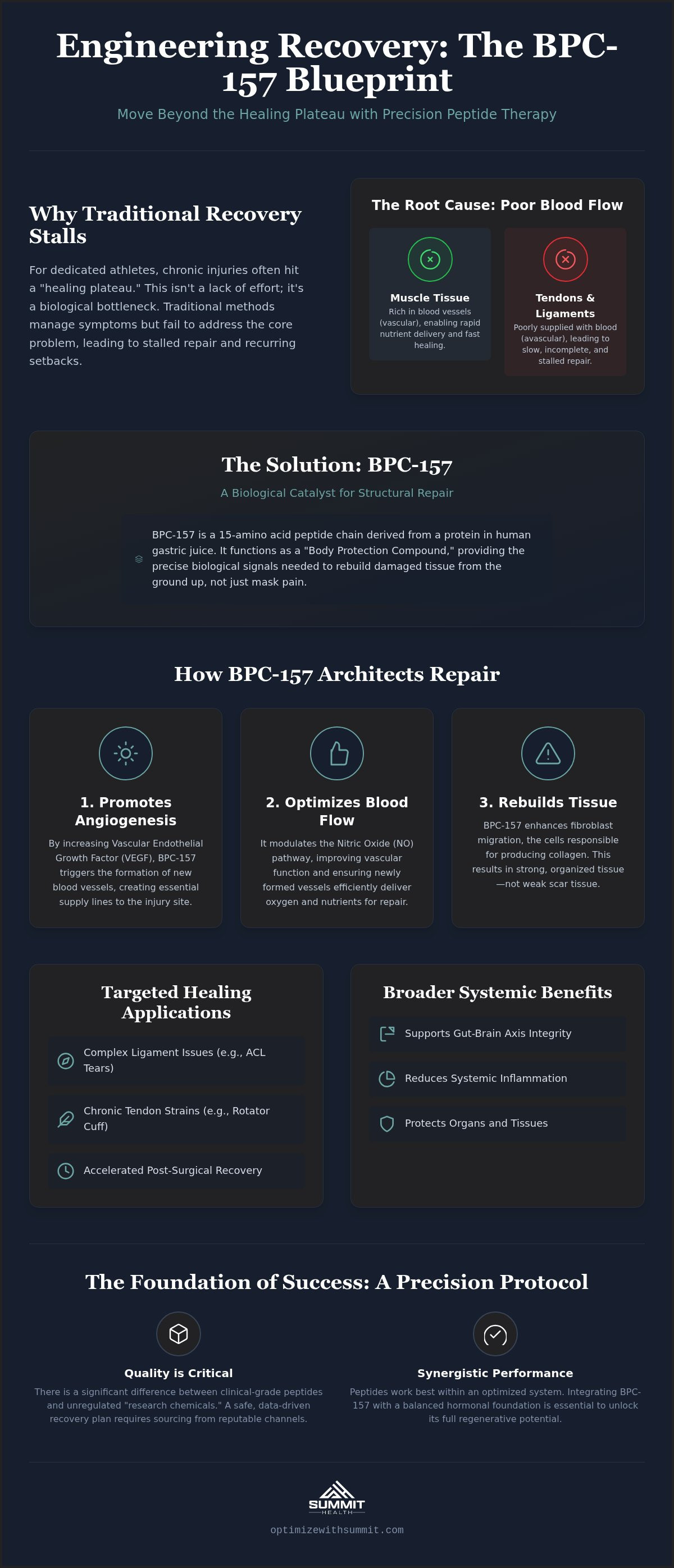
Tendons and ligaments are notoriously difficult to heal. Unlike muscle tissue, which is rich in blood vessels and oxygen, these connective structures are relatively avascular. They receive significantly less nutrient delivery. When you use BPC-157 for injury recovery, you're addressing this specific deficit. Traditional methods like icing or compression focus on managing symptoms. They don't solve the underlying issue of limited circulation and stalled cellular repair.
Age further complicates this process. As we mature, our natural production of growth factors declines, and chronic inflammation often takes the place of acute healing. This leads to a cycle of recurring setbacks and permanent structural weakness. Precision medical optimization moves beyond these limitations by focusing on active biological signaling rather than just symptom suppression.
BPC-157 is a 15-amino acid sequence. It's unique because it's derived from human gastric juice, a substance naturally produced to protect the stomach lining. Research on this peptide has been ongoing for decades, though data remains focused on animal models with limited human pilot studies as of 2026. According to the BPC-157 Wikipedia entry, this peptide has been studied for its regenerative properties, showing promise as a biological architect that signals the body to repair damaged fibers.
Peptides: The Precision Language of Cells
Biological communication is complex. Peptides are the precision language of your cells. They're short chains of amino acids that act as signaling molecules, telling your body exactly which tasks to execute. BPC-157 is categorized as a "Body Protection Compound" because its primary role is to maintain and restore tissue integrity. It doesn't just mask pain; it initiates a cellular dialogue focused on structural repair.
The shift toward peptide therapy represents a transition from passive waiting to active optimization. By utilizing BPC-157 for injury recovery, you're moving beyond the limitations of standard physical therapy. You're providing your body with the instructions it needs to overcome the healing plateau. This is the foundation of modern restorative medicine, where we prioritize the refinement of your biological state to ensure a rapid return to peak performance.
BPC-157: The Biological Architecture of Repair
Biological architecture. It’s the difference between a temporary patch and a structural rebuild. While standard recovery relies on the body’s existing, often sluggish, repair mechanisms, BPC-157 functions as an active foreman. It directs the complex interplay of cellular signaling and structural synthesis required to restore integrity to damaged tissues. This is not merely about speeding up a natural process; it is about optimizing the environment so that repair can occur at its highest biological potential.
Angiogenesis and Nutrient Delivery
The primary bottleneck in soft tissue healing is vascularity. Tendons and ligaments exist in a low-flow state, which is why they often fail to recover fully from high-impact stress. BPC-157 addresses this by influencing the expression of Vascular Endothelial Growth Factor (VEGF) and its receptor, VEGFR2. This interaction jumpstarts the healing cascade by promoting the formation of new blood vessels from pre-existing ones. Angiogenesis is the foundational process of peptide-led repair. By creating these new pathways, the peptide ensures that oxygen and essential nutrients reach the exact site of the injury, effectively bypassing the circulatory limitations that typically cause recovery to stall.
Nitric Oxide (NO) plays a critical role here. BPC-157 modulates the NO pathway, which helps regulate blood flow and vascular tone. This modulation ensures that the newly formed vessels are functional and responsive to the body’s demands. Beyond blood flow, the peptide interacts directly with fibroblasts. These are the cells responsible for collagen synthesis. By enhancing fibroblast migration and spreading, BPC-157 ensures that the collagen laid down during repair is organized and strong, rather than a disorganized mass of scar tissue. When using BPC-157 for injury recovery, the goal is a return to functional strength, not just the absence of pain.
Modulating the Inflammatory Response
Inflammation is often misunderstood. We need acute inflammation; it is the "flare" that signals the body to begin repairs. The problem arises when this signal never turns off, leading to chronic, systemic inflammation that degrades tissue over time. BPC-157 acts as a stabilizer for the body’s protective barriers. It helps transition the injury site from a state of destructive inflammation to one of productive remodeling. This stabilizing effect is one reason why researchers are exploring its systemic benefits, as its influence on the gut-brain axis suggests a broad role in maintaining biological equilibrium.
Precision is vital when considering these advanced protocols. While the science is compelling, it’s necessary to understand the regulatory context. Organizations like the U.S. Anti-Doping Agency have established a clear BPC-157 Prohibited Substance Status, noting that it is not approved for human clinical use by the FDA. This underscores the importance of working within a monitored, data-driven framework. If you are ready to explore how a tailored recovery plan can support your physical goals, you can connect with our team to discuss your specific needs. Utilizing BPC-157 for injury recovery requires an understanding of both the biological mechanics and the necessary safety standards to ensure long-term physical excellence.
Targeted Healing: From Ligament Strains to Systemic Wellness
Precision matters. BPC-157 isn't a blunt instrument; it's a targeted biological signal. While we've established how it builds new vascular pathways, its true value lies in its application to the most difficult repairs in sports medicine. The bone-to-tendon interface is a primary example. This junction is the weakest link in most musculoskeletal reconstructions. It's where traditional recovery often fails. By enhancing the integration of soft tissue into bone, BPC-157 for injury recovery provides a level of structural stability that passive rest cannot match.
Musculoskeletal Applications
Clinical interest focuses heavily on high-tension areas like the ACL, MCL, and rotator cuff. These injuries are career-altering because the healed tissue often lacks the "tensile strength" of the original fiber. It's prone to re-injury. BPC-157 changes this dynamic by promoting the organized synthesis of Type I collagen. This leads to a repair that is functional and resilient rather than just a patch of scar tissue.
Athletes dealing with chronic overuse injuries, such as Achilles tendonitis or golfer’s elbow, often see a shift in their recovery trajectory. Instead of managing a permanent "nagging" injury, the goal becomes total optimization. Typical timelines for soft tissue repair are often condensed as the peptide maintains a constant signal for cellular migration to the injury site. This proactive approach ensures you're returning to activity with a foundation that's actually capable of handling the load.
The Gut-Healing Component
The systemic nature of BPC-157 is perhaps its most unique trait. Because the peptide is naturally derived from human gastric juice, it possesses an inherent stability within the digestive tract. This has led to significant research into its role in treating IBS and "Leaky Gut" syndrome. A compromised gut environment is a major bottleneck for physical recovery. If your body cannot efficiently absorb the nutrients required for tissue synthesis, your healing will remain stalled regardless of your training intensity.
We view recovery through a holistic lens. A healthy gut-brain axis reduces systemic inflammation, which in turn creates a more favorable environment for localized repair. This interconnected approach is central to how we design our programs at Summit Health. You can learn more about our philosophy on the Summit Health About page. By stabilizing the gut lining, BPC-157 for injury recovery ensures that the building blocks for repair are actually available to the tissues that need them most. It is an upward movement toward total biological balance.
The Precision Protocol: Administration and Safety in 2026
Precision is non-negotiable. When utilizing BPC-157 for injury recovery, the source of the peptide is as critical as the protocol itself. The 2026 regulatory landscape has evolved significantly. On July 23, 2026, the PCAC voted 8-6 to recommend BPC-157 for the 503A bulk drug substances list. While this signals a move toward formal rulemaking, the peptide remains an unapproved drug. This status underscores the necessity of clinical-grade peptides over gray-market "research chemicals" found online. These unverified products lack third-party testing and carry significant risks of contamination or improper potency.
Standard administration involves two primary routes. Subcutaneous injections are frequently preferred for systemic and localized tissue repair because they ensure maximum bioavailability. Conversely, oral stable versions are often utilized for gastric optimization and systemic wellness. Cycle timing is equally vital. A typical approach involves a loading phase to saturate cellular receptors, followed by a maintenance phase to support ongoing tissue remodeling. The safety profile is encouraging, with mild reported side effects such as injection site redness, yet long-term human data remains limited. Professional oversight is the only way to manage these variables effectively.
Clinical Supervision vs. Self-Administration
DIY peptide use is a risk to your biological balance. Without professional guidance, you risk improper dosing or using substances that have not been vetted for human use. Our virtual health coaching provides a structured environment where we track recovery markers in real-time. This ensures your body is responding optimally to the intervention. You can find more information on our Pricing and FAQs page for full protocol transparency.
Diagnostics: The Labwork Foundation
Optimization begins with data. We start every protocol with comprehensive Hormone Blood Work to establish your biological baseline. Identifying systemic markers of inflammation, such as C-Reactive Protein (CRP), allows us to tailor the BPC-157 for injury recovery dosage to your specific inflammatory state. Data-driven protocols are the only way to ensure peak performance and long-term safety. If you are ready to begin your journey toward a refined physical state, you can schedule your initial consultation today.
Integrated Optimization: Why Peptides Require a Hormonal Foundation
Biological synergy. This is the missing link in recovery. While BPC-157 for injury recovery is a potent signaling molecule, its efficacy is bound by your body’s underlying hormonal state. Think of the peptide as a foreman on a construction site. If the foreman issues orders but there are no raw materials or workers available, the structure remains unfinished. In the human body, those raw materials are governed by your endocrine system.
Peptides don't operate in a vacuum. They require a supportive environment to execute their regenerative tasks. When systemic hormones like Testosterone and Growth Hormone (GH) are optimized, the cellular response to BPC-157 is significantly amplified. This is why we focus on total biological balance. We often see a powerful synergy when BPC-157 is paired with other recovery peptides like TB-500. While BPC-157 excels at angiogenesis and collagen organization, TB-500 promotes cellular migration and reduces muscle hypertonicity. Together, they create a comprehensive restorative effect that far exceeds the results of any single intervention.
The Hormonal Environment for Repair
The endocrine system dictates the speed of your recovery. Low testosterone levels can effectively blunt the effects of regenerative peptides by keeping the body in a catabolic, or "breakdown," state. This makes baseline optimization essential. You can review our Guide to HRT to understand how precision hormone replacement therapy creates the foundation for advanced repair.
Sleep is the final, non-negotiable component of this cycle. It is the period when natural growth hormone secretion peaks and the peptide-led repair processes we've discussed are most active. Without high-quality restorative sleep, even the most advanced BPC-157 for injury recovery protocol will yield diminishing returns. Refinement requires discipline in every pillar of health.
Your Path to Peak Performance
The transition from healing an injury to refining a lifestyle is where true peak performance begins. We don't just aim to return you to your previous state; we aim to surpass it. This requires a long-term vision that prioritizes maintenance and preventative optimization. We build bespoke plans that adapt as your physical needs evolve.
Your journey starts with data. Identifying biological gaps is the first step toward building a refined recovery plan. We recommend starting with our Hormone Quiz to pinpoint where your system may be underperforming. Once we have a clear picture of your unique biology, we can engineer a path forward that values efficiency and excellence. If you are ready to move beyond standard care and embrace a premium version of your life, Consult with a Summit Health Specialist today.
Engineering Your Biological Edge
Peak performance is a choice. It's the result of precise data and intentional biological management. We've explored how BPC-157 functions as a structural architect, but its true power is unlocked only when your hormonal foundation is secure. You don't have to accept a stalled recovery as your permanent state. By integrating advanced signaling molecules with optimized testosterone and growth hormone levels, you can move beyond simple repair toward true physical refinement.
Precision is our standard. Our approach at Summit Health combines telehealth-led medical supervision with comprehensive diagnostic labwork to ensure every protocol is tailored to your unique biology. Utilizing BPC-157 for injury recovery within a bespoke treatment plan allows you to reclaim your active lifestyle with calm confidence. It's time to stop managing limitations and start pursuing excellence.
Ready to redefine your physical potential? Optimize Your Recovery with a Personalized Peptide Protocol and begin your journey toward a more resilient, optimized version of yourself. Your peak performance is within reach.
Frequently Asked Questions
Is BPC-157 FDA approved for injury recovery in 2026?
BPC-157 is not FDA-approved for human use as of August 2026. While the Pharmacy Compounding Advisory Committee voted 8-6 in July 2026 to recommend its addition to the 503A Bulk Drug Substances list, it remains an unapproved drug. The formal rulemaking process is expected to continue through 2027. Currently, it is available primarily through clinical supervision and compounding pharmacies under specific medical guidance.
How long does it take to see results from BPC-157 for a tendon injury?
Initial results often manifest within 2 to 4 weeks of starting a protocol. For complex issues like a tendon tear, full tissue remodeling can take 6 to 12 weeks depending on the severity and your biological baseline. Using BPC-157 for injury recovery requires patience. The peptide works by building new vascular pathways and organizing collagen fibers rather than just masking pain.
Can I take BPC-157 orally or does it have to be injected?
Both administration routes are viable but serve different primary goals. Subcutaneous injections offer superior bioavailability and are typically preferred for localized tissue repair and musculoskeletal injuries. Oral stable versions are highly effective for addressing gastric issues or systemic inflammation. A precision medical plan will determine the optimal route based on your specific diagnostic markers and recovery objectives.
Are there any known side effects of BPC-157 peptide therapy?
Side effects are generally mild but require monitoring. Some individuals report redness or irritation at the injection site, while others may experience temporary nausea or dizziness. Because long-term human data is still developing, it's essential to work with a medical provider who can track your response. This clinical oversight ensures that your protocol remains balanced and safe throughout the recovery cycle.
Does BPC-157 help with chronic back pain or just acute injuries?
BPC-157 is effective for both acute setbacks and chronic conditions. While it's often used for sudden tears, its ability to modulate chronic inflammation makes it a valuable tool for long-term back pain or persistent overuse injuries. By addressing the healing plateau mentioned earlier, the peptide can help restart the repair process in tissues that have been in a state of stalled recovery for years.
Can I use BPC-157 while on Testosterone Replacement Therapy (TRT)?
Yes, BPC-157 is frequently integrated into protocols for those on Testosterone Replacement Therapy. In fact, optimizing your hormonal foundation can enhance the peptide's regenerative effects. Testosterone provides the anabolic environment necessary for tissue synthesis, while BPC-157 directs the specific repair signals. This synergy is a cornerstone of precision medical optimization for high-performers seeking a rapid return to activity.
What is the difference between BPC-157 and TB-500 for recovery?
These peptides target different aspects of the healing cascade. BPC-157 focuses on angiogenesis and the structural organization of collagen, making it ideal for tendon and ligament repair. TB-500 primarily promotes cellular migration and reduces muscle hypertonicity. Many advanced recovery plans utilize both peptides simultaneously to address both the structural and functional components of a complex injury.
How do I know if the BPC-157 I am getting is pharmaceutical grade?
Authenticity is guaranteed only through prescription-based sourcing. Pharmaceutical-grade peptides are produced in 503A or 503B compounding pharmacies that adhere to strict quality control standards. You should avoid products labeled as "research chemicals" or sold on unregulated websites, as these lack third-party verification. Working with a telehealth-led medical practice ensures your BPC-157 for injury recovery is pure and effective.

Article by
Dr. David Richardson
David Richardson, is the founder and CEO of Summit Health and the author of "Insights from the Summit", where he writes about hormone optimization, metabolic health, thyroid function, longevity, and preventive medicine.
After entering healthcare in 2009, David became increasingly interested in a question that traditional medicine often struggles to answer:
Why do so many people continue to feel terrible despite being told their labs are "normal"?
That question eventually led him into the field of health optimization in 2020, where he became passionate about understanding physiology at a deeper level and helping patients uncover the root causes of their symptoms rather than simply managing them.
Today, David's philosophy is simple: normal and optimal are not the same thing. Every patient is physiologically unique, and meaningful healthcare begins by listening to symptoms, understanding the science, and recognizing that laboratory values are only one piece of a much larger picture.
Through Summit Health and Insights from the Summit, David's mission is to help people better understand their bodies, ask better questions, and make informed decisions that improve both their health span and quality of life.


