
IMPORTANT DISCLAIMERS
Medical Disclaimer: The information in this article is provided for educational purposes only and is not intended as medical advice or a substitute for individualized medical care. Every person's health needs are unique. Always consult a qualified healthcare professional before starting, stopping, or changing any medication, supplement, or treatment plan. -------
Article Disclaimer: Articles are reviewed and published by Summit Health to provide evidence-based educational information. While Summit Health strives to provide reliable and current health information, medical knowledge is always evolving over time. Depending on when you are reading this content, it may not reflect the latest research or apply to your individual circumstances.
A recovery claim isn’t proof of recovery. If you’re considering peptides for muscle recovery, confident online testimonials can make it hard to distinguish promising research from established treatment. Start by separating what a peptide is claimed to do from what human studies have demonstrated.
That distinction matters because “peptides” describes a broad group of substances, not one treatment. Collagen peptides taken as a supplement differ from injectable compounds promoted for tissue repair or muscle growth, and their evidence and risks aren’t interchangeable. As of October 2026, no peptide is FDA-approved specifically for muscle growth. A change in compounding status, where applicable, is not the same as FDA approval or proof of effectiveness.
This article explains how recovery claims are framed, what current evidence can and can’t establish, and which safety questions deserve attention. It also covers why individual health context matters, including how comprehensive labwork, personalized planning, and ongoing monitoring can support a more informed clinical conversation. The aim is a clear-eyed view, not a promise of faster results.
Key Takeaways
- Learn why “peptide” covers distinct compounds, claims, and levels of human evidence.
- Assess claims about peptides for muscle recovery by looking beyond anecdotes to the type and limits of the supporting research.
- Compare potential benefits with uncertainties, including safety questions that deserve clinical attention.
- Use a structured recovery review to clarify the issue, training and lifestyle factors, and broader health context before considering treatment.
- See how labwork, personalized planning, and ongoing virtual monitoring can support a clinician-guided discussion of recovery goals.
Peptides for Muscle Recovery: What They Are and What People Mean
Peptides are short chains of amino acids, but the term describes a broad family of molecules, not a single treatment or predictable effect. Some peptides are discussed as dietary supplements, while others are investigated or promoted for specific biological actions. Their composition, intended use, and evidence can differ substantially.
That distinction matters when people search for peptides for muscle recovery. Collagen peptides, for example, are consumed as a supplement, while compounds such as BPC-157 are often discussed in relation to injury or tissue repair. A general overview of BPC-157 is available from BPC-157 Wikipedia, but a background page or proposed biological explanation can’t establish that a compound improves recovery in people.
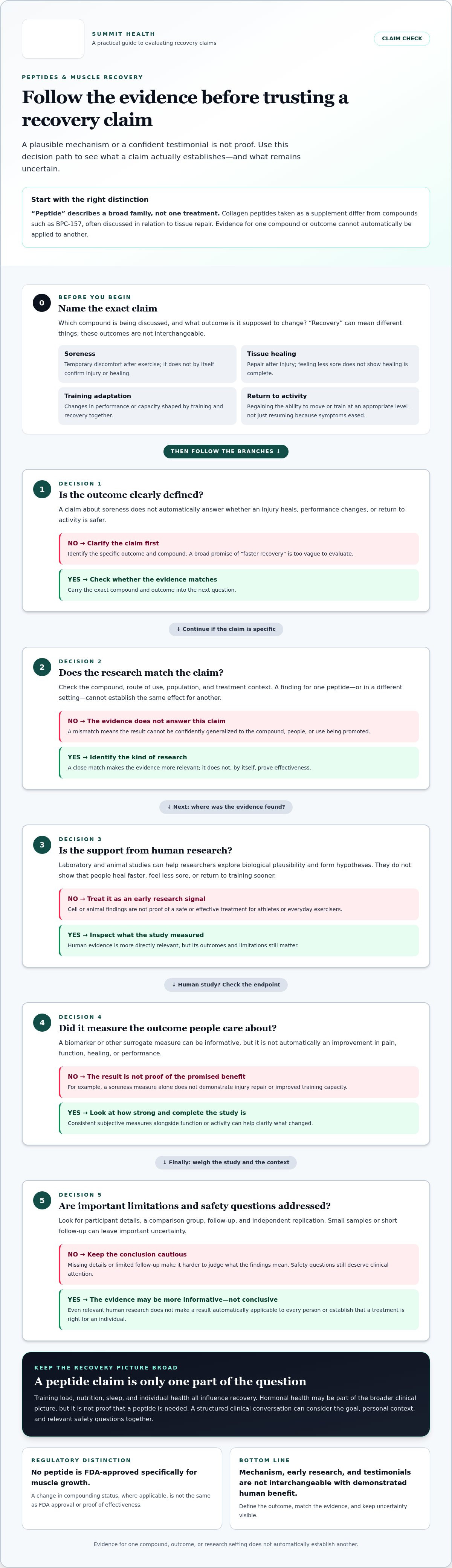
Claims can also blur different goals. Reducing post-exercise soreness is not the same as repairing an injury, changing how muscle adapts to training, or returning safely to activity. Evidence for one outcome can’t automatically be applied to another. Ask a specific question: which compound, for what outcome, and supported by what kind of human research?
How peptide signals relate to recovery claims
Some peptides are described as signals that may influence how cells communicate or respond to processes such as inflammation and tissue maintenance. This can give researchers a reason to investigate a compound. It’s a starting point, not proof of a meaningful benefit.
Effects may vary by compound, tissue, dose, route of use, and research setting. Findings in cells or animals may help frame a hypothesis, but they don’t show that a treatment improves strength, healing time, or function in people. A plausible mechanism needs relevant human evidence before it can support a clinical claim.
What readers may mean by muscle recovery
Define the outcome before evaluating a claim. These terms refer to different experiences:
- Soreness: Temporary discomfort after exercise. It doesn’t by itself confirm an injury or measure how well tissue has healed.
- Tissue healing: The repair process after an injury. Feeling less sore doesn’t show that healing is complete.
- Training adaptation: Changes in performance or capacity over time, shaped by training and recovery together.
- Return to activity: Regaining the ability to train or move at an appropriate level, not simply resuming activity because symptoms have eased.
Recovery is influenced by training load, nutrition, sleep, and individual health. Hormonal health can also be part of a broader clinical picture. It should be considered in context, rather than treated as proof that a peptide is needed. Summit Health provides hormone therapy care as one part of that wider health conversation.
One person’s experience can’t establish a treatment effect. Soreness naturally changes, and training, rest, expectations, and other factors may change at the same time. A useful assessment looks for defined outcomes and credible evidence, not a single before-and-after story.
What the Evidence Says About Peptides and Muscle Recovery
Evidence is most useful when it answers a clearly defined question in people. A laboratory finding may explain why a peptide deserves study, but it can’t show that an athlete heals faster, feels less sore, or returns to training sooner. Those are separate outcomes, and each needs relevant human research.
How to interpret early-stage and human research
Laboratory research can examine how a compound interacts with cells under controlled conditions. Animal studies can explore effects in a living system, but species differences and experimental injuries limit how directly the results apply to people. These stages help generate hypotheses. They don’t establish a safe or effective treatment for athletes or everyday exercisers.
Human studies are more directly relevant, but the details matter. Check whether the tested compound, route, population, and treatment context match the claim. A finding for one peptide can’t be generalized to all peptides. A change in a biomarker, such as a measure associated with tissue activity, also isn’t automatically a meaningful improvement in pain, function, healing, or performance.
For any study, look for the number and characteristics of participants, comparison group, outcomes measured, follow-up period, and publication date. Small samples, short follow-up, or a lack of independent replication can leave important uncertainty. If those details aren’t available, interpret the result cautiously rather than accepting stronger claims.
Which recovery outcomes studies should measure
The right endpoint depends on the claim. For post-exercise soreness, a study might track discomfort over time, but that alone wouldn’t show that an injury healed or training capacity improved. A tissue-repair claim calls for evidence about healing and function. A return-to-activity claim should examine whether people resume relevant activity and sustain that progress.
Consider whether results reflect a clinical outcome or only a surrogate measure. A lab value can be informative, yet it doesn’t necessarily predict how someone feels or performs. Subjective reports also have value, but they’re more persuasive when measured consistently and alongside objective measures such as function or activity.
- Laboratory and animal findings: Useful for exploring biological plausibility, not proof of human recovery benefits.
- Human trials: More relevant, but conclusions depend on the compound, participants, comparison, outcomes, and study quality.
- Clinical guidance: Helps place evidence and individual health context into a decision, but isn’t a substitute for strong trials.
Key distinction: A plausible biological mechanism is a reason to investigate a peptide, not proof that it produces a meaningful recovery outcome in people. Assess peptides for muscle recovery against the specific result claimed, and treat gaps in human evidence as uncertainty.
A clinician-guided conversation can connect your recovery goals with personal health context and the limits of available evidence. You can use an appointment to discuss your health goals as a starting point for that assessment.
Comparing Peptide Claims, Evidence, and Safety Considerations
Compare a claim with evidence for the exact compound and outcome being promoted. A mechanism that seems relevant to healing, online popularity, or easy availability doesn’t establish effectiveness or safety. The comparison below offers a practical starting point, not a substitute for reviewing current clinical and regulatory information.
How to assess an individual peptide claim
Start with the match: does the research study the same compound, route, and recovery outcome described in the claim? Then check whether the participants were people, what the comparison group received, and whether other researchers replicated the result. Testimonials and promotional language can describe individual experiences, but they can’t establish that a treatment caused the outcome or that it will apply to others.
Regulatory status is a separate question from evidence. As of October 2026, no peptide is FDA-approved specifically for muscle growth. Compounding status, where applicable, is not the same as FDA approval or proof that a product is effective for recovery. Because regulatory information can change, review current FDA information with a qualified clinician before drawing conclusions about a specific compound.
Safety, oversight, and uncertainty
Risk depends on the substance, route, product quality, and the person’s health circumstances. Products sold as “research use only” don’t come with a guarantee of purity or safety. Uncertainty can include contamination, incorrect amounts, and side effects that haven’t been adequately studied. Don’t infer safety from a product being discussed online or described as a peptide.
A clinically grounded discussion considers the exact claim, the quality of evidence, potential risks, relevant health history, and how progress would be monitored. This helps distinguish an investigational idea from a decision supported by appropriate evidence and individual context.
Build a Recovery Plan Before Chasing a Peptide
Start with the recovery pattern, not a product. A clear description of what’s happening can help distinguish routine training fatigue from a concern that needs clinical assessment. It also gives a clinician useful context before discussing treatment options, including peptides for muscle recovery.
Start with the recovery pattern, not a product
Before the conversation, note when symptoms began, how they change, what training preceded them, and whether they affect daily activities. Ordinary post-training soreness may follow a change in workout intensity. Persistent or worsening pain, restricted movement, or symptoms that interfere with normal function deserve clinical evaluation rather than assumptions based on an online claim.
Use this four-step framework to organize next steps:
- Define the issue. Describe the location, duration, pattern, and effect on training and daily function. Clarify whether your goal is less soreness, injury assessment, improved function, or a safe return to activity.
- Review training and lifestyle. Summarize recent changes in exercise volume, intensity, rest days, and progression. Consider whether nutrition and sleep support your current training demands. Sleep is part of the recovery picture; this guide to magnesium glycinate and restorative sleep explores that connection.
- Assess health context. Gather relevant medical history and a current list of medications and supplements. If laboratory testing is appropriate, results should inform an individualized discussion, not serve as a stand-alone reason to choose a treatment. Learn more about hormone blood work and optimization in the context of personal health assessment.
- Discuss options. Review the evidence for the exact treatment and outcome being considered, potential risks, monitoring, and realistic measures of progress. Keep foundational recovery habits separate from medical treatment decisions. Neither a supplement nor a peptide should be assumed necessary.
Bring useful context to a clinical conversation
A concise record makes the discussion more precise. Bring your training pattern, sleep quality, eating habits, medications, supplements, relevant health history, and a clear description of what you hope to improve. Ask whether evidence applies to your specific goal, what uncertainties remain, how safety would be considered, and what outcome would count as meaningful progress.
Personalized planning can place recovery concerns in a broader health picture. Summit Health’s telehealth-led care includes comprehensive labwork, health coaching, and ongoing virtual monitoring, supporting decisions grounded in individual context rather than generalized claims. Discuss your health goals as part of a clinically guided conversation.
A Clinically Guided Next Step for Recovery Goals
Recovery decisions are more useful when they start with the person, not a product. Summit Health’s telehealth-led model brings individual goals and health context into a clinical discussion, supported by comprehensive labwork, personalized planning, health coaching, and ongoing virtual monitoring. Summit Health offers peptide therapy as part of its health services, but it isn’t a guaranteed shortcut to faster healing or improved performance.
What personalized clinical care can contribute
A clinician can consider your health history, current concerns, goals, and relevant lab findings together. Testing may help inform assessment, but lab results don’t independently diagnose every cause of soreness, injury, or slow recovery. Their meaning depends on the broader clinical picture. Health factors such as hormones may also inform broader care; Summit Health’s hormone therapy approach fits into that wider context, not a presumption that hormones explain every recovery concern.
This process supports a more precise discussion of whether a treatment option is appropriate to consider. A clinician can review what is known about the proposed option, where evidence is limited, what uncertainties apply to your situation, and whether other aspects of health or training should be addressed first.
Set realistic expectations for progress
Recovery is a process. Training load, sleep, nutrition, and individual health all contribute, so a treatment decision should sit within that larger picture. Before starting an approach, define a practical goal that reflects your concern, such as improved daily function or a gradual return to a chosen activity. Track relevant changes over time rather than judging effectiveness from one unusually good or difficult day.
Follow-up matters. Ongoing virtual monitoring can help review how your plan is progressing, consider new information, and discuss whether the approach still aligns with your goals. An immediate change in sensation doesn’t prove tissue healing or lasting performance improvement. Measures should match the outcome you care about, and expectations should remain grounded in the available evidence.
For a focused clinical conversation, prepare a brief summary of your symptoms, training pattern, health history, and priorities. Bring questions about the evidence for any option under consideration, possible risks, how progress would be monitored, and what would prompt a change in plan. This gives the discussion a clear starting point while leaving room for individualized judgment.
Peptides for muscle recovery deserve the same careful evaluation as any treatment decision: clear goals, relevant evidence, personal context, and follow-up. Schedule an appointment to discuss your recovery goals in a clinically guided setting.
Move Forward With a Clear Recovery Goal
Your next step doesn’t need to be choosing a peptide. Start by identifying the change you want to make, then build a plan that can be reviewed as your health and training evolve. This keeps decisions about peptides for muscle recovery connected to a meaningful goal, rather than a promise or a momentary impression.
At Summit Health, comprehensive diagnostic labwork can help assess individual health needs, while personalized treatment planning, health coaching, and ongoing virtual monitoring provide structure for continued decision-making. These tools support a broader clinical conversation; they don’t guarantee a particular treatment or result. The focus stays on what’s appropriate for you, what progress looks like, and how the plan should adapt over time.
Bring your recovery priorities and questions into a clinician-guided discussion. Schedule an appointment to take a considered next step toward your health goals. With a clear plan and thoughtful follow-up, you can move forward with greater confidence.
Frequently Asked Questions
Do peptides help with muscle recovery?
Current evidence doesn’t establish that peptides broadly improve muscle recovery in people. Findings for one compound or outcome can’t be applied to every peptide or claim. When assessing a treatment, look for human studies that measure the result you care about, such as function or return to activity, rather than relying on testimonials or a change in a laboratory marker alone.
Which peptides are used for muscle recovery?
BPC-157 and TB-500 are commonly discussed online in relation to healing, while collagen peptides are used as dietary supplements. These aren’t interchangeable: they differ in form, intended use, and evidence base. A compound’s popularity or presence in online listings doesn’t show that it’s an established recovery treatment. Discuss the exact substance and intended outcome with a clinician before considering it.
Are peptides for muscle recovery FDA-approved?
No peptide is FDA-approved specifically for muscle growth. Approval for a different medical indication doesn’t establish effectiveness for recovery. For example, tesamorelin is approved for HIV-associated lipodystrophy, not muscle growth. Compounding status, where applicable, is also distinct from FDA approval. Regulatory details can change, so discuss the current status of a specific compound and its intended use with a qualified clinician.
How long do peptides take to support muscle recovery?
There isn’t a reliable, evidence-based timeline for peptides to improve muscle recovery. The answer depends on the compound and the outcome being claimed, and available evidence may not establish a benefit in people. Be cautious of advertised timelines that promise a predictable result. For any treatment discussion, define how progress would be assessed, such as changes in function or ability to resume planned activity.
Can peptides replace sleep, nutrition, or a well-managed training plan?
No. Peptides shouldn’t be treated as substitutes for sufficient sleep, appropriate nutrition, or training that matches your current capacity. For example, persistent fatigue after a sharp increase in training may call for reviewing workload and recovery habits, not assuming a peptide is the solution. A clinician can help consider these factors alongside your health history and clarify whether further assessment is appropriate.
What should I ask a clinician before considering peptide therapy?
Ask whether human evidence supports the specific compound for your goal, what uncertainties remain, and whether its regulatory status matches the proposed use. Also discuss possible risks, product quality, interactions with medications or supplements, and how progress and safety would be monitored. Bring your health history and training context. At Summit Health, a telehealth-led clinical discussion can include individual goals and relevant diagnostic labwork.

Article by
Dr. David Richardson
David Richardson, is the founder and CEO of Summit Health and the author of "Insights from the Summit", where he writes about hormone optimization, metabolic health, thyroid function, longevity, and preventive medicine.
After entering healthcare in 2009, David became increasingly interested in a question that traditional medicine often struggles to answer:
Why do so many people continue to feel terrible despite being told their labs are "normal"?
That question eventually led him into the field of health optimization in 2020, where he became passionate about understanding physiology at a deeper level and helping patients uncover the root causes of their symptoms rather than simply managing them.
Today, David's philosophy is simple: normal and optimal are not the same thing. Every patient is physiologically unique, and meaningful healthcare begins by listening to symptoms, understanding the science, and recognizing that laboratory values are only one piece of a much larger picture.
Through Summit Health and Insights from the Summit, David's mission is to help people better understand their bodies, ask better questions, and make informed decisions that improve both their health span and quality of life.


