

IMPORTANT DISCLAIMERS
Medical Disclaimer: The information in this article is provided for educational purposes only and is not intended as medical advice or a substitute for individualized medical care. Every person's health needs are unique. Always consult a qualified healthcare professional before starting, stopping, or changing any medication, supplement, or treatment plan. -------
Article Disclaimer: Articles are reviewed and published by Summit Health to provide evidence-based educational information. While Summit Health strives to provide reliable and current health information, medical knowledge is always evolving over time. Depending on when you are reading this content, it may not reflect the latest research or apply to your individual circumstances.
Normal is a statistical average of the unwell. If you've been told your blood work is "fine" while you still struggle with stubborn weight gain and persistent fatigue, you aren't alone. Standard reference ranges are designed to identify disease, not to facilitate peak performance. It's time to demand more from your data.
You likely know that feeling optimal is vastly different from simply being "not sick." We're moving into an era of precision vitality where your unique biology dictates the protocol. This guide details the essential lab tests for hormone optimization that move beyond basic screening to unlock your true biological potential. You'll discover why the 2026 diagnostic standards have shifted toward individualized excellence, reflecting a more sophisticated understanding of human performance.
We'll provide a definitive list of biomarkers, from free testosterone to advanced thyroid panels, and explain how to interpret them through the lens of optimization rather than just deficiency. By the end, you'll have a clear, data-driven strategy to eliminate brain fog and reclaim your edge through a personalized path toward hormone therapy and peak wellness.
Key Takeaways
- Shift your focus from standard laboratory reference ranges to "optimal" targets designed to support peak performance rather than just the absence of disease.
- Discover why testing for free hormone levels provides a more precise clinical snapshot of your biological potential than traditional total hormone measurements.
- Learn the essential "Circadian Rule" for diagnostic timing to ensure your lab tests for hormone optimization yield the most accurate and actionable data possible.
- Identify the specific biomarkers required to move past common symptoms like brain fog and stubborn weight gain through targeted, evidence-based health solutions.
- Understand the seamless transition from virtual lab results to a personalized protocol involving health coaching and bioidentical hormone therapy.
Beyond Basic Blood Work: Why Optimization Requires Precision
Precision matters. Data delivers. Most individuals rely on a standard annual physical to gauge their health, yet these basic screenings are often inadequate for those pursuing peak performance. Standard blood panels are designed as a safety net to catch active disease, not as a blueprint for excellence. They identify when you're broken, but they rarely show you how to thrive.
Specialized lab tests for hormone optimization represent a shift in perspective. Instead of reactive medicine, we focus on an "upward" movement. This approach isn't about fixing a deficit; it's about refining your current state to achieve a premium version of your life. Biological balance is the essential foundation for every high-performance goal, from cognitive clarity to physical endurance. Without precise data, you're simply guessing at the variables that govern your vitality.
The Clinical Authority of Precision Diagnostics
Results, not guesses. Clinical authority is built on comprehensive data. Relying on "symptom-guessing" is an inefficient way to manage your health because fatigue, brain fog, and low libido are non-specific indicators. They can stem from dozens of different imbalances. Comprehensive labwork provides a definitive map of your internal landscape, allowing for the creation of bespoke treatment plans that address your unique endocrine profile.
This proactive model moves beyond the limitations of traditional healthcare. By analyzing a wider array of biomarkers, we can develop targeted hormone therapy protocols that are calibrated to your specific needs. It's a transition from being a passive patient to an active participant in your own optimization. Data-driven health ensures that every intervention is intentional and every result is measurable.
Identifying the 'Hidden' Imbalances
Subclinical issues are silent performance killers. You don't need a diagnosed medical condition to feel the effects of hormonal decline. Even if your results fall within the "normal" range, they may be far from optimal. Standard Thyroid function tests, for example, often stop at TSH levels, missing the nuanced interplay between T4 and T3 that dictates your metabolic rate and daily energy. These hidden gaps are where brain fog and stubborn weight gain often reside.
True optimization requires looking at the "Optimization Gap"—the space between being statistically average and biologically elite. When your labs are interpreted through a high-performance lens, we can identify opportunities to enhance recovery, improve sleep quality, and accelerate weight loss. Achieving your peak potential isn't about luck; it's about the precise management of your biological data.
Essential Biomarkers: Decoding Your Hormone Optimization Panel
Precision diagnostics. Actionable data. Comprehensive lab tests for hormone optimization provide the granular detail required to move from "normal" to "optimal." While standard panels offer a surface-level glance, an optimization protocol decodes the intricate interplay between your primary hormones, metabolic health, and inflammatory status. This data is the prerequisite for any effective, personalized intervention.
The Male Optimization Stack
Depth over breadth. Measuring Total Testosterone is merely the starting point. To understand your true performance potential, we must evaluate Free Testosterone. This represents the bioavailable hormone actually accessible to your tissues. SHBG (Sex Hormone Binding Globulin) and Albumin levels are essential here because they act as the transport system. High SHBG can trap testosterone, leaving you symptomatic despite a normal total number. Additionally, safety is paramount. Monitoring PSA (Prostate-Specific Antigen) and Hematocrit ensures that your protocol remains within healthy physiological boundaries while you pursue peak vitality.
The Female Optimization Stack
Balance is everything. For women, the focus shifts to the delicate ratio between Estradiol and Progesterone. This balance is the primary driver of cycle regularity, mood stability, and metabolic health. We also prioritize DHEA-S, often called the "mother hormone," for its role in cognitive longevity and adrenal resilience. To gain a complete picture of reproductive health and cycle phase, FSH (Follicle-Stimulating Hormone) and LH (Luteinizing Hormone) provide critical context that a single estrogen marker cannot offer.
Metabolic and Adrenal Support Markers
Hormones do not function in isolation. Cortisol, the primary stress hormone, can derail even the most precise protocol if levels are chronically elevated or depleted. It is a major factor in stubborn weight gain and sleep disruption. Likewise, a standard TSH (Thyroid-stimulating hormone) Test is often insufficient. Accurate lab tests for hormone optimization must look deeper into Free T3 and Free T4 to assess actual metabolic activity.
Metabolic markers like Hemoglobin A1c and fasting insulin reveal how your body processes fuel, while inflammation markers like hs-CRP indicate systemic stress. Micronutrient foundations, specifically Vitamin D and B12, provide the raw materials your endocrine system needs to function. If you're ready to see where your levels actually sit, taking a hormone quiz is a logical first step toward clarity.
The Optimization Gap: Standard Reference Ranges vs. Peak Performance
Normal is not a destination. It's a statistical floor. Most patients are relieved when their results fall within the "standard reference range," yet this range is merely a reflection of the average population. When reviewing lab tests for hormone optimization, the first thing to realize is that the "Reference Range" is a moving target that includes the sick, the elderly, and the metabolically unwell. It defines the absence of acute disease, not the presence of peak vitality.
Optimization is about moving from the middle of the pack to the leading edge. We focus on the "Optimization Gap," which is the space between being statistically average and biologically elite. To achieve your peak potential, you must look past the broad strokes of standard diagnostics and focus on the specific data points that correlate with high performance and longevity. Precision is the difference between surviving and thriving.
Understanding the Reference Range Trap
The reference range is a trap. It's calculated using a bell curve of the middle 95% of people who visited a specific lab. This population often includes individuals with subclinical conditions, chronic stress, and age-related decline. Professional Interpretation of common endocrine laboratory tests reveals that these ranges are often too broad to be clinically useful for those seeking a premium version of their health. If you're comparing yourself to a group that is largely sedentary, your "normal" results will reflect that mediocrity.
Individual variability is the core of precision medicine. Your optimal level might be at the very top of a standard range, while another person feels best in the middle. Standard ranges have actually shifted downward over the last 30 years as general population health has declined. This means that being "normal" today would have been considered "low" a few decades ago. We refuse to accept this downward trend as the new standard for our clients.
The Clinical Case for Performance Ranges
Performance ranges represent the future of longevity. Instead of settling for the middle, we target the high-normal quartile for essential markers like Testosterone and Thyroid hormones. This refinement of health isn't about supra-physiological levels; it's about restoring you to the top 25% of your healthy peer group. For a deeper dive into this methodology, explore our report on Diagnostic Precision: The 2026 Guide to Hormone Blood Work.
Targeting these specific ranges ensures that your body composition, cognitive clarity, and recovery speed remain at their peak. This is why lab tests for hormone optimization are increasingly age-adjusted. Modern longevity medicine recognizes that a 50-year-old shouldn't be forced to accept the hormone profile of an average 80-year-old. We aim for the biological markers of a more resilient, energetic version of yourself, ensuring your internal data matches your external ambitions.
Strategic Diagnostic Timing: Preparing for Your Hormone Blood Work
Precision diagnostics require disciplined preparation. If the timing of your draw is incorrect, the resulting data is essentially noise. To move beyond standard results and achieve a high-performance state, your lab tests for hormone optimization must reflect your baseline physiology under controlled conditions. Data integrity is the foundation of your optimization blueprint.
The "Circadian Rule" is non-negotiable for accuracy. Testosterone levels naturally peak in the early morning; therefore, blood draws should occur before 10:00 AM to capture your peak production. Testing later in the day often results in falsely low readings that can lead to incorrect clinical interpretations. Similarly, fasting for 8 to 12 hours is required for metabolic accuracy, particularly when measuring fasting insulin and lipid profiles.
Supplement and medication timing also play a critical role. Biotin, a common ingredient in hair and nail vitamins, can significantly skew thyroid and hormone results. If you are already utilizing hormone therapy, timing your draw relative to your last dose is essential for measuring trough levels rather than a temporary peak. For women, timing is dictated by the menstrual cycle; baseline markers are typically drawn on Day 3, while progesterone requires a different approach to verify cycle stability.
Pre-Draw Protocol: Ensuring Data Integrity
Physical activity and stress management are vital on the day of your draw. Strenuous exercise within 24 hours of a test can temporarily elevate inflammation markers and alter hormone concentrations. Hydration is the most overlooked factor; well-hydrated veins ensure an efficient draw and prevent hemoconcentration, which can subtly distort your hematocrit and lipid data. For female patients, testing progesterone on Day 21 of a standard 28-day cycle is the gold standard for assessing luteal phase health and mood stability.
Frequency of Testing: The Optimization Lifecycle
Baseline testing provides the initial map, but follow-up monitoring is where the refinement happens. We typically establish 90-day intervals for follow-up labs after any adjustment to your protocol. This timeframe allows your biology to reach a steady state, ensuring that the next set of data accurately reflects the impact of your personalized treatment. If you are unsure about your specific schedule, it's best to consult with a specialist to determine when is the best time to test for hormone imbalance? for your unique situation.
Accurate data is the only way to ensure your protocol remains safe and effective. If you're ready to move from guessing to knowing, book your diagnostic consultation to review your specific laboratory requirements.
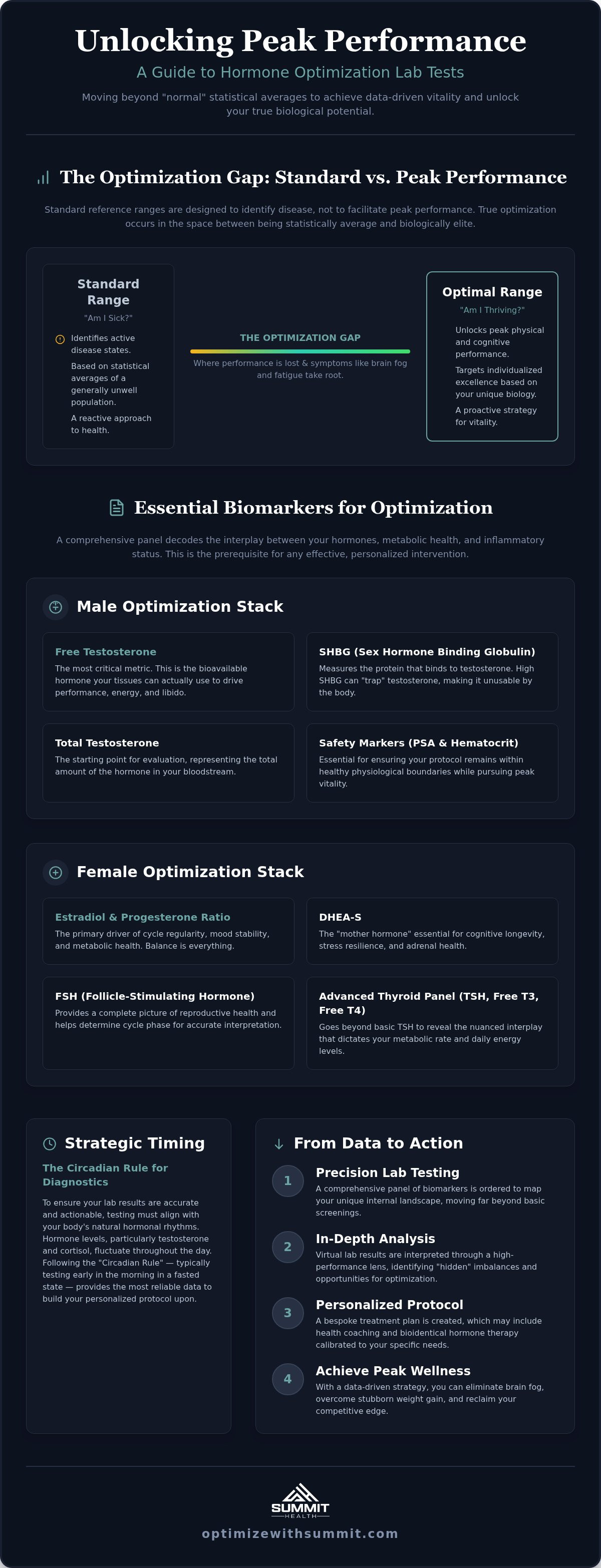
From Data to Action: The Summit Health Integrated Path
Data is the foundation. Action is the architect. While many providers treat lab tests for hormone optimization as a final destination, we view them as the baseline for your evolution. A lab report without a clinical roadmap is merely noise. At Summit Health, we bridge the gap between complex biological data and a high-performance lifestyle through a sophisticated, integrated approach that prioritizes your progress.
Our methodology centers on telehealth-led clinical interpretation. We don't simply deliver results; we decode them. These insights directly inform the creation of bespoke Hormone Therapy protocols and medical Weight Loss plans. By aligning your unique endocrine profile with evidence-based health solutions, we ensure that every intervention is precise, intentional, and focused on your peak biological potential.
Health coaching provides the essential translation layer. Data identifies the "what," but coaching implements the "how." Our experts help you convert your laboratory findings into sustainable lifestyle habits, from sleep hygiene to nutritional timing. This ongoing partnership, supported by virtual monitoring and follow-up lab tests for hormone optimization, ensures that your protocol remains safe, refined, and effective as your biology advances. We prioritize long-term refinement over short-term fixes.
The Virtual Consultation: Modern, Minimalist, Effective
High-performance care. Zero friction. The transition from a lab report to a structured health roadmap happens within a seamless virtual environment. This modern approach respects your time while providing the clinical depth required for an "upward" movement in your wellness journey. You receive expert-level guidance from the privacy of your own home, ensuring that your path to optimization is as efficient as it is effective. We value measurable results over redundant office visits.
Next Steps: Your Path to Peak Performance
Your evolution begins with clarity. The first step is taking our Hormone Quiz to identify potential imbalances and physiological gaps. Following this, we will coordinate your comprehensive labwork panel to establish your diagnostic baseline. Once your data is secured, you'll schedule an expert consultation to finalize your data-backed optimization protocol. Excellence is a choice. Start yours today.
Precision Vitality: Your Data-Driven Future
Hormonal balance is the silent engine of high performance. You now understand that "normal" results are often a baseline for the average, not a target for those seeking the elite. By utilizing precise lab tests for hormone optimization, you move beyond the limitations of standard screenings and into a realm of clinical certainty. We have detailed how identifying subclinical gaps and targeting peak reference ranges can effectively resolve brain fog and restore your physical resilience.
Your biological evolution requires more than just raw data; it requires an intentional roadmap. Summit Health provides the sophisticated infrastructure for your upward movement, combining comprehensive diagnostics with the modern convenience of virtual consultations. Our integrated health coaching ensures that your laboratory insights translate into actionable lifestyle habits for long-term refinement. This bespoke experience is designed for the individual who refuses to settle for anything less than their peak potential.
It's time to align your internal data with your external ambitions. Schedule your diagnostic consultation to begin your personalized protocol. Reclaim your edge with a plan built for excellence.
Frequently Asked Questions
What specific lab tests are included in a full hormone optimization panel?
A comprehensive panel evaluates the entire endocrine ecosystem rather than isolated markers. At Summit Health, our diagnostic baseline includes:
- Total and Free Testosterone
- Estradiol and Progesterone
- DHEA-S and Cortisol
- Full Thyroid Panel (TSH, Free T3, Free T4)
- Metabolic markers like Fasting Insulin and Hemoglobin A1c
This data ensures your protocol is built on a complete biological map.
Do I need a doctor's referral to get my hormone blood work done?
No, an external referral is not required to begin your journey with us. As a telehealth-led practice, Summit Health facilitates all necessary laboratory orders as part of your initial diagnostic phase. This streamlined process allows you to move directly from our online assessment to a blood draw, ensuring you receive high-performance care without the friction of traditional primary care hurdles.
Why should I test my hormones if my doctor says my results are 'normal'?
Standard "normal" ranges are statistical averages that include the unwell and the elderly; they identify disease but ignore peak performance. You can fall within a reference range and still experience significant fatigue or brain fog. Optimization focuses on "Optimal Ranges," which are the narrower targets associated with peak vitality and the biological markers of a much younger, more resilient version of yourself.
How long does it take to receive and review my hormone lab results?
Most laboratory results are finalized and available within 3 to 7 business days after your blood draw. Once the data is processed, you will participate in a virtual consultation to review the findings. This session isn't just a summary of numbers; it's a structured translation of your data into a personalized roadmap for hormone therapy, weight loss, or health coaching.
Can I use my HSA or FSA to pay for hormone optimization lab tests?
Yes, most HSA and FSA accounts are eligible for use when paying for lab tests for hormone optimization and subsequent medical treatments. Because these are clinical diagnostic tests required for a provider-led treatment plan, they typically qualify as reimbursable medical expenses. We recommend verifying the specific documentation requirements of your plan, but this is a common and efficient way to fund your wellness journey.
Is fasting required for all hormone blood work draws?
Fasting is required for 8 to 12 hours before your draw to ensure the accuracy of your metabolic and lipid markers. While some hormones aren't directly affected by food, markers like fasting insulin and glucose are highly sensitive to recent intake. To get a clean, actionable baseline of your metabolic health, you should consume only water during the fasting window preceding your early morning appointment.
How often should I repeat my hormone labs once I start therapy?
Follow-up labs are typically scheduled every 90 days during the initial refinement phase of your protocol. This interval allows your body to reach a biological steady state following any adjustments to your treatment. Once your markers are stabilized within the optimal range, monitoring usually shifts to a six-month or annual schedule to ensure long-term safety and continued performance results.
What is the difference between total testosterone and free testosterone in labs?
Total testosterone measures the entire amount of the hormone in your blood, while free testosterone represents the tiny fraction that is actually bioavailable to your tissues. Much of your testosterone is "locked up" by proteins like SHBG, rendering it inactive. Lab tests for hormone optimization must measure both because you can have a high total number but still feel symptomatic if your free levels are low.

Article by
Dr. David Richardson
David Richardson, is the founder and CEO of Summit Health and the author of "Insights from the Summit", where he writes about hormone optimization, metabolic health, thyroid function, longevity, and preventive medicine.
After entering healthcare in 2009, David became increasingly interested in a question that traditional medicine often struggles to answer:
Why do so many people continue to feel terrible despite being told their labs are "normal"?
That question eventually led him into the field of health optimization in 2020, where he became passionate about understanding physiology at a deeper level and helping patients uncover the root causes of their symptoms rather than simply managing them.
Today, David's philosophy is simple: normal and optimal are not the same thing. Every patient is physiologically unique, and meaningful healthcare begins by listening to symptoms, understanding the science, and recognizing that laboratory values are only one piece of a much larger picture.
Through Summit Health and Insights from the Summit, David's mission is to help people better understand their bodies, ask better questions, and make informed decisions that improve both their health span and quality of life.


