

IMPORTANT DISCLAIMERS
Medical Disclaimer: The information in this article is provided for educational purposes only and is not intended as medical advice or a substitute for individualized medical care. Every person's health needs are unique. Always consult a qualified healthcare professional before starting, stopping, or changing any medication, supplement, or treatment plan. -------
Article Disclaimer: Articles are reviewed and published by Summit Health to provide evidence-based educational information. While Summit Health strives to provide reliable and current health information, medical knowledge is always evolving over time. Depending on when you are reading this content, it may not reflect the latest research or apply to your individual circumstances.
Your training capacity isn't limited by your willpower. It's limited by your biological infrastructure. You hit the gym with intensity, yet persistent muscle soreness lingers for days. You track every macro, but your strength gains have hit a stubborn plateau. Achieving the ideal hormone balance for muscle recovery is often the invisible barrier between stagnation and progress. It's exhausting to wake up feeling unrefreshed despite a full eight hours of sleep. You've likely accepted these hurdles as part of the grind. They aren't mandatory. They're signals of a system out of alignment.
We understand the frustration of putting in the work and seeing stagnant results. Optimizing your hormonal profile is the missing gear in your high-performance lifestyle. By fine-tuning these internal signals, you'll accelerate tissue repair, reduce inflammation, and finally achieve an improved muscle-to-fat ratio. This guide provides a sophisticated look at how precision diagnostics and evidence-based protocols unlock your true athletic potential. We'll examine the specific biomarkers that dictate your bounce-back speed and the modern therapies that turn recovery into a competitive advantage.
Key Takeaways
- Shift your perspective from passive rest to active biological signaling. Understand how specific chemical messengers drive the cellular repair of micro-tears after every session.
- Balance the internal tug-of-war. Learn how maintaining peak testosterone levels while managing cortisol is essential for nitrogen retention and lean tissue construction.
- Protect your biological laboratory. Discover why 90% of growth hormone is secreted during deep sleep and how to optimize this critical recovery window.
- Eliminate the guesswork. Use comprehensive labwork to identify the specific gaps in your hormone balance for muscle recovery and long-term performance.
- Refine your protocol. Explore how bespoke treatment plans using hormone therapy and peptides provide the missing gear for a high-performance lifestyle.
The Biological Blueprint: Why Muscle Recovery is a Hormonal Event
Recovery. Precision. Performance. These aren't just buzzwords; they're the pillars of elite physical development. While most athletes view muscle recovery as a passive waiting period, it's actually a complex, active hormonal signaling event. Every intense training session creates micro-tears in your muscle fibers. Repairing those tears requires more than just time on the couch. It requires a precise symphony of chemical messengers to initiate cellular reconstruction. Without a proper hormone balance for muscle recovery, your body lacks the biological work orders needed to rebuild stronger tissues.
Passive rest is insufficient. You can sleep for ten hours and eat a perfect diet, but if your hormonal signals are muted or imbalanced, your progress will stall. The Anabolic Window is a widely misunderstood concept. It isn't just a 30-minute window for a post-workout shake; it's a 24/7 hormonal state. Your body is either in a state of repair or a state of breakdown. Maintaining an optimized environment around the clock ensures that your effort in the gym translates into tangible physical advancement.
The Signal vs. The Noise: How Hormones Direct Repair
Hormones act as the foremen of the cellular construction site. They provide the instructions that tell your body to utilize amino acids for repair. Without the right signal, muscle protein breakdown will consistently outpace repair. Growth hormone and IGF-1 are central to this process. Muscle Protein Synthesis (MPS) is the biological mechanism by which your body builds new protein tissue, and its efficiency is directly proportional to your systemic IGF-1 levels. If these signals are weak, your construction crew simply stays home.
The Performance Plateau: When Effort Exceeds Biology
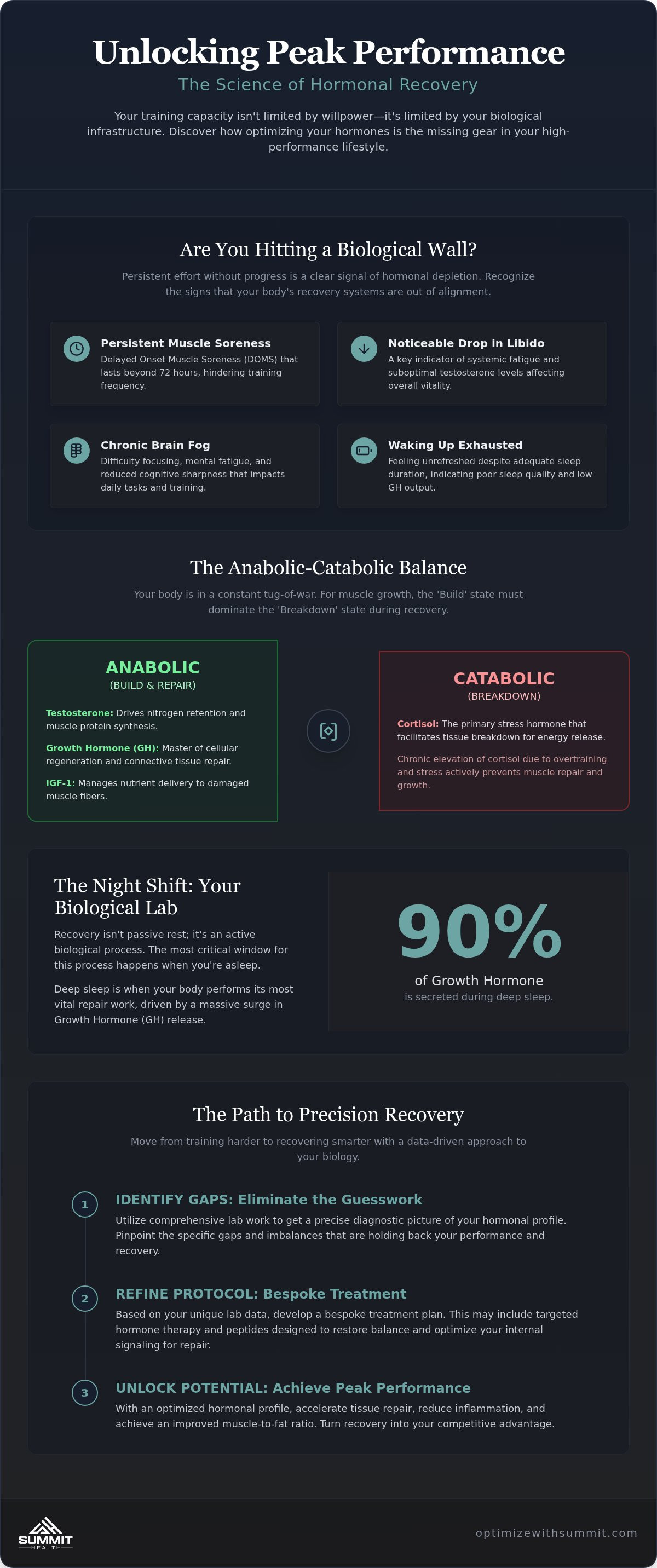
Grinding through fatigue is a common mistake. Many athletes believe that more intensity is the solution to a plateau, but this often leads to overtraining syndrome fueled by hormonal depletion. When your output exceeds your biological capacity to recover, your endocrine system begins to fail. You'll notice specific signs that your recovery signals are failing.
- Persistent Delayed Onset Muscle Soreness (DOMS) that lasts beyond 72 hours.
- A noticeable drop in libido or sexual drive.
- Chronic brain fog and difficulty focusing on daily tasks.
- Waking up feeling exhausted despite adequate sleep duration.
True optimization requires a shift in mindset. It's time to move from training harder to recovering smarter. By addressing the underlying hormone balance for muscle recovery, you unlock the ability to train with high frequency without the risk of burnout. Precision diagnostics allow you to see exactly where your biology is lagging, turning a frustrating plateau into a launchpad for your next peak.
The Anabolic-Catabolic Seesaw: Key Hormones Governing Tissue Repair
Build. Break. Rebuild. Your body exists in a constant state of biological flux. This internal tug-of-war between anabolic and catabolic processes is the foundation of every physical adaptation. Anabolic hormones prioritize tissue construction and energy storage. Catabolic hormones facilitate energy release by breaking down complex molecules. Achieving the ideal hormone balance for muscle recovery requires ensuring the anabolic side of the seesaw remains dominant during your rest periods. When this balance shifts toward a chronic catabolic state, your hard work in the gym effectively goes to waste.
Testosterone and Growth Hormone: The Recovery Powerhouse
Testosterone is the primary driver of nitrogen retention. It's the chemical signal that tells your cells to synthesize new protein structures. Growth Hormone acts as the master of cellular regeneration. It doesn't just build muscle; it strengthens connective tissues and improves collagen synthesis. Together, they create a synergistic environment that slashes the time you need between high-intensity sessions. Supporting these pathways often involves looking at precursors like DHEA benefits, which provide the raw materials your body needs for long-term endocrine health.
Insulin and IGF-1 are your body's logistics managers. They ensure that glucose and amino acids are delivered directly to damaged muscle fibers when they're needed most. Without efficient nutrient partitioning, your post-workout nutrition won't reach its target. This universal biological mechanism applies to every athlete, regardless of gender. While hormonal fluctuations differ, the need for these specific signals to drive repair is a biological constant.
The Catabolic Threat: Cortisol and Muscle Wasting
Cortisol is the primary antagonist in your recovery story. While it's necessary for the acute stress response, chronic elevation is a muscle-wasting event. High cortisol levels act like a biological brake. They blunt the effectiveness of testosterone and actively encourage the breakdown of lean tissue for emergency energy. During high-volume training blocks, managing this stress response is non-negotiable. Strategies for keeping cortisol in check include structured deload weeks, precise nutrient timing, and targeted supplementation.
If you're struggling with persistent fatigue or plateaued gains, it's worth exploring how your individual biomarkers align. You can evaluate your hormonal health to see if a catabolic state is hindering your progress. Precision optimization ensures that your internal environment is always primed for growth rather than depletion.
Beyond the Gym: How Sleep and Stress Hijack Your Recovery
Sleep is the laboratory of hormonal optimization. While you remain unconscious, your endocrine system initiates a series of pulses designed to repair the structural damage of the day. This isn't a passive state. It is an active biological requirement. Many athletes focus exclusively on the hours spent in the gym, yet the most critical work occurs during the hours spent in bed. Achieving a proper hormone balance for muscle recovery is impossible without respecting the circadian rhythms that govern your internal chemistry.
Consider the 90% Rule. Research indicates that the vast majority of your daily Growth Hormone is secreted during Stage 3 and 4 deep sleep. If your sleep is shallow or interrupted, you're effectively starving your muscles of their primary repair signal. This explains why you might sleep for eight hours and still wake up feeling sore and unrefreshed. Sleep quantity is a vanity metric; sleep quality is the performance metric. Evening blue light exposure and late-night cognitive stress disrupt the delicate Melatonin-Cortisol rhythm, keeping your body in an alert, catabolic state when it should be transitioning into repair.
The Circadian Connection to Testosterone
Morning vitality is a primary marker of healthy male hormones. Your testosterone levels peak in the early hours, provided your sleep cycles remain undisturbed. Sleep fragmentation is a silent performance killer. Studies show that even a single week of restricted or interrupted sleep can lead to a 10-15% drop in daytime testosterone levels. This reduction blunts your strength potential and slows fiber repair. Utilizing foundational tools like Magnesium Glycinate for sleep can help stabilize the nervous system, ensuring you spend more time in the restorative deep-sleep phases required for optimization.
Managing the "Internal Load" of Daily Stress
Your body doesn't distinguish between the stress of a heavy squat session and the stress of a high-pressure deadline. It simply processes the "total internal load." While training stress is a positive stimulus for growth, chronic life stress is recovery-killing. True progress requires a dominant Parasympathetic Nervous System. This "Rest and Digest" state is the only environment where the body can prioritize long-term tissue maintenance over immediate survival. Chronic psychological stress shifts the body into a catabolic-dominant state, effectively dismantling the protein structures you've worked to build. To maintain a functional hormone balance for muscle recovery, you must manage your total stress budget with the same precision as your training volume.
The Diagnostic Edge: Identifying the Gaps in Your Performance Profile
Data. Not guesswork. You track your sets, reps, and nutrition with precision. Your internal biology deserves the same level of scrutiny. Establishing a baseline through comprehensive blood work is the first step toward a functional hormone balance for muscle recovery. This "Performance Profile" acts as a biological map. It identifies exactly where your recovery is stalling and where your potential remains untapped. Without this data, you're simply training in the dark, hoping your effort translates into results.
Essential Biomarkers for Recovery Optimization
Assessing your available muscle-building potential starts with Total and Free Testosterone. Total levels provide the broad landscape, but Free Testosterone represents the bioavailable hormone actually capable of driving tissue repair and nitrogen retention. We also prioritize High-Sensitivity C-Reactive Protein (hs-CRP). This marker measures systemic inflammation. Elevated hs-CRP indicates that your body is struggling to manage training stress, which effectively mutes your anabolic signals. For a comprehensive list of the markers we analyze, explore our 2026 guide to Hormone Blood Work.
The Difference Between Normal and Optimized
Traditional reference ranges are designed for the average population. They're built to detect clinical deficiency rather than fuel peak performance. For an athlete, being at the bottom of a "normal" range is often the primary cause of a strength plateau. Precision optimization moves beyond these broad averages toward levels that support your specific training volume. Personalized health coaching is critical for interpreting how these biomarkers interact with your daily life. Our telehealth-led virtual monitoring ensures your protocol remains responsive to your evolving training load and goals.
Correlating lab data with physical symptoms turns vague fatigue into a solvable biological problem. If you're experiencing persistent soreness or brain fog, the data usually reveals the missing gear in your hormone balance for muscle recovery. You can book a consultation today to begin identifying the specific gaps in your performance profile. This data-driven approach ensures your effort in the gym is never wasted by an unoptimized internal environment.
Precision Recovery: The Summit Health Path to Hormonal Optimization
Summit Health. Your partner in peak performance. We bridge the gap between traditional medicine and high-performance living. For many athletes, the struggle isn't a lack of effort but a lack of biological alignment. Our protocols are designed to restore the hormone balance for muscle recovery that allows you to train at your absolute limit. We move beyond the treatment of symptoms to focus on the refinement of your current state. This is about upward movement and the relentless pursuit of your true athletic potential.
Tailored Protocols for Muscle Preservation and Repair
Precision is our standard. Our bespoke treatment plans integrate advanced Hormone Therapy to restore the anabolic signaling often lost to age or chronic training stress. This isn't a one-size-fits-all approach. We utilize peptide therapy to target specific tissue repair and naturally stimulate growth hormone release. For those seeking an improved muscle-to-fat ratio, we incorporate medical weight loss solutions to ensure your body composition supports your performance goals. Every protocol is data-driven and tailored to your unique biomarkers. We focus on the "missing gear" that turns your hard work into visible, measurable progress.
Getting Started: From Lab to Peak Performance
The path to optimization is streamlined. It begins with a 30-second Hormone Quiz to identify your specific recovery roadblocks. From there, we provide comprehensive at-home labwork to establish your performance baseline. Our national telehealth model means you can access specialist care from anywhere in the United States without the need for in-person exams. During your first virtual consultation, a Summit Health specialist will walk you through your data and build a roadmap for your advancement. We provide ongoing coaching and virtual monitoring to ensure your protocol evolves as you reach new peaks. It's a methodical, intentional process designed to respect your time and maximize your results.
We value efficiency and evidence-based results. Our commitment is to your long-term vitality and the refinement of your physical state. We don't just help you bounce back from your last session; we help you prepare for your best one yet. Achieving a functional hormone balance for muscle recovery is the foundation of a high-performance lifestyle. Start your journey with a team that understands the intricacies of human biology and the drive for excellence.
Elevate Your Biological Baseline
Peak performance is a choice. It requires moving beyond the traditional grind and addressing the internal chemistry that dictates your results. By prioritizing a functional hormone balance for muscle recovery, you transition from passive rest to active biological advancement. Recovery isn't a break from progress; it's the engine that drives it. You now understand that your potential is limited only by your infrastructure. Utilizing precise diagnostics allows you to move from broad reference ranges toward a state of true optimization.
Summit Health provides the missing gear for your high-performance lifestyle. Our telehealth-led precision protocols combine comprehensive labwork with ongoing virtual monitoring to ensure your biology stays aligned with your ambitions. Through expert health coaching, we help you refine your endocrine profile for maximum tissue repair and consistent vitality. Stop guessing and start optimizing. It's time to unlock the premium version of your life through medical science and intentional action.
Begin Your Optimization Journey with Summit Health. Refine your state. Achieve your peak.
Frequently Asked Questions
How exactly does testosterone help with muscle recovery?
Testosterone facilitates nitrogen retention and increases muscle protein synthesis. It signals satellite cells to repair micro-tears in muscle fibers after intense training. Without adequate levels, your body cannot effectively use amino acids to rebuild tissue. It essentially provides the construction orders for your biological repair crew. This ensures that your training stimulus results in actual physical adaptation rather than just cumulative fatigue and tissue breakdown.
Can high cortisol levels prevent muscle growth even if I eat enough protein?
Yes, chronic cortisol elevation creates a catabolic environment that actively breaks down muscle tissue for energy. Even with high protein intake, cortisol can blunt the effectiveness of anabolic hormones like testosterone. It acts as a biological brake on your growth. To maintain a functional hormone balance for muscle recovery, you must manage your systemic stress levels alongside your nutritional intake to prevent lean tissue wasting.
What are the signs that my hormones are affecting my recovery?
Common indicators include persistent muscle soreness that lasts beyond 72 hours and a lack of morning vitality. You might also experience a plateau in strength gains despite consistent training. Other subtle signs include brain fog, lowered libido, and waking up feeling unrefreshed after a full night of sleep. These symptoms suggest that your internal signaling is out of alignment and failing to drive efficient cellular repair and regeneration.
How long does it take to see recovery improvements after starting hormone therapy?
Most patients report improvements in sleep quality and energy levels within the first two to three weeks of a protocol. Significant changes in muscle recovery speed and strength gains typically become evident after six to eight weeks of consistent optimization. Your biological infrastructure requires time to recalibrate. Ongoing virtual monitoring ensures that your dosage and protocol evolve as your body begins to respond to the refined hormonal environment.
Is hormone optimization safe for long-term athletic performance?
Precision optimization is safe when managed by specialists through evidence-based health solutions and regular diagnostic testing. We focus on restoring your markers to optimal rather than supraphysiological levels. This data-driven approach minimizes risks while maximizing performance benefits. Long-term vitality is our primary goal. By maintaining a balanced endocrine profile, you protect your metabolic health and skeletal muscle mass as you pursue higher levels of physical achievement.
Do I need to see a doctor in person to start a hormone recovery protocol?
No, Summit Health utilizes a telehealth-led model that provides national US coverage without the need for in-person physical exams. We coordinate comprehensive diagnostic labwork that you can complete at a local facility. Your consultations with our specialists occur virtually, allowing for a seamless integration into your high-performance lifestyle. This modern approach respects your time while providing the same level of clinical authority as a traditional medical provider.
What is the difference between supplements and clinical hormone optimization?
Supplements provide raw materials like vitamins and minerals, whereas clinical optimization directly addresses the signaling molecules that govern your biology. Hormone therapy and peptide therapy involve targeted interventions based on your specific biomarkers. While supplements can support general health, they cannot override a systemic deficiency or correct a significant anabolic-catabolic imbalance. Clinical protocols provide a precise, data-driven solution that produces more predictable and significant performance outcomes.
Can improving my sleep really fix my hormonal balance for muscle gain?
Quality sleep is foundational, but it is often only one piece of the puzzle. While deep sleep triggers the release of growth hormone, it cannot always fix deeper endocrine disruptions caused by age, chronic stress, or underlying health issues. Improving sleep hygiene supports your hormone balance for muscle recovery, but comprehensive labwork is necessary to determine if lifestyle changes alone are sufficient to reach your peak performance goals.

Article by
Dr. David Richardson
David Richardson, is the founder and CEO of Summit Health and the author of "Insights from the Summit", where he writes about hormone optimization, metabolic health, thyroid function, longevity, and preventive medicine.
After entering healthcare in 2009, David became increasingly interested in a question that traditional medicine often struggles to answer:
Why do so many people continue to feel terrible despite being told their labs are "normal"?
That question eventually led him into the field of health optimization in 2020, where he became passionate about understanding physiology at a deeper level and helping patients uncover the root causes of their symptoms rather than simply managing them.
Today, David's philosophy is simple: normal and optimal are not the same thing. Every patient is physiologically unique, and meaningful healthcare begins by listening to symptoms, understanding the science, and recognizing that laboratory values are only one piece of a much larger picture.
Through Summit Health and Insights from the Summit, David's mission is to help people better understand their bodies, ask better questions, and make informed decisions that improve both their health span and quality of life.


