

IMPORTANT DISCLAIMERS
Medical Disclaimer: The information in this article is provided for educational purposes only and is not intended as medical advice or a substitute for individualized medical care. Every person's health needs are unique. Always consult a qualified healthcare professional before starting, stopping, or changing any medication, supplement, or treatment plan. -------
Article Disclaimer: Articles are reviewed and published by Summit Health to provide evidence-based educational information. While Summit Health strives to provide reliable and current health information, medical knowledge is always evolving over time. Depending on when you are reading this content, it may not reflect the latest research or apply to your individual circumstances.
Your 3 AM wake-up call isn't a failure of willpower. It's a breakdown in your brain's chemical architecture. Precision. Performance. Recovery. If you've spent nights staring at the ceiling with racing thoughts, you're not alone. Many high-performers struggle with sleep maintenance insomnia and the resulting brain fog that follows. Utilizing bioidentical progesterone for sleep offers a sophisticated solution that goes beyond traditional sedatives. It acts as a targeted neurosteroid to calm the central nervous system and restore the natural rhythm of your rest.
Deep, restorative sleep is the ultimate competitive advantage. You deserve to wake up feeling refreshed without the lingering hangover effect of synthetic alternatives. We agree that quality rest should be consistent and effortless. This guide explores how bioidentical progesterone interacts with GABA receptors to stabilize your mood and optimize your sleep architecture. We'll outline a clear, medically supervised path toward hormone optimization. Discover how to reclaim your nights and refine your cognitive performance through intentional, data-driven recovery.
Key Takeaways
- Master the science. Understand how progesterone converts into allopregnanolone to modulate GABA receptors for natural sedation without next-day grogginess.
- Choose precision. Learn the critical distinction between synthetic progestins and bioidentical progesterone for sleep to ensure a safer path to recovery.
- Recognize the signs. Identify the "wired but tired" phenotype and other indicators that your sleep issues are fundamentally hormonal.
- Prioritize data. Discover why precision labwork is required to move beyond standard reference ranges and create a bespoke optimization plan.
- Optimize continuously. Explore how a personalized telehealth protocol provides the monitoring and coaching needed for peak cognitive performance.
Progesterone as a Neurosteroid: The Science of Sleep Architecture
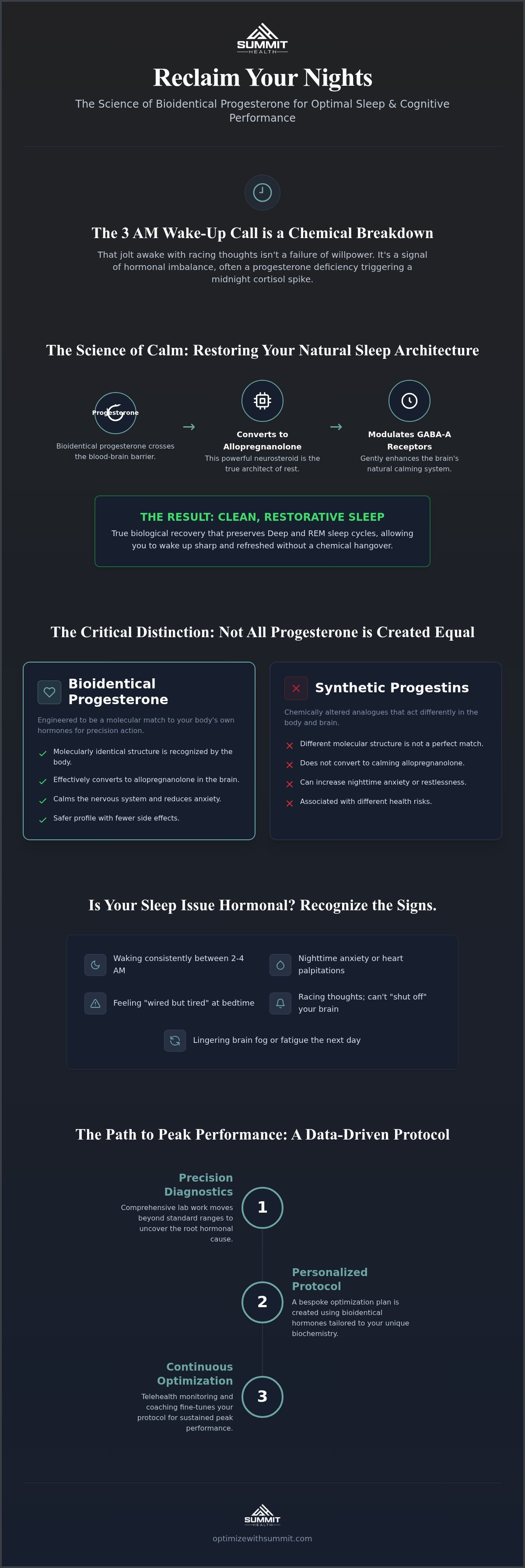
Biological precision. Neural recovery. Progesterone is often categorized strictly as a reproductive hormone. Its primary impact on the brain is that of a potent neurosteroid. It crosses the blood-brain barrier with ease. Once inside, it undergoes a metabolic conversion into allopregnanolone. This derivative is the true architect of rest. By acting as a positive allosteric modulator of GABA-A receptors, it creates a calming effect that transcends simple sedation. Using bioidentical progesterone for sleep isn't about knocking the brain out. It's about restoring the chemical environment necessary for natural, high-quality recovery.
This mechanism is vital for maintaining sleep architecture. Unlike synthetic options, bioidentical Progesterone (medication) supports the natural progression through sleep stages. It specifically preserves Deep Sleep, also known as Slow Wave Sleep, and REM cycles. These stages are where cognitive restoration and physical repair happen. Without them, you wake up feeling chemically sedated but biologically exhausted. True optimization requires these stages to remain intact.
The GABA Connection: Nature’s Anxiolytic
Precision over power. Traditional sleep medications often act like a blunt instrument. They force the brain into a state of unconsciousness that lacks the restorative properties of true sleep. Progesterone metabolites work differently. They gently enhance the brain's existing GABAergic system. This natural modulation quiets the central nervous system. It silences the internal noise that keeps you in a state of hyperarousal. Because the body recognizes the molecular structure of bioidentical progesterone for sleep, it processes the hormone efficiently. You achieve a state of clean sleep. There is no morning grogginess. No cognitive fog. Just a sharp, ready mind.
Sleep Maintenance vs. Sleep Onset
The 3 AM wake-up. It's a hallmark of hormonal imbalance. While many supplements help you fall asleep, few address the issue of staying asleep. This is where progesterone excels. It stabilizes the Hypothalamic-Pituitary-Adrenal (HPA) axis. During the night, a drop in progesterone can trigger a compensatory spike in cortisol. This surge of stress hormone jolts you awake, often accompanied by a racing heart or sudden anxiety. Progesterone acts as a buffer. It prevents these midnight cortisol spikes. By regulating the stress response, it ensures you remain in a deep, uninterrupted state of rest until your alarm goes off. It is the key to ending sleep maintenance insomnia for good.
Bioidentical vs. Synthetic: The Case for Micronized Progesterone
Molecular identity is paramount. Bioidentical progesterone is engineered to be an exact match for the hormone your body naturally produces. It is frequently referred to as micronized progesterone. This term describes a specific pharmaceutical process that reduces particle size to enhance absorption and bioavailability. Synthetic progestins, such as medroxyprogesterone acetate, are different. They are chemical analogues. While they may protect the uterine lining, they lack the specific molecular structure required to interact with the brain's recovery centers. Choosing bioidentical progesterone for sleep ensures that you are providing your nervous system with a familiar and effective tool for restoration.
Molecular Precision and Brain Uptake
The brain is discerning. For a hormone to act as a neurosteroid, it must cross the blood-brain barrier with efficiency. Micronization facilitates this journey. Once bioidentical progesterone enters the central nervous system, it converts into allopregnanolone. This is the key to the calm confidence that high-performers seek. Synthetic progestins do not undergo this conversion. In many cases, these synthetic versions can increase nighttime anxiety or restlessness. They bind to receptors with a blunt force that disrupts rather than optimizes. Precision matters when the goal is peak cognitive function and deep recovery.
Safety Profiles and Long-Term Health
Scientific understanding has evolved significantly. Older studies often grouped all hormone therapies together, leading to widespread misconceptions about safety. We now know that the risks associated with synthetic progestins do not necessarily apply to bioidentical options. On February 12, 2026, the FDA approved labeling changes for several hormone therapy products to reflect this nuanced understanding. These changes removed previous black box warnings regarding cardiovascular disease and dementia for specific formulations. Bioidentical progesterone supports long-term health by offering bone-protective and cardiovascular benefits without the metabolic friction of synthetics. It represents a refined approach to wellness that prioritizes both safety and performance.
To see if your current symptoms align with a hormonal deficiency, you can take a personalized hormone quiz to begin your optimization journey.
When comparing your options, consider these primary differences:
- Bioidentical Progesterone: Converts to sleep-promoting neurosteroids; supports natural sleep architecture; lower risk profile for blood clots.
- Synthetic Progestins: Lacks neurosteroid activity; often associated with mood disturbances and higher metabolic risks.
Signs of Deficiency: Is Your Sleep Issue Hormonal?
Exhaustion without relief. Restlessness without cause. Identifying the subtle cues of hormonal decline is the first step toward reclaiming your cognitive edge. For many high-performers, the struggle to stay asleep isn't just a lifestyle issue; it's a biochemical signal. Integrating bioidentical progesterone for sleep provides the necessary support to quiet the system when the body's natural production falters under pressure.
The timing of these disturbances often provides the clearest evidence. Women may notice a significant decline in sleep quality during the luteal phase of their cycle, which is the two weeks preceding menstruation. This is when progesterone should be at its peak. If levels are insufficient, the brain loses its primary source of nighttime sedation, leading to a predictable pattern of midnight wakefulness.
The 'Wired but Tired' Phenomenon
Physical fatigue meets mental hyperarousal. This specific phenotype is the hallmark of progesterone deficiency and the resulting state of Estrogen Dominance. When progesterone levels drop, estrogen's excitatory effects on the brain go unchecked. You feel drained and ready for rest, yet your mind remains locked in a state of overactivity. This imbalance directly compromises your recovery. Without the calming influence of allopregnanolone, your brain cannot transition into the deep, restorative stages of sleep required for peak daytime performance.
Secondary symptoms often accompany this state. You might experience:
- Nighttime heart palpitations or a sudden sense of urgency.
- Racing thoughts that escalate the moment the lights go out.
- Restless legs or general physical agitation that prevents stillness.
Beyond the Menopause Transition
Hormonal decline is not exclusive to aging. High-performance lifestyles and chronic stress accelerate the depletion of vital precursors. This is known as the Pregnenolone Steal. When the body is under constant perceived threat, it prioritizes the production of cortisol over sex hormones. It diverts pregnenolone away from progesterone synthesis to meet the demand for stress response. Consequently, even younger individuals can find themselves in a state of deficiency that mimics perimenopause.
Optimizing these levels is about more than just symptom management; it's about refining your biological baseline. Understanding the nuances of this process is essential for long-term health. For a deeper look at how these interventions fit into a comprehensive wellness plan, see The Sophisticated Guide to Hormone Replacement Therapy. Whether you are navigating a life transition or simply pushing the limits of your performance, bioidentical progesterone for sleep offers a data-driven path back to restorative rest.
The Diagnostic Framework: Precision Testing for Sleep Optimization
Data drives results. Guesswork is the enemy of optimization. To effectively use bioidentical progesterone for sleep, you must first understand your current biological baseline. Standard lab reports often provide a broad reference range that encompasses a wide population, including individuals with sub-optimal health. These ranges are designed to identify pathology, not to refine peak performance. True restoration requires a more granular approach.
Achieving restorative sleep requires a deep dive into specific biomarkers. For women with active cycles, timing is the most critical variable. Testing must occur during the mid-luteal phase, typically day 19 to 22 of a 28-day cycle. This is the only way to capture peak progesterone levels and assess the true balance between your sex hormones. A comprehensive diagnostic panel should include:
- Serum Progesterone: To evaluate the natural calming capacity of your system.
- Estradiol: To ensure an optimal ratio that prevents excitatory estrogen dominance.
- Morning Cortisol: To assess the baseline stress response of your HPA axis.
Optimal vs. Normal: The Summit Standard
There is a vast difference between being clinically normal and physiologically optimal. A level that keeps you out of a disease state may still be low enough to cause 3 AM wake-ups and chronic brain fog. We focus on the upper quartile of healthy ranges to ensure your neurochemistry is fully supported. This allows for precision dosing tailored to your unique feedback and lab results. For a detailed breakdown of our methodology, explore Diagnostic Precision: The Hormone Blood Work Protocol.
The Role of Cortisol and DHEA
Progesterone does not work in a vacuum. It exists in a delicate balance with your stress hormones. High nighttime cortisol can override the calming effects of even the most precise dose of bioidentical progesterone for sleep. By testing DHEA and Cortisol alongside your sex hormones, we gain a complete picture of your recovery capacity. There is also a powerful synergy between DHEA, progesterone, and specific minerals. For instance, combining hormone optimization with targeted micronutrients can accelerate your results. Learn more in our Magnesium Glycinate for Sleep: The Precision Guide.
Ready to move beyond standard care? Schedule your comprehensive diagnostic consultation today to begin your personalized optimization journey.
Optimization Through Telehealth: The Summit Health Sleep Protocol
Modern recovery. Digital precision. Reclaiming your sleep shouldn't be a logistical hurdle. Summit Health transforms the traditional medical model into a streamlined, high-performance experience. By utilizing bioidentical progesterone for sleep within a comprehensive telehealth framework, we bridge the gap between diagnostic data and daily excellence. Your journey begins with a virtual consultation and evolves into a bespoke optimization plan delivered directly to your doorstep.
Doorstep delivery. Personalized care. The logistics of health optimization should never interfere with your pursuit of a peak state. Once your protocol is established, your personalized Bioidentical Hormone Replacement is shipped directly to you. This ensures consistency and removes the friction of traditional pharmacy visits. Every aspect of the Summit Health Sleep Protocol is designed for the modern high-performer who values efficiency and clinical precision.
Virtual Monitoring and Precision Adjustments
Data-driven evolution. Telehealth allows for a level of agility that physical offices cannot match. We utilize virtual monitoring to track your progress and make precision adjustments in real-time. This ensures that your dosage remains perfectly aligned with your changing physiological needs. Instead of waiting months for a follow-up, you have access to a system that prioritizes your immediate recovery and long-term health refinement.
Aspirational guidance. We serve as your specialist and your health coach. Our platform provides the weight of clinical expertise with the sleekness of modern innovation. Your health coach is an essential partner in this process. They help you navigate the 'Sleep & Recovery' pillar, ensuring that your use of bioidentical progesterone for sleep is supported by optimal sleep hygiene and stress management. We don't just treat symptoms; we refine your biological potential through intentional, data-backed action.
Getting Started: The Path to Peak Recovery
The path is clear. You can begin your journey toward restorative rest today. The first step is identifying the specific imbalances that are hindering your cognitive performance and physical recovery. Taking our Hormone Quiz provides immediate insight into your hormonal health and helps determine if a deficiency is the root of your sleep maintenance insomnia.
Excellence is a choice. From the quiz, we facilitate comprehensive labwork through our platform to build your personalized protocol. We provide the diagnostic precision required to move beyond standard reference ranges and into the realm of physiological optimization. Your ascent toward peak recovery starts with a single, data-driven decision. Schedule your consultation with Summit Health and reclaim the restorative power of your sleep.
Reclaim Your Restorative Edge
Restorative sleep is the ultimate foundation for cognitive performance. It isn't a luxury. It's a biological requirement for those pursuing excellence. We've detailed how bioidentical progesterone for sleep acts as a powerful neurosteroid to stabilize your sleep architecture and eliminate the 3 AM wake-up call. By moving beyond standard reference ranges, you can unlock a state of recovery that fuels your daily ambitions. Precision diagnostics and molecularly identical hormones provide a cleaner, safer path than traditional sedatives.
Summit Health offers a sophisticated journey toward this optimized state. Our protocol integrates comprehensive diagnostic labwork with telehealth-led precision monitoring to ensure your balance is never left to chance. You deserve the support of personalized health coaching to fine-tune your performance and maintain long-term results. The transition from exhaustion to peak recovery is within your reach. Every step is designed to refine your current state into a premium version of your life.
Take the Hormone Quiz to see if Progesterone is your missing link to restorative sleep.
Your ascent to a more refined, energetic version of yourself begins today. Calm confidence is just one data-driven decision away.
Frequently Asked Questions
Is bioidentical progesterone safe for long-term use?
Yes, bioidentical progesterone is safe for long-term health optimization when overseen by a specialist. On February 12, 2026, the FDA updated labeling for several hormone products, removing previous cardiovascular and dementia warnings. This shift reflects a more accurate understanding of bioidentical safety profiles. Ongoing telehealth monitoring ensures your levels remain within an optimal range, supporting both your neurological health and physical recovery over the long term.
How quickly will I see improvements in my sleep after starting progesterone?
Many individuals notice a shift in sleep quality within the first few doses. While initial relaxation happens quickly, the full restoration of your sleep architecture typically requires several weeks of consistent use. Your body needs time to stabilize its response to allopregnanolone and the GABAergic system. We use data from your recovery feedback to fine-tune your protocol, ensuring that your sleep continues to improve as your hormone levels reach their peak physiological state.
Can I take bioidentical progesterone if I am not in menopause?
Menopause is not the only indicator for hormone optimization. High-performance lifestyles and chronic stress often lead to a "pregnenolone steal," which depletes your natural progesterone levels prematurely. Younger individuals who struggle with sleep maintenance or nighttime anxiety often find that utilizing bioidentical progesterone for sleep restores their cognitive edge. Our diagnostic labwork identifies these deficiencies regardless of your age, allowing for a personalized recovery plan that targets your specific biological needs.
What is the best time of day to take progesterone for sleep benefits?
The optimal time for administration is roughly 30 to 60 minutes before your intended bedtime. This window allows the hormone to be absorbed and converted into its sedative metabolites, such as allopregnanolone, just as you are winding down. Taking it consistently at the same time each night helps regulate your circadian rhythm and prevents the midnight cortisol spikes that cause wakefulness. This precision timing is a key component of our recovery protocol.
Will progesterone make me feel groggy the next morning?
No, bioidentical progesterone rarely causes a morning hangover effect. Unlike traditional sleep medications that act as blunt sedatives, progesterone supports the brain's natural recovery processes. It facilitates a clean transition between sleep stages, leaving you feeling refreshed and cognitively sharp upon waking. If you feel lingering sleepiness, it's often a sign that your dosage requires a minor adjustment. Our health coaches work with you to find the perfect physiological balance for your body.
Do I need to take estrogen if I am taking progesterone for sleep?
Standalone progesterone therapy is common for sleep and recovery optimization. While many women in perimenopause benefit from a combination of estrogen and progesterone, you don't necessarily need both to improve your sleep quality. If your labs show adequate estrogen but low progesterone, a targeted protocol can address your "wired but tired" symptoms without unnecessary intervention. We prioritize a bespoke approach based on your specific biomarkers and performance goals.
Is a prescription required for bioidentical micronized progesterone?
Yes, a prescription is required to obtain high-quality, micronized progesterone. This requirement ensures that you are using a regulated, pharmaceutical-grade substance that is molecularly identical to your body's natural hormones. Over-the-counter creams often lack the potency and standardized absorption rates necessary for true sleep optimization. Summit Health streamlines this process through comprehensive labwork and virtual consultations, delivering your personalized bioidentical progesterone for sleep directly to your door for maximum efficiency.
How does progesterone differ from over-the-counter sleep aids?
Over-the-counter aids usually focus on temporary sedation, while progesterone addresses the underlying hormonal architecture of rest. Most OTC options can disrupt your REM cycles or lead to dependency. Progesterone acts as a neurosteroid that stabilizes the HPA axis and quiets the central nervous system naturally. It works with your biology to prevent the stress-induced wakefulness that OTC products often miss. This makes it a more sustainable solution for long-term cognitive and physical recovery.

Article by
Dr. David Richardson
David Richardson, is the founder and CEO of Summit Health and the author of "Insights from the Summit", where he writes about hormone optimization, metabolic health, thyroid function, longevity, and preventive medicine.
After entering healthcare in 2009, David became increasingly interested in a question that traditional medicine often struggles to answer:
Why do so many people continue to feel terrible despite being told their labs are "normal"?
That question eventually led him into the field of health optimization in 2020, where he became passionate about understanding physiology at a deeper level and helping patients uncover the root causes of their symptoms rather than simply managing them.
Today, David's philosophy is simple: normal and optimal are not the same thing. Every patient is physiologically unique, and meaningful healthcare begins by listening to symptoms, understanding the science, and recognizing that laboratory values are only one piece of a much larger picture.
Through Summit Health and Insights from the Summit, David's mission is to help people better understand their bodies, ask better questions, and make informed decisions that improve both their health span and quality of life.


